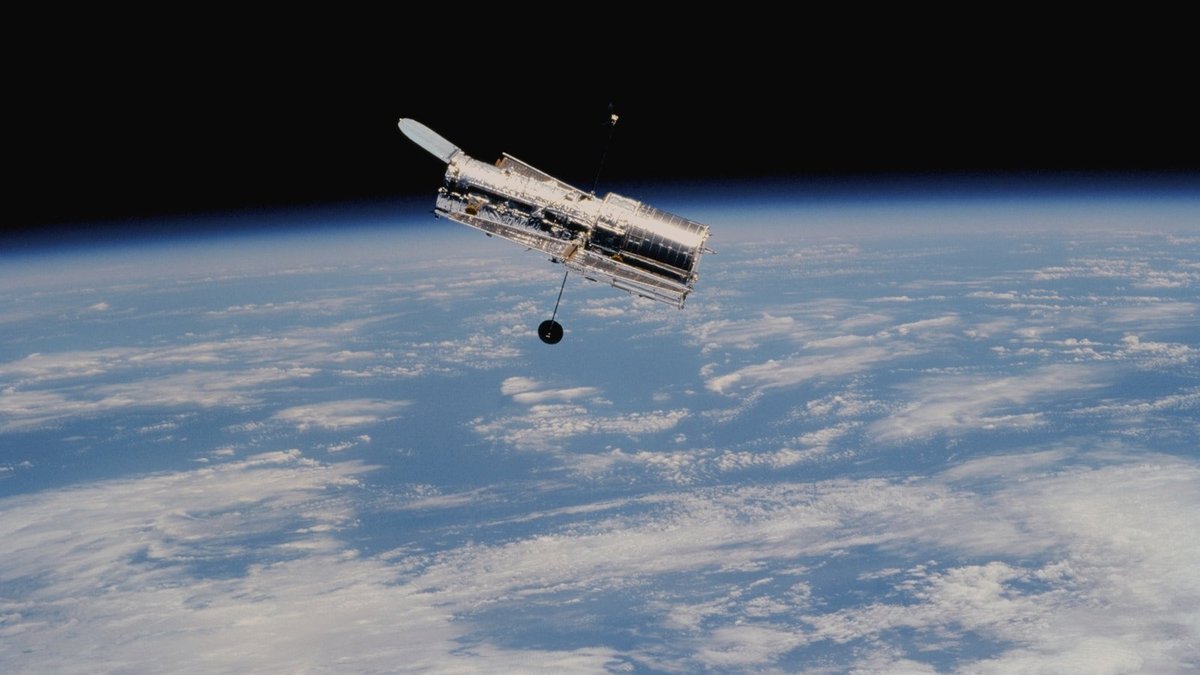
NASA’s official Roman mission announcement marks a major step toward launch for the agency’s next great space observatory. The NASA’s Nancy Grace Roman Space Telescope arrived at Kennedy Space Center in Florida on June 21, 2026, starting its final round of launch preparations before a targeted liftoff no earlier than Aug. 30.
The spacecraft is scheduled to ride a SpaceX Falcon Heavy from Launch Complex 39A. NASA says the current target places the mission eight months ahead of its formal launch commitment, which called for launch by May 2027. That early arrival gives Roman a clear path into the final stretch, where testing, fueling and rocket integration will decide whether the late-summer date holds.
Roman is built to survey huge regions of the cosmos with Hubble-like sharpness and a much wider view. Once it reaches deep space, the telescope will help astronomers study dark energy, map billions of galaxies, hunt for exoplanets and test new technology for seeing faint worlds beside bright stars.
Roman arrives for final launch processing
The arrival at Kennedy moves Roman from spacecraft assembly into launch-site operations. NASA built and tested the observatory at Goddard Space Flight Center in Maryland, then shipped it to Florida for the last work before flight. For a mission this large, reaching the launch site is a milestone with real momentum behind it.
At Kennedy, Roman was taken to the Payload Hazardous Servicing Facility. This specialized clean-room environment supports spacecraft that need close inspection, fueling and careful handling before launch. Technicians will open the protective shipping container, check the spacecraft and prepare it for the sequence that leads to encapsulation inside the Falcon Heavy payload fairing.
Roman weighs nearly 18,000 pounds, according to NASA’s mission materials. That mass includes a 2.4-meter primary mirror, major spacecraft systems, the Wide Field Instrument and a coronagraph technology demonstration. Each part has to arrive at the pad ready to survive launch loads and then perform in the cold stability of deep space.
A 70-day campaign before liftoff
The final launch campaign is expected to last about 70 days. During that period, teams will check systems that stayed folded or protected during transport. The process includes solar array testing, inspections of thermal blankets and insulation, fueling and mechanical work that connects the observatory to launch hardware.
Roman carries six solar panels that will power the observatory after launch. Those arrays must deploy and operate reliably once the spacecraft is beyond Earth orbit. Ground teams will confirm their readiness before the telescope is sealed for flight.
Another major step is propellant loading. NASA’s campaign plan calls for about 290 gallons of hydrazine to be loaded into the spacecraft. Hydrazine is used for spacecraft maneuvers and attitude control, so this step takes place in a facility designed for hazardous operations.
After fueling and final checks, the telescope will be attached to the hardware that connects it to the rocket. It will then be enclosed inside the Falcon Heavy fairing. That fairing protects Roman during ascent through the atmosphere, then separates once the rocket reaches space.
How the telescope traveled to Florida
Roman’s trip began at NASA’s Goddard Space Flight Center, where the observatory was assembled and tested. From there, it moved by road to Baltimore. The next leg took place aboard NASA’s Pegasus barge, which carried the spacecraft down the Atlantic coast toward Kennedy.
The barge gave NASA a controlled way to move a delicate observatory that is too large and too sensitive for ordinary shipping. Roman traveled inside an environmentally controlled container. That container helped protect the telescope from contamination, vibration, temperature swings and humidity changes.
The journey also supported another NASA program. Pegasus carried a weather cover for the Artemis III core stage of the Space Launch System rocket during the same voyage. One trip therefore served two major agency efforts, Roman’s astrophysics mission and the Artemis lunar campaign.
The voyage also showed how much care a flagship observatory needs before it ever reaches space. Reports from the trip described cooling challenges during transport, which led the team to add rental cooling units before the barge continued. NASA’s launch-site checks will give engineers another chance to verify the spacecraft after that long move.
What Roman is built to survey
Roman’s science program centers on large cosmic surveys. The telescope will scan broad areas of the sky in infrared light, allowing scientists to study galaxies, stars, planets and cosmic structure across enormous volumes of space. Its design favors both depth and speed.
NASA expects Roman to reveal billions of galaxies over its primary mission. Those observations will help researchers study how galaxies are distributed across cosmic time. The patterns can act like a map of how the universe expanded and how gravity shaped matter into clusters, filaments and voids.
The mission will also search for planets beyond the solar system. Roman is expected to discover hundreds of thousands of new exoplanets, many through microlensing. That method detects the brightening of a background star when a foreground object bends its light through gravity.
Roman’s surveys will also support studies of black holes. NASA has said the mission could find hundreds of black holes. By collecting wide-field infrared data at high resolution, Roman will give astronomers a powerful way to identify rare objects across large patches of sky.
A wide-field view of the infrared universe
The heart of Roman’s survey power is the Wide Field Instrument. NASA describes it as a 300-megapixel camera with 18 detectors. It will observe the infrared sky, a wavelength range that helps astronomers peer through dust and study distant objects whose light has been stretched by cosmic expansion.
Roman’s field of view is at least 100 times wider than Hubble’s at the same sharpness. That combination is central to the mission. Hubble can study small regions in exquisite detail. Roman will bring similar clarity to much larger areas, which lets scientists build huge statistical samples.
Large samples matter when scientists study dark energy. This mysterious driver of cosmic acceleration is measured through patterns that appear across many galaxies and long spans of time. Roman’s surveys are designed to help pin down how the expansion rate has changed as the universe evolved.
The same wide view will help researchers find rare events and unusual objects. A telescope that watches more of the sky can catch phenomena that would be easy to miss in narrower snapshots. That makes Roman a discovery engine as well as a precision surveyor.
The coronagraph technology test
Roman also carries a coronagraph built by NASA’s Jet Propulsion Laboratory. The instrument is a technology demonstration, meaning it is designed to prove advanced techniques that could support future missions. Its goal is to block the glare of a star so nearby faint objects can be seen more clearly.
Directly imaging planets around other stars is extremely difficult because stars are so bright. A planet can be billions of times fainter than its host star. A coronagraph uses masks, mirrors and careful optical control to suppress starlight inside the telescope’s view.
Roman’s coronagraph could help image faint planets and planet-forming disks. Even as a demonstration, it will give engineers and scientists valuable experience with the hardware and control methods needed for future observatories. Those future missions may one day study small planets around nearby stars in far greater detail.
The instrument also adds a second layer to Roman’s value. While the Wide Field Instrument is the main science workhorse, the coronagraph tests a path toward a major goal in astronomy, seeing worlds near other suns directly enough to study their properties.
Why the Aug. 30 date still matters
NASA’s current target is Aug. 30, 2026, with liftoff no earlier than that date. That phrase matters because launch schedules can shift during final processing. Spacecraft checks, rocket readiness, weather and range availability can all affect the final date.
The schedule still represents an important achievement. NASA says Roman is eight months ahead of its formal commitment to launch by May 2027. The agency had also been working toward an earlier window in 2026, so the Aug. 30 target reflects progress in both long-term planning and near-term readiness.
Final launch campaigns are designed to find problems while they can still be fixed on the ground. Engineers will continue checking thermal systems, electrical connections, fuel systems, deployable hardware and contamination controls. A smooth campaign would keep Roman aligned with the late-summer launch opportunity.
Once the observatory is integrated with the Falcon Heavy, the mission will move into a tighter launch sequence. The rocket and payload will roll to Launch Complex 39A before liftoff. That historic pad has supported Apollo, shuttle and commercial crew operations and now it is preparing for a major astrophysics mission.
Roman’s route to deep space
After launch, Roman will travel toward the second Sun-Earth Lagrange point, often called L2. This region lies about 1.5 million kilometers from Earth in the direction opposite the Sun. It offers a stable operating environment for space telescopes that need steady temperatures and a broad view of the sky.
L2 is already an important home for major observatories. From that distant region, Roman can keep the Sun, Earth and Moon generally on the same side of the spacecraft. That helps its sunshield and thermal systems maintain the stable conditions needed for sensitive infrared observations.
Roman’s primary mission is planned for at least five years. Program officials have said the propellant supply could allow the observatory to operate for a decade or longer, depending on spacecraft health and mission operations. Longer operations would increase the amount of sky surveyed and the number of discoveries available to scientists.
Once in place, Roman will begin the checkout process that follows every major space observatory launch. Engineers will verify communications, power, pointing, thermal performance and instrument behavior. Science observations can begin after the mission team confirms that the telescope is ready for precision work.
The legacy behind the mission’s name
Roman is named for Nancy Grace Roman, NASA’s first chief of astronomy. She played a central role in advancing space-based astronomy and is widely known as the “Mother of Hubble” because of her work in helping make the Hubble Space Telescope possible.
The telescope carrying her name reflects a long arc in astronomy. Hubble transformed the field with deep, sharp views of the universe. Roman will extend that legacy through wide-field surveys that can gather Hubble-like detail across far larger regions.
That wider view could reshape several fields at once. Cosmologists will use Roman to probe the expansion of the universe. Planet hunters will search for worlds across the Milky Way. Astronomers studying galaxies, stars and black holes will gain a vast infrared archive.
If the launch campaign stays on track, Roman could begin its journey before the end of the summer. From Kennedy to L2, the mission now stands at the edge of flight. Its next chapter will unfold above Earth’s atmosphere, where its wide eye can start mapping the hidden structure of the cosmos.