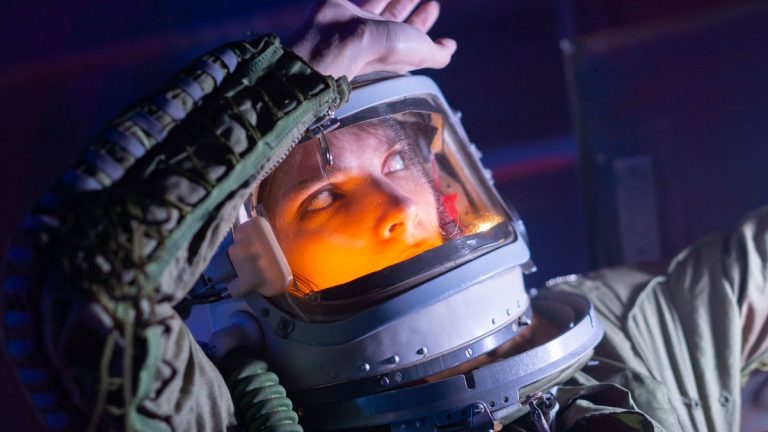
NASA has documented cosmic-ray flashes seen by astronauts in orbit, a strange spaceflight experience that begins with invisible particles and ends as sudden light inside the human visual system. The flashes can appear when an astronaut is in darkness or trying to sleep, even with closed eyes.
For crews aboard the International Space Station, the effect can feel oddly personal. A particle from deep space crosses the spacecraft, passes through tissue and briefly triggers a signal that the brain reads as light. NASA astronaut Don Pettit described the timing simply: “I see them mostly when I’m trying to fall asleep.”
The experience matters because it gives astronauts a rare direct sensation of the radiation environment around them. Most space radiation is invisible to the body in the moment. These flashes offer a fleeting sign of energetic particles moving through living tissue.
Apollo crews first reported the flashes
The first widely known reports came during the Apollo era. Astronauts traveling beyond low Earth orbit described streaks, spots and bursts of light after their eyes adapted to the dark cabin. Buzz Aldrin and other Apollo astronauts reported the flashes on lunar missions, which pushed NASA to investigate the phenomenon more closely.
Later Apollo missions carried hardware designed to connect the experience with particle tracks. One instrument, the Apollo Light Flash Moving Emulsion Detector, was worn by an astronaut during dark periods. It recorded charged-particle paths while the crew member reported flashes.
That approach turned a strange crew report into a measurable spaceflight problem. If a flash happened at the same time as a particle track passed near the eye or head, researchers could begin to match the sensation with a physical cause.
The Apollo observations also showed why human perception can become a scientific instrument in space. The eye can notice a single event that no camera sees as an ordinary photograph. In this case, the event begins with high-energy matter from outside Earth’s atmosphere.
Cosmic rays pass through the body
Cosmic rays are energetic particles that move through space at tremendous speeds. Many are protons, while others are heavier atomic nuclei. They are produced by powerful astrophysical processes and can arrive at spacecraft with enough energy to penetrate shielding.
Earth protects people on the ground through a thick atmosphere and a magnetic field. Astronauts still receive some shielding in low Earth orbit, but their environment is far more exposed than the surface. A spacecraft hull can reduce some radiation, yet the most energetic particles can cross walls, equipment and bodies.
When one of these particles passes through an astronaut, it leaves a narrow trail of ionization. That means it strips electrons from atoms along its path. In sensitive tissue, such as the eye, that track can interact with cells that normally respond to visible light.
This is why the flashes can appear during complete darkness. Light from the cabin does not need to enter the eye. The particle itself provides the trigger that starts the visual signal.
How the retina turns radiation into light
The retina lines the back of the eye and contains rods and cones. These cells normally react to photons, the tiny packets of energy that make up visible light. In orbit, a cosmic ray can stimulate the same system through a different physical route.
NASA astronaut Don Pettit explained the core idea in plain language: “When a cosmic ray happens to pass through the retina it causes the rods and cones to fire.” The brain then receives a signal from the visual pathway and the astronaut experiences that signal as a flash.
The shape of the flash can vary. Astronauts have reported points, streaks and small bursts. The exact appearance likely depends on the particle’s path, its energy and the part of the visual system it crosses.
Some particles may pass directly through the light-sensitive layer at the back of the eye. Others may affect related parts of the visual pathway. Researchers have studied both possibilities because the sensation is simple to describe but difficult to trace in the body.
Cherenkov glow inside the eye
Another route involves Cherenkov radiation, a faint glow produced under special conditions. A charged particle can move through a material faster than light travels through that material. In the fluid of the eye, that can generate a small burst of visible light.
The comparison sounds unusual because light in a vacuum has an ultimate speed limit. Inside water, glass, or eye fluid, light travels more slowly. An energetic particle can outrun light in that medium and leave behind a bluish glow, similar in principle to the glow seen in some nuclear reactors.
In the eye, this glow would be tiny and brief. Still, the retina is built to detect small amounts of light. If the glow reaches the light-sensitive cells, the brain can register it as a flash.
NASA’s discussion of the phenomenon points to more than one pathway. Direct stimulation of retinal cells and Cherenkov light can both contribute. Together, they explain why a particle that remains invisible to ordinary sight can become visible from inside the eye.
NASA experiments caught the particles
The key challenge was matching a subjective report with an objective measurement. Astronauts could press a button or mark a time when they saw a flash. Detectors near the head could record the particles moving through the same region.
Experiments on the Russian space station Mir and later on the ISS helped refine the picture. The SilEye investigations used silicon detectors to measure charged particles and their paths. The ALTEA experiment, short for Anomalous Long Term Effects on Astronauts, continued that work in orbit.
These studies placed detectors around an astronaut’s head while the astronaut reported visual events. The setup allowed researchers to compare timing, direction and particle type. Heavy nuclei and energetic protons emerged as important contributors to the flashes.
The result is a rare case where a single particle event can be linked to a human sensation. Pettit offered a more poetic description of the experience, saying, “It’s like seeing a luminous dancing fairy.” The science behind that image is a charged particle crossing a biological detector.
The experiments also showed why space biology often needs unusual tools. A laboratory on Earth can simulate some radiation exposures, but the orbital environment supplies a complex mix of particles. Crewed spacecraft let researchers study that environment with instruments and human reports at the same time.
Why the flashes matter for Mars
The flashes themselves pass quickly. Their deeper importance comes from what they reveal about space radiation. Every flash marks an interaction between an energetic particle and the nervous system or the eye.
For astronauts in low Earth orbit, Earth’s magnetic field still provides partial protection. A mission to Mars would spend long periods beyond that shelter. Crews would face a larger share of galactic cosmic rays during interplanetary travel.
That makes cosmic-ray research central to mission planning. Radiation exposure can affect the eyes, the central nervous system and other tissues over time. NASA and partner agencies study these risks because future missions will last months or years.
The visual flashes give astronauts an immediate experience of a hazard that is usually measured only by instruments. They also help communicate the problem clearly. Space radiation is invisible, yet a single cosmic particle can leave a bright trace in human perception.
The shielding challenge ahead
Protecting crews from galactic cosmic rays is difficult because the particles can carry enormous energy. Simple shielding can help with some radiation, but heavy particles can produce secondary radiation when they strike spacecraft materials. Engineers have to consider both the incoming particles and the particles created inside the shielding.
Spacecraft design, mission timing, habitat layout and operational choices all matter. Water, supplies and dedicated shielding materials can be arranged to reduce exposure in crew areas. Storm shelters can help during solar particle events, while galactic cosmic rays require a broader strategy.
For Mars missions, the challenge grows with distance and duration. Crews would spend time in deep space, on the Martian surface and then in deep space again during the return. Each phase carries its own radiation profile.
The eye flashes seen by astronauts are small moments within that larger engineering problem. They show that the human body is part of the detector system in space. They also remind researchers that radiation protection is a biological challenge as much as a spacecraft challenge.
Future missions will keep improving measurements with particle detectors, medical monitoring and crew reports. The flashes behind closed eyelids will remain one of the most vivid signs of the invisible particle storm through which astronauts travel.