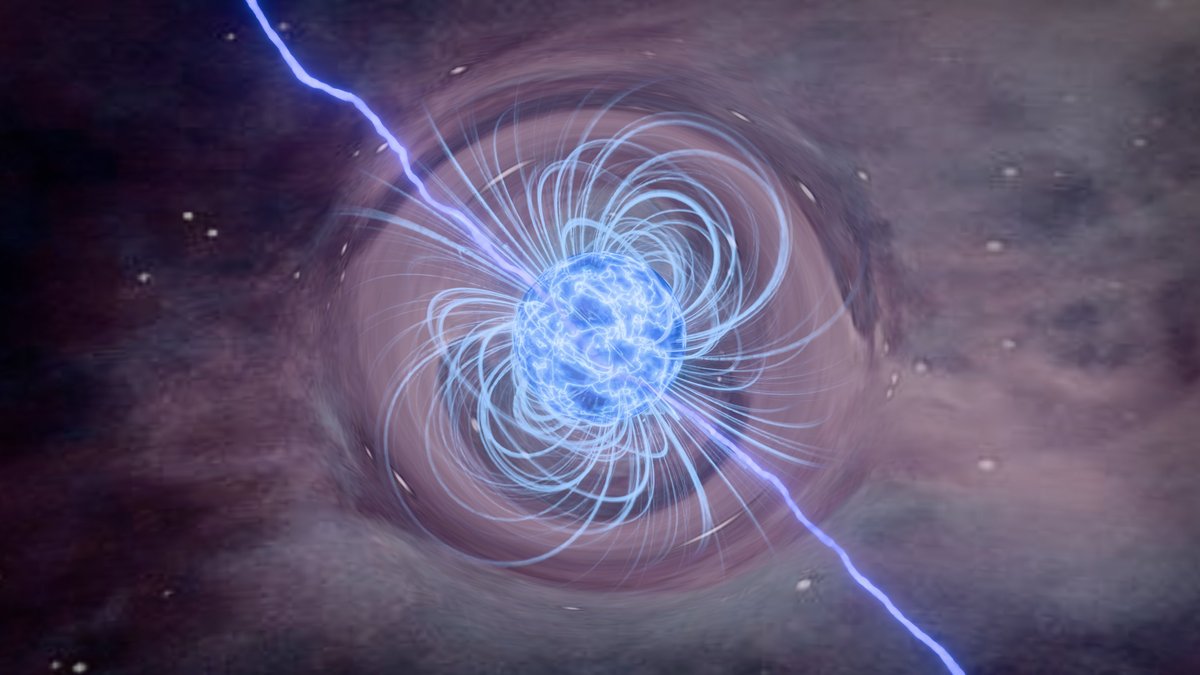
A Nature study captured a rare astrophysical mystery from across the Milky Way: a magnetar called SGR 1806-20 erupted on December 27, 2004, with a flash so intense that Earth’s upper atmosphere briefly responded. The event came from a compact stellar remnant in Sagittarius and became one of the most dramatic magnetar flares ever recorded.
The numbers remain startling. In the first 0.2 seconds, the flare released energy comparable to what the Sun emits in about 250,000 years. Nature’s abstract put it plainly: “In the first 0.2 s, the flare released as much energy as the Sun radiates in a quarter of a million years.” That burst crossed many thousands of light-years before striking spacecraft detectors and leaving a measurable trace in Earth’s ionosphere.
The flare was brief at its peak, but the scientific afterimage lasted far longer. Spacecraft saw an overwhelming initial pulse, followed by a fading tail that carried the rotation rhythm of the neutron star. Radio telescopes later tracked the aftermath. Together, those observations turned a distant cosmic outburst into a detailed case study of what magnetars can do.
A giant flare from SGR 1806-20
Magnetars are neutron stars with magnetic fields so extreme that their internal stresses can power violent high-energy flares. SGR 1806-20 belongs to a class known as soft gamma repeaters, objects that occasionally release short bursts of X-rays and gamma rays. Giant flares are the rare, oversized events in that family.
On December 27, 2004, SGR 1806-20 produced one of those rare eruptions. The flare began with an intense spike that lasted only a fraction of a second. After that came a longer tail, lasting several minutes, which carried the imprint of the star’s spin.
The Nature paper led by K. Hurley and colleagues reported a long flare lasting about 380 seconds. Its first flash was the most dramatic part. The study connected that initial pulse to a huge release of stored magnetic energy, most likely during a major rearrangement of the neutron star’s magnetic field.
A neutron star packs more mass than the Sun into a sphere roughly the size of a city. In a magnetar, the magnetic field adds another layer of strain. When that field shifts suddenly, the star can release energy in a gamma-ray flare that briefly outshines most high-energy events in the Galaxy.
What satellites actually saw
The first pulse from SGR 1806-20 was so bright that several detectors struggled to measure it cleanly. Instruments designed for intense cosmic flashes were overwhelmed. Some records had to be reconstructed from partial data and from instruments that were affected in different ways.
NASA reported that the flare was detected by NASA and European spacecraft. Other observations came from satellites and radio telescopes that followed the event after the first gamma-ray blast. The main flash arrived so strongly that it saturated detectors and even produced radiation scattered from the Moon.
The RHESSI spacecraft, built to study solar flares, also recorded the event. An Astrophysical Journal study led by Steven E. Boggs later used RHESSI data and other measurements to recover details from a signal that exceeded the instrument’s ordinary range. The saturation itself became part of the story. It showed how far beyond typical high-energy events this flare had gone.
ESA’s INTEGRAL observatory also saw the flare. A team led by S. Mereghetti reported that INTEGRAL’s SPI Anti-Coincidence Shield recorded a strong initial pulse followed by a roughly 400-second tail. That tail was modulated at the magnetar’s 7.56-second rotation period, which tied the fading signal directly to the spinning neutron star.
That rotating tail is crucial. A random cosmic flash might look like a brief spike on a detector. A pulsating tail reveals a source with a stable rhythm. In this case, the rhythm matched the known rotation of SGR 1806-20.
How Earth’s ionosphere responded
Earth was far from the source, yet the flare still changed the planet’s upper atmosphere in a measurable way. NASA reported that the flash lit up the upper atmosphere. Amateur observers also detected the associated disturbance in the ionosphere.
Earth’s ionosphere is a high-altitude region where solar radiation and energetic particles create electrically charged atoms and molecules. Radio signals can reflect from or pass through this region, depending on conditions. When the gamma rays and hard X-rays from SGR 1806-20 arrived, they briefly changed that electrical environment.
The effect was detected by instruments sensitive to radio propagation. It became an unusual link between a compact object elsewhere in the Galaxy and conditions around Earth. The flare’s photons had crossed interstellar space for thousands of years before producing a short-lived atmospheric signature.
The response also helps place the event in human terms. The magnetar did its work from far across the Milky Way. Even at that distance, the high-energy pulse reached Earth strongly enough to alter part of the atmosphere that scientists and radio observers can monitor.
Why the distance changes the numbers
The famous quarter-million-years comparison depends on how far away SGR 1806-20 is. Astronomers measure the energy that arrives at Earth, then estimate how much energy must have been released at the source. A larger distance implies a larger original release. A smaller distance implies a smaller one.
Early reporting often used a distance of about 15 kiloparsecs, or roughly 50,000 light-years. Later radio work refined the picture. A Nature study led by P. B. Cameron detected a fading radio counterpart after the flare and used hydrogen absorption measurements to estimate the distance.
That later work argued for a distance greater than 6.4 kiloparsecs and less than 9.8 kiloparsecs. Those values are lower than the larger early estimate. Even at those distances, the source remains a remote Galactic object by everyday standards.
This matters because energy estimates scale strongly with distance. The flare remains extraordinary under the revised distance range. The most careful version of the story keeps the energy comparison tied to the assumptions used in the Nature paper and treats later distance measurements as important context.
NASA’s 2005 account used a comparison of more than 150,000 years of solar output. The Hurley-led Nature paper used the quarter-million-years figure for the first 0.2 seconds. Both comparisons describe the same basic reality: a magnetar released an immense amount of energy in less time than a human blink.
A clue to short gamma-ray bursts
The 2004 flare also mattered because of what it might resemble from far outside the Milky Way. Hurley and colleagues argued that if the initial pulse had been seen from much greater distance, it could have looked like a short, hard gamma-ray burst.
Short gamma-ray bursts are brief flashes of high-energy radiation. Many last less than two seconds. Astronomers now connect at least some of them to neutron star mergers, especially after the 2017 gravitational-wave event GW170817 and its gamma-ray counterpart.
The SGR 1806-20 flare showed that magnetars can create a signal with some similar timing and energy traits. From another galaxy, without a clear distance or afterglow pattern, a giant magnetar flare could be placed in the same observational neighborhood as some short bursts.
That possibility gives astronomers a useful caution. A short, hard flash may need more than timing alone to identify its source. Host galaxy information, distance, afterglow behavior, gravitational-wave data and repeated activity can all help separate different kinds of explosive events.
In that sense, SGR 1806-20 became a boundary marker. It showed the upper range of what a Galactic magnetar could produce. It also gave observers a nearby example of a flare that could masquerade as something else if seen with less context.
What the flare still leaves open
The physical picture favored by the Nature study involved a catastrophic instability in the magnetar. In simple terms, the star’s magnetic field may have rearranged suddenly. That shift could have cracked the crust and released stored magnetic energy as an enormous flare.
Follow-up studies filled in different parts of the event. INTEGRAL data clarified the long pulsating tail. RHESSI analysis helped reconstruct the saturated early signal. Radio observations revealed a fading afterglow and expanding material linked to the outburst.
The event also exposed the limits of existing instruments. The brightest part of the flare overwhelmed detectors that were never built with such an extreme Galactic flash in mind. Scientists had to combine spacecraft records, timing signatures and follow-up observations to recover the best possible picture.
The open questions now center on frequency, physics and classification. Astronomers still want to know how often magnetars produce giant flares of this scale. They also want to understand how magnetic stress builds inside the star and how much energy can escape in a single eruption.
SGR 1806-20 remains one of the clearest examples of a magnetar giant flare reaching across astronomical distance into near-Earth space. Its first fraction of a second carried a solar-scale comparison that still sounds unreal. Its ionospheric signature showed that the Milky Way’s most compact objects can leave measurable fingerprints at home.