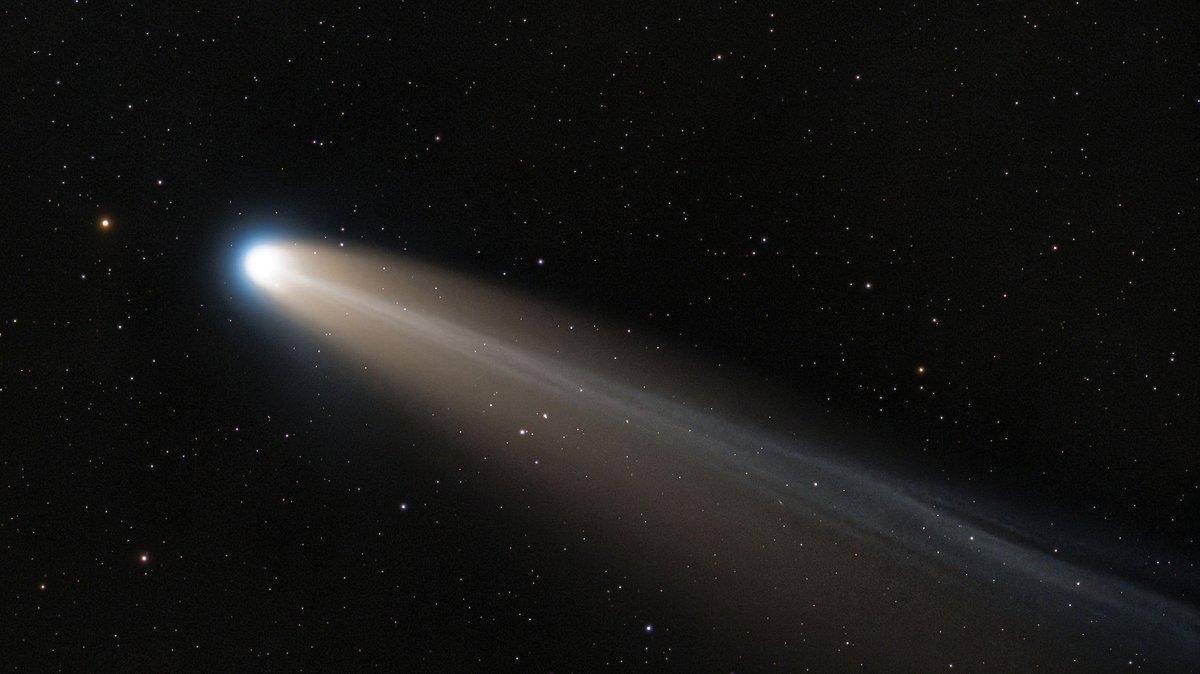
On November 12, 2014, the European Space Agency’s Rosetta mission made spaceflight history when its Philae lander touched down on Comet 67P/Churyumov – Gerasimenko. It was the first time a spacecraft had achieved a soft landing on a comet, after a ten-year journey through deep space.
The landing became even more remarkable once engineers reconstructed what had happened. Philae reached the surface, bounced back into space, touched down again and finally came to rest in a shadowed crevice. Its batteries lasted for only about 60 hours, yet the small European lander still returned the first direct measurements ever taken from the surface of a comet.
For planetary scientists, the mission offered a rare look at one of the solar system’s oldest building blocks. Comets preserve ice, dust and organic chemistry from the era when planets were forming. By sending Philae down to the surface while Rosetta watched from orbit, ESA turned a risky landing into one of the most memorable robotic explorations ever attempted.
A Ten-Year Chase to Comet 67P
Rosetta began its journey on March 2, 2004, lifting off from Kourou in French Guiana with Philae attached to its side. The spacecraft could reach its target only through a long series of carefully timed gravity assists. It swung past Earth three times and Mars once, gathering speed from planetary flybys without carrying impossible amounts of fuel.
Along the way, the mission also passed two asteroids. Rosetta flew by 2867 Šteins in 2008 and 21 Lutetia in 2010, returning close-up images and measurements during the cruise. Those flybys served as scientific opportunities and practical tests for a spacecraft that would eventually have to operate far from Earth.
The original comet target had been 46P/Wirtanen. A launch delay after an Ariane 5 failure in late 2002 forced ESA to revise the plan. Mission teams selected Comet 67P/Churyumov – Gerasimenko, a roughly 4-kilometer-wide body that travels around the Sun every 6.5 years.
When Rosetta reached 67P on August 6, 2014, it became the first spacecraft to enter orbit around a comet. The achievement alone was extraordinary. The orbiter then spent months mapping the irregular surface, studying the comet’s activity and helping scientists select a landing site for Philae.
The Seven-Hour Descent
Philae separated from Rosetta at 08:35 UTC on November 12, 2014. At that moment, the lander was about 22.7 kilometers from the comet’s center. With gravity far too weak for anything like a fast fall, Philae drifted downward for about seven hours.
The descent speed was about one meter per second, close to walking pace on Earth. That slow motion hid the difficulty of the operation. The comet was moving through space, the surface was poorly known and the lander had to arrive with enough precision to survive contact.
The mission plan relied on several systems working together. Two harpoons were meant to fire into the surface. Ice screws in the landing legs were intended to grip the ground. A small top-mounted thruster was designed to press the lander down as the harpoons anchored it.
Everything depended on the strange physics of a tiny world. The comet’s pull on the 100-kilogram lander was only a tiny fraction of Earth’s gravity. In that environment, even a gentle rebound could carry Philae high above the surface again.
The first touchdown took place at 15:34 UTC at a site later named Agilkia. A signal confirming the landing reached Earth through Rosetta at 16:03 GMT. In mission control, that confirmation marked a historic first for space exploration.
Why Philae Bounced Twice
The landing systems failed to secure Philae to the comet. The harpoons did not fire and the small thruster did not operate as planned. The screws in the landing legs also failed to hold the lander firmly to the surface.
That left Philae behaving like a free object in extremely weak gravity. After first contact, it rebounded from the surface and rose again above the comet. The first bounce carried it roughly a kilometer from the original landing area.
For nearly two hours, the lander drifted slowly over the comet. This long, silent arc would have been impossible on a larger world. On 67P, the faint gravity let Philae float before it came down for a second contact.
A final smaller bounce followed. Philae eventually settled at 17:31 UTC in a location called Abydos. The final position was about a kilometer from the intended landing site, wedged near a cliff wall in deep shade.
The bounce changed the mission’s power outlook. At Agilkia, mission planners expected several hours of sunlight during each 12.4-hour comet rotation. At Abydos, Philae’s solar panels received only about 1.5 hours of direct sunlight per rotation.
Science From a Shadowed Crevice
Philae’s final resting place looked challenging, but the lander’s first science sequence depended on its primary battery. That battery had been charged before separation and could support operations without immediate solar power. Mission teams quickly used that narrow window.
All ten of Philae’s scientific instruments were operated at least once during the initial surface mission. The lander returned images from the comet’s surface and measurements of the material around it. Those data gave scientists the first close contact with a cometary nucleus.
The instruments studied several parts of the environment. Cameras recorded the immediate surroundings. Chemical sensors examined gases and surface material. Other instruments measured properties such as temperature, strength, electrical behavior and magnetic conditions.
One of the most valuable results came from the lander’s ability to work directly on the surface. Orbiters can study a comet from above, but a lander can touch the material that has preserved ancient solar system chemistry. Philae’s short life on the surface made that contact possible.
At 00:08 UTC on November 15, 2014, Philae’s primary battery was exhausted. The lander entered hibernation. It later communicated sporadically with Rosetta in June and July 2015, as the comet moved closer to the Sun and sunlight briefly improved.
What Rosetta and Philae Found
The combined Rosetta and Philae mission changed the way scientists think about comets. Comet 67P was far more complex than a simple dirty ice body. Its surface showed cliffs, pits, dust fields, fractured terrain and changing activity as sunlight warmed it.
Rosetta’s instruments found that water vapor from 67P carried a deuterium-to-hydrogen ratio higher than the ratio in Earth’s oceans. That measurement made 67P a poor match for the main source of Earth’s water. It pushed scientists to look more closely at asteroids and other delivery routes in the early solar system.
The mission also detected complex organic molecules associated with comet material. These included compounds connected to prebiotic chemistry, the kinds of ingredients that interest astrobiologists. Such findings strengthened the view that comets carried chemically rich material through the young solar system.
Rosetta also revealed molecular oxygen around the comet. That discovery surprised researchers because oxygen is highly reactive. Its presence suggested that some gases in 67P had been trapped or preserved since very early times.
The shape of 67P became another clue to its past. The comet’s two-lobed form looked like a rubber duck in Rosetta’s images. Analysis indicated that the shape likely formed when two smaller bodies merged gently in the early solar system.
The Final Resting Place on the Comet
For much of the mission, Philae’s exact location remained uncertain. Engineers knew it had bounced away from Agilkia and ended up in shadow. The terrain made the search difficult because the lander was small, bright in some angles and hidden among rough comet features.
Rosetta finally found Philae in high-resolution images in September 2016. The lander was visible in a dark crack on the comet’s smaller lobe. Its legs could be seen against the rough surface, confirming the geometry that had limited sunlight after landing.
The discovery gave scientists the context they needed to interpret Philae’s measurements. Knowing the final attitude and surroundings helped explain the power problem, the communication difficulty and some details of the surface data.
Rosetta’s own mission ended on September 30, 2016. ESA guided the orbiter down to the comet’s surface after 67P had moved too far from the Sun for the spacecraft’s solar panels to keep it operating. The controlled descent allowed Rosetta to collect close-up measurements until the final moments.
Today, both spacecraft remain on Comet 67P. Philae sits in its shadowed crevice and Rosetta rests elsewhere on the same ancient body. Together, they mark the first human-made machines to take up permanent residence on the surface of a comet.