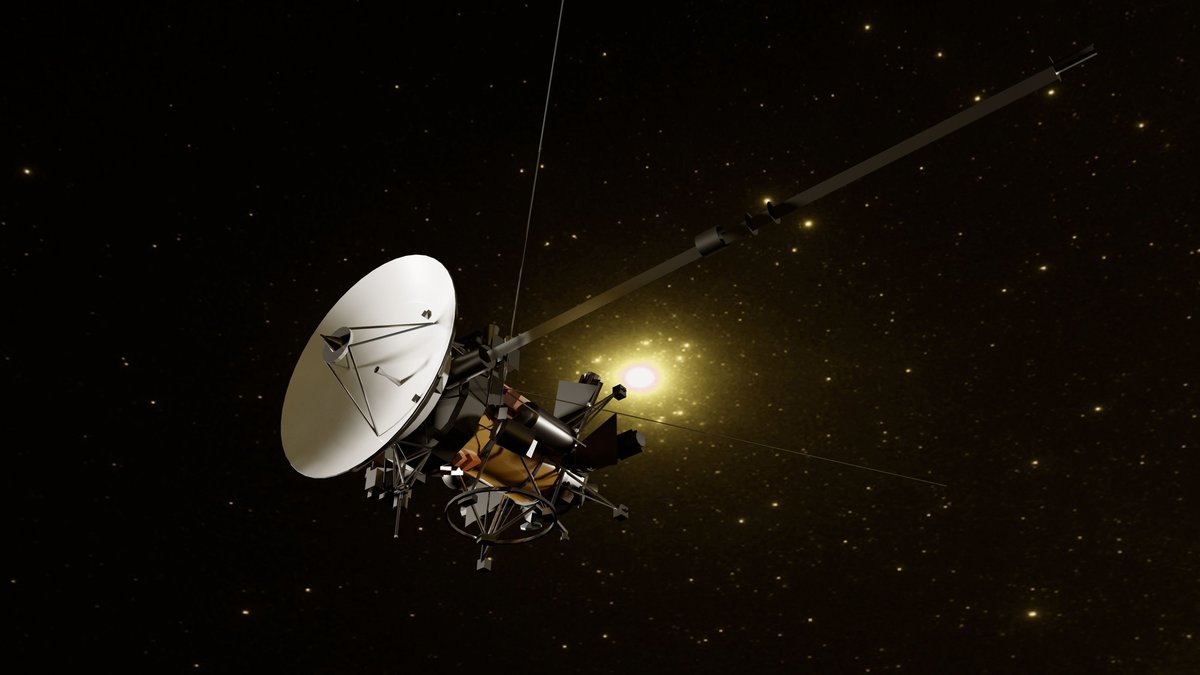
NASA’s Voyager 1 mission remains one of the strangest success stories in spaceflight. Nearly 49 years after launch, the small car sized spacecraft is still operating in interstellar space, still sending faint data home and still forcing engineers on Earth to work at the speed of light across a distance that now stretches for more than 23 light hours.
The probe left Earth on September 5, 1977, during a mission designed around flybys of Jupiter and Saturn. That original planetary tour ended decades ago. Yet NASA/JPL continues to operate Voyager 1 as a long lived outpost beyond the Sun’s protective bubble, where it can sample a region no other working spacecraft has reached.
Its survival now depends on careful energy management, aging electronics and patient communication. Every signal sent to the spacecraft takes more than 23 hours to arrive. Every reply takes more than 23 hours to come back. A simple command cycle can stretch across two Earth days before engineers know whether it worked.
Voyager 1 is still alive after nearly 49 years
Nearly five decades after launch, Voyager 1 is still returning science data from far beyond the orbit of Pluto. NASA describes it as the most distant human made object in existence, a status it reached in 1998 when it passed Pioneer 10’s distance from the Sun.
The spacecraft is now in the interstellar medium, the thin material between stars. It crossed the heliopause in August 2012, which marked its passage beyond the region dominated by the solar wind. That crossing gave scientists their first direct measurements from outside the heliosphere.
For readers used to fast electronics and constant connectivity, Voyager’s endurance feels almost unreal. The spacecraft was built before modern smartphones, before household internet and before most of today’s space engineers began their careers. Its survival is a practical lesson in conservative engineering, redundancy and patient troubleshooting.
A four year mission became an interstellar record
The mission began with a clear planetary target. Voyager 1 was built to visit Jupiter and Saturn, then return images and measurements that would reshape planetary science. Its flybys revealed active worlds, complex rings and moons that looked far more dynamic than earlier telescopic views suggested.
After Saturn, the spacecraft followed a path that carried it out of the planetary plane. That trajectory ended any chance of visiting Uranus or Neptune, a task later completed by Voyager 2. It also placed Voyager 1 on a faster outward path, turning a planetary probe into an interstellar spacecraft.
NASA later extended the mission into what became the Voyager Interstellar Mission. The goal shifted from planetary encounters to long distance exploration of the Sun’s outer influence. As the probe kept moving, it tracked the solar wind’s fading power and helped scientists identify the boundary where interstellar space begins.
The mission’s record comes from time as much as distance. Voyager 1 has been in flight longer than most of the global population has been alive. It has outlasted the political era, technology culture and original workforce that shaped its launch.
The 1977 spacecraft runs on tiny computing power
By modern standards, Voyager 1’s onboard computing is astonishingly small. The spacecraft uses hardware designed in the 1970s, with extremely limited memory and slow processing speeds compared with even low cost consumer devices today.
That simplicity has become part of its strength. The spacecraft was built for reliability under severe limits, with systems that could be understood, tested and operated across vast distances. Engineers cannot treat it like a modern spacecraft with frequent software updates and abundant onboard resources.
Its data system also belongs to another technological world. Voyager 1’s transmission rate is tiny compared with broadband internet. When data must be stored, the spacecraft relies on hardware from the era of magnetic tape, including an 8-track tape recorder architecture that reflects its 1970s origin.
Power is the deeper limit. Voyager 1 runs on radioisotope thermoelectric generators, which convert heat from plutonium-238 decay into electricity. That power supply has declined steadily since launch, leaving engineers to decide which heaters, instruments and support systems can stay on.
Why every command now takes days
Distance controls everything about Voyager operations. Radio waves travel at light speed, which sounds instant on Earth. Across billions of miles, light speed becomes a slow clock that governs every engineering decision.
A command from Earth now takes more than 23 hours to reach Voyager 1. If the spacecraft responds right away, the answer needs another 23 hours to return. That means a single test can consume almost two full days before the team sees the result.
This delay changes the rhythm of spacecraft operations. Engineers must plan carefully, check every command and wait through long periods of silence. The process leaves little room for improvisation when a problem appears.
Voyager 1’s faint signal is received through NASA’s Deep Space Network, the global antenna system used to communicate with distant spacecraft. The probe’s transmissions are weak by the time they reach Earth, so ground antennas must listen with extraordinary sensitivity.
JPL is keeping the probe alive instrument by instrument
Power management is now the central challenge for the Voyager team at Jet Propulsion Laboratory. As the spacecraft’s generators produce less electricity, engineers preserve the mission by turning off systems in a careful sequence.
NASA has explained that Voyager teams agreed years ago on the order for shutting down instruments and other equipment. The aim is to keep the spacecraft returning unique science for as long as possible. Each shutdown buys time for the remaining instruments and spacecraft systems.
That work has become more delicate with age. Components that were never expected to operate for half a century can behave unpredictably. When a fault appears, engineers often have to study old documentation and build new workarounds around hardware designed for another era.
The mission’s recent history shows how demanding that work can be. A telemetry problem can take months to diagnose because every test requires a long wait. Even so, the team has repeatedly restored useful communication and kept the spacecraft productive.
The people who built Voyager are passing into history
Voyager 1’s human story is now inseparable from its engineering story. The spacecraft was built by scientists and engineers who came of age long before the modern digital era. Many of those original team members have retired and many have died.
Edward Stone was one of the central figures in that history. He served as Voyager project scientist for decades, guiding the mission from its planetary encounters through its entry into interstellar space. His long tenure gave the mission a rare continuity across generations.
Other names remain tied to Voyager’s cultural legacy. Carl Sagan helped lead the team behind the Golden Record, the message mounted on both Voyager spacecraft. Frank Drake also contributed to that record, which carries sounds, images, greetings and symbolic information about Earth.
Today’s operators inherited a spacecraft already deep into its journey. Many current engineers were children or had yet to be born when Voyager 1 launched. Their task is to keep a 1977 machine working in a region that no repair crew can ever reach.
What Voyager 1 is still measuring
Voyager 1’s remaining science is focused on the space between stars. Its instruments help researchers study the environment outside the heliosphere, where particles and magnetic fields differ from conditions closer to the Sun.
NASA says Voyager 1 still has two science instruments operating. Those remaining systems include the plasma wave subsystem and the magnetometer. Together, they provide data on plasma waves and magnetic fields in interstellar space.
The measurements matter because the heliosphere acts as a vast shield around the solar system. Its boundary is shaped by the outward pressure of the solar wind and the surrounding interstellar environment. Voyager 1 gives scientists a direct way to compare the inside and outside of that boundary.
Every bit of data is precious. The spacecraft is alone in its direction of travel, far beyond the planets and sampling space that no newer mission has reached. Its slow stream of measurements helps scientists refine models of how stars interact with their galactic surroundings.
Where the spacecraft goes after NASA loses contact
Voyager 1’s active mission will eventually end when its power falls below what the spacecraft needs to operate and communicate. NASA expects the remaining margin to shrink through the coming years as the generators continue to fade.
Contact loss will end the flow of data, but the spacecraft’s motion will continue. Voyager 1 is traveling fast enough to keep moving outward through interstellar space for ages. No known natural process will quickly stop it.
Long after its radio voice fades, the spacecraft will carry the Golden Record into deep time. The record was designed as a symbolic message from Earth, with greetings, music, images and diagrams meant to represent human life and our planet.
Its future path will take it near other stars on timescales far beyond human history. Those encounters will be distant by everyday standards, measured in light years or fractions of light years. Even so, they show the scale of the journey that began with a 1977 launch from Earth.
Voyager 1 has become a moving boundary marker for human exploration. It began as a planetary mission and became a probe of interstellar space. Its greatest achievement may be the simplest one, a machine built for a short mission is still answering from the dark after nearly half a century.