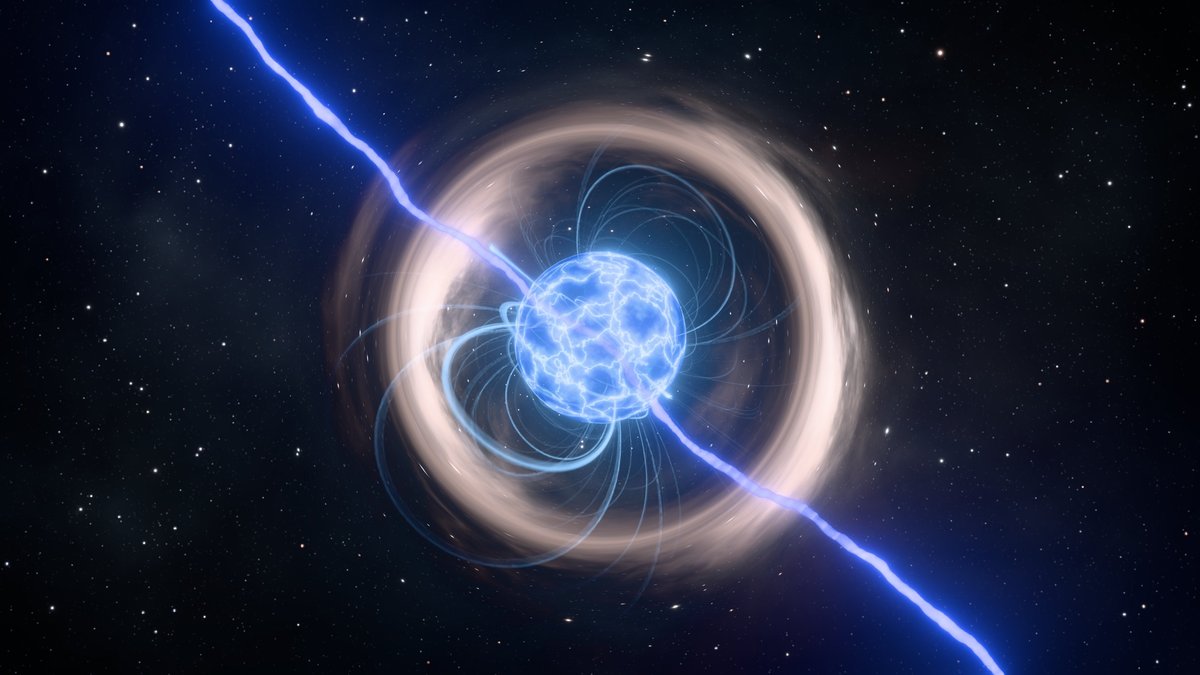
NASA’s Webb announcement reports that astronomers used the James Webb Space Telescope to watch PSR J2322-2650b through a full orbit around a pulsar. The result is a strange world with a carbon-rich atmosphere, a stretched shape and a history that current formation ideas struggle to explain.
The planet has roughly the mass of Jupiter and circles a rapidly spinning neutron star. Its orbit lasts only 7.8 hours. At that distance, the pulsar’s gravity pulls the planet into a tapered form that researchers compare to a lemon.
The real surprise came from the atmosphere. Webb detected molecular carbon, specifically C2 and C3. Those molecules point to an environment with very little oxygen or nitrogen available to bind with carbon.
For planetary scientists, PSR J2322-2650b is a rare chance to study an atmosphere in a system that seems to sit outside ordinary categories. It resembles a hot gas giant in some ways, yet it orbits a dead stellar core and carries chemistry unlike any known planet atmosphere examined so far.
Webb spots a planet that breaks expectations
The observation centered on a world in an extreme setting. PSR J2322-2650b orbits a millisecond pulsar, which is the compact remnant left behind after a massive star died. These objects can spin hundreds of times each second and release intense beams of radiation.
Michael Zhang of the University of Chicago led the study. He described the host star in stark terms: “The planet orbits a star that’s completely bizarre, the mass of the Sun, but the size of a city.” That combination creates a powerful gravitational and radiation environment around the planet.
Webb’s measurements revealed a world heated far beyond familiar planetary conditions. NASA reported temperatures ranging from about 1,200 degrees Fahrenheit on the coldest parts of the night side to about 3,700 degrees Fahrenheit on the hottest parts of the day side.
The planet’s closeness also gives it an ultra-short year. It sits about 1 million miles from its host star. Earth circles the Sun at roughly 100 million miles, so this planet is packed into an orbit that would be violently hostile by solar system standards.
A world lit by a star Webb can’t see
The unusual host star helped make the observation possible. A normal star would shine brightly in the infrared wavelengths Webb uses to study planetary heat. That glare can overwhelm the faint signal from a nearby planet.
A pulsar behaves differently for Webb. It pours out high-energy radiation such as gamma rays and streams of particles. Its strongest output sits outside the infrared view used for this study, giving astronomers a cleaner look at the planet’s own glow.
Maya Beleznay, a Stanford PhD candidate who modeled the planet’s shape and orbit, explained the advantage: “This system is unique because we are able to view the planet illuminated by its host star, but not see the host star at all.” She added that the team gets “a really pristine spectrum.”
That spectrum is the key. As the planet moved around the pulsar, Webb watched its light change through the orbit. Those changes allowed researchers to infer temperature patterns, atmospheric chemistry and wind behavior across the planet.
The strange carbon chemistry
The spectrum contained an unexpected chemical signature. Webb found molecular carbon, including C2 and C3, in an atmosphere thought to be dominated by helium and carbon. Those molecules are rare as major atmospheric ingredients on planets.
Peter Gao of the Carnegie Earth and Planets Laboratory captured the team’s first reaction with a short question: “What the heck is this?” The phrase fits the result. Planetary atmospheres usually show molecules such as water, methane, carbon monoxide, or carbon dioxide when conditions allow them.
Carbon tends to bond readily with oxygen and nitrogen at these temperatures. For C2 and C3 to appear so strongly, the atmosphere must have extraordinary chemical ratios. NASA’s summary says the study points to a carbon-to-oxygen ratio above 100 and a carbon-to-nitrogen ratio above 10,000.
Those numbers put the planet into a chemical regime that astronomers haven’t seen before. Among roughly 150 planets with studied atmospheres, including worlds inside and outside the solar system, NASA says this is the first known case with detectable molecular carbon as a dominant feature.
Why the planet looks like a lemon
The lemon shape comes from tides. Because the planet orbits so close to the pulsar, gravity pulls much harder on the near side than on the far side. That difference stretches the planet away from a rounder form.
For a gas giant, this distortion can be dramatic. PSR J2322-2650b is massive enough to resemble Jupiter by mass, yet it moves through an orbit so tight that the pulsar’s pull sculpts the entire planet.
The planet is also tidally locked. One hemisphere faces the pulsar while the other points outward into space. This creates a permanent day side and night side, with a huge temperature contrast between them.
The study also reports strong westward winds. In simple terms, the atmosphere seems to transport heat around the planet while it rotates quickly and receives fierce external irradiation. That combination gives researchers a laboratory for atmospheric motion under extreme conditions.
The black widow puzzle
The system resembles what astronomers call a black widow pulsar system. In these systems, a pulsar gradually erodes a nearby companion with wind and radiation. Over time, the companion can lose material as the pulsar spins rapidly.
This framework gives scientists one possible starting point. A companion object could have been stripped down by the pulsar over a long period. Such stripping can expose deeper layers and change the visible composition.
The carbon result complicates that story. A stripped stellar core should contain a broader mix of elements. The near absence of oxygen and nitrogen in the atmospheric signal leaves a gap in the formation picture.
Roger Romani of Stanford and the Kavli Institute for Particle Astrophysics and Cosmology suggested one possible route. As the companion cooled, carbon and oxygen inside it might have crystallized. Pure carbon crystals could then have floated upward and mixed into helium.
Even that idea leaves a major question. The oxygen and nitrogen still need some pathway out of the observable atmosphere. For now, the formation history remains the central mystery around this planet.
What the models can and can’t explain
Webb measured light and researchers used models to translate that light into physical properties. That process is standard in exoplanet science. It also means the findings depend on how well the models capture this unusual atmosphere.
The evidence for molecular carbon is the sturdy core of the result. The exact carbon-to-oxygen and carbon-to-nitrogen ratios come from atmospheric modeling. The shape and winds also come from fitting observations to a physical picture of the planet.
That distinction matters because the object is unique. With only one known planet like this, researchers have limited comparison points. Future observations could sharpen the chemistry and test whether the same model continues to fit the data.
The study describes a world with a minimum density around 1.8 grams per cubic centimeter and an equilibrium temperature near 1900 kelvin. Those values make it resemble a hot Jupiter in bulk terms. Its pulsar orbit and atmospheric chemistry place it in a much stranger setting.
Some popular descriptions may jump quickly to diamond imagery. NASA notes that carbon could condense as diamond deep inside the planet under the right conditions. That remains a model-based possibility, while Webb’s spectrum directly points to carbon-rich atmospheric gases.
Why this atmosphere matters
PSR J2322-2650b matters because it expands the range of planetary atmospheres astronomers can study. Most exoplanet atmosphere work focuses on worlds around ordinary stars. This planet shows that dead stellar remnants can host objects with measurable and deeply unusual air.
The observation also highlights Webb’s strength. The James Webb Space Telescope can separate faint thermal signals and read chemical fingerprints from distant worlds. In this case, the host star’s unusual invisibility in infrared light gave Webb a cleaner view than astronomers usually get.
The result pushes theory in a useful way. Planet formation models need to account for the objects astronomers actually find. A helium-and-carbon-rich atmosphere around a pulsar companion gives researchers a demanding test case.
It also connects several branches of astrophysics. The system touches stellar death, pulsar spin-up, atmospheric chemistry, heat transport and tidal distortion. Few planets give scientists so many extremes in one target.
For now, PSR J2322-2650b’s atmosphere stands as the strongest clue. It shows carbon chemistry operating in a regime far beyond familiar planetary air. The planet’s origin remains open and that is exactly why astronomers will want to look again.