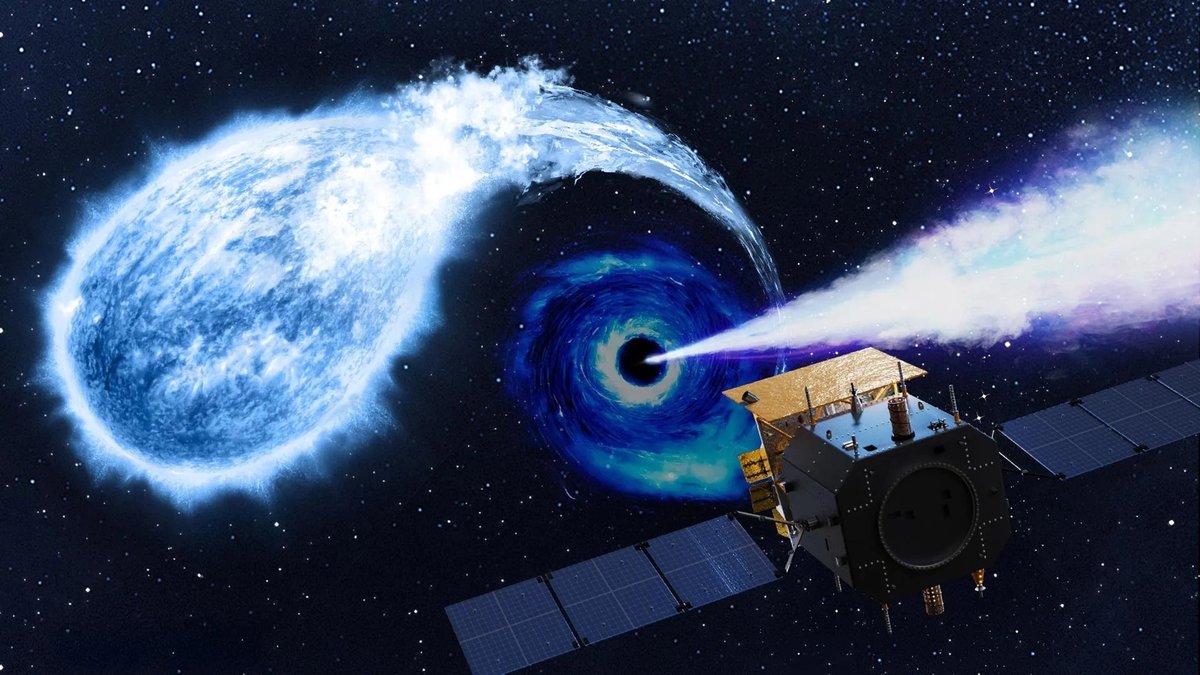
A study in Science Bulletin reports that China’s Einstein Probe detected an extraordinary X-ray outburst called EP250702a, a fast and brilliant event that may reveal an intermediate-mass black hole tearing apart a white dwarf star. If the interpretation holds, the observation would give astronomers a rare view of a predicted but elusive kind of black hole feeding event.
The object first appeared on July 2, 2025, during a routine sky survey by the Einstein Probe mission. Its brightness changed rapidly, which immediately separated it from the quieter X-ray sources that often populate survey images. Follow-up observations soon drew in telescopes across the world.
The research effort was coordinated by the Einstein Probe Science Center at the National Astronomical Observatories, Chinese Academy of Sciences. Scientists from several countries contributed, including researchers from the Department of Physics at The University of Hong Kong, who helped interpret the event as part of the Einstein Probe scientific collaboration.
At the center of the puzzle is a simple sequence with dramatic implications. X-rays arrived before the gamma-ray burst activity. Then came intense flares, an extreme peak brightness and a rapid decline. Together, those clues point toward a violent encounter between a compact stellar remnant and a black hole in a mass range that astronomers have long struggled to pin down.
A strange X-ray signal appeared first
The first surprise came from timing. The mission’s Wide-field X-ray Telescope detected a rapidly changing source later designated EP250702a, also known as GRB 250702B. Around the same time, NASA’s Fermi Gamma-ray Space Telescope detected several gamma-ray bursts from the same region of the sky.
After reviewing earlier observations, the team found that the X-ray source had already been shining roughly a day before the gamma-ray activity. That early emission made the event especially unusual. In the paper’s abstract, the researchers write, “Here we report observations of a fast and luminous X-ray transient EP250702a detected by Einstein Probe.”
The Wide-field X-ray Telescope was built for exactly this kind of discovery. It uses lobster-eye micro-pore optics to watch a very large patch of sky with high sensitivity. That wide view lets the mission catch brief X-ray events in their earliest stages, before other observatories know where to look.
Soon after the first detection, astronomers used the position measured by Einstein Probe to guide follow-up observations. The fast alert helped researchers collect information across the electromagnetic spectrum while the event was still changing rapidly.
The flare faded with extreme speed
Roughly 15 hours after the first X-ray detection, the object erupted into a series of intense flares. At its brightest, the event reached an estimated luminosity of about 3 × 10 49 erg s -1. That places it among the most powerful instantaneous outbursts recorded in the universe.
Then the source dimmed with remarkable speed. Over about 20 days, its brightness fell by more than a factor of 100,000. A decline that steep gives scientists a strong clue about the size and physics of the system producing the flare.
The X-ray color also changed. Early emission included higher-energy, or harder, X-rays. As the event evolved, the signal shifted toward lower-energy, or softer, X-rays. This kind of energy evolution helps researchers test whether the outburst came from a gamma-ray burst, a tidal disruption event, or another kind of extreme engine.
Einstein Probe’s Follow-up X-ray Telescope tracked the fading source as it evolved. By pairing those data with observations at other wavelengths, the team could compare the event with known classes of cosmic explosions.
A white dwarf may have met an intermediate-mass black hole
The leading interpretation is a tidal disruption event, a cosmic shredding in which a star passes close enough to a black hole that gravity tears it apart. The torn material forms a hot flow around the black hole and some of that energy can escape as intense radiation.
EP250702a appears especially important because the victim may have been a white dwarf. A white dwarf is the dense core left behind after a star like the Sun exhausts its fuel. It packs a star’s worth of material into an Earth-size object, making it far tougher to tear apart than an ordinary gaseous star.
That detail points to the possible culprit. A black hole that can shred such a compact object must fall into a specific mass range. In the study’s abstract, the authors state that white dwarfs “can only be disrupted by intermediate-mass black holes.”
An intermediate-mass black hole sits between stellar-mass black holes and the supermassive black holes found in galactic centers. Astronomers have found many examples at the small and enormous ends of that scale. The middle category remains harder to observe because these objects are faint unless they are actively feeding.
A white dwarf disruption would provide a powerful natural spotlight. The brief flare, the fast fading and the extreme X-ray brightness all fit the idea of a compact star being torn apart and swallowed in a relatively small but ferocious system.
Why the location matters
The event’s location adds another key clue. Follow-up observations placed the source on the outskirts of a distant galaxy. That position is important because the centers of galaxies are where supermassive black holes usually live.
An off-center location fits a different kind of black hole environment. Intermediate-mass black holes could reside in star clusters, dwarf-galaxy remnants, or other regions away from bright galactic nuclei. Finding a flare in a galaxy’s outer region therefore strengthens the case for a smaller black hole.
The location also helps researchers weigh competing explanations. Many powerful high-energy events are tied to massive stars, galaxy centers, or compact-object collisions. EP250702a combined an early X-ray signal, extreme luminosity, rapid softening and an unusual host-galaxy position.
Those clues made the white dwarf tidal disruption scenario especially compelling. Still, the interpretation remains cautious. The study describes the event as possible evidence for this rare process and further observations will be needed to test the picture in detail.
Einstein Probe opens a new window on violent cosmic events
Einstein Probe was designed to find fast-changing X-ray sources across the sky. EP250702a shows why that strategy matters. By catching X-rays before the gamma-ray activity peaked, the mission revealed part of the event that could have been missed by narrower or slower surveys.
The detection also shows the value of rapid multiwavelength observations. X-rays, gamma rays, optical light and other signals each trace a different part of the explosion. When combined, they let scientists reconstruct the timing, energy, environment and possible engine behind the outburst.
For astronomers hunting intermediate-mass black holes, events like EP250702a may become crucial signposts. These objects are expected to help explain how black holes grow from stellar remnants into the enormous black holes found in galaxies. Each candidate gives researchers another chance to map that missing middle ground.
The discovery also highlights white dwarfs as extreme probes of gravity. Their density makes them difficult to disrupt, so a successful shredding event reveals the strength and scale of the black hole involved. A brief flash can therefore act like a cosmic measurement tool.
As Einstein Probe continues scanning the sky, similar fast X-ray transients may appear. EP250702a already offers a striking example of how a sudden flare can expose hidden black holes and the compact stars that wander too close.