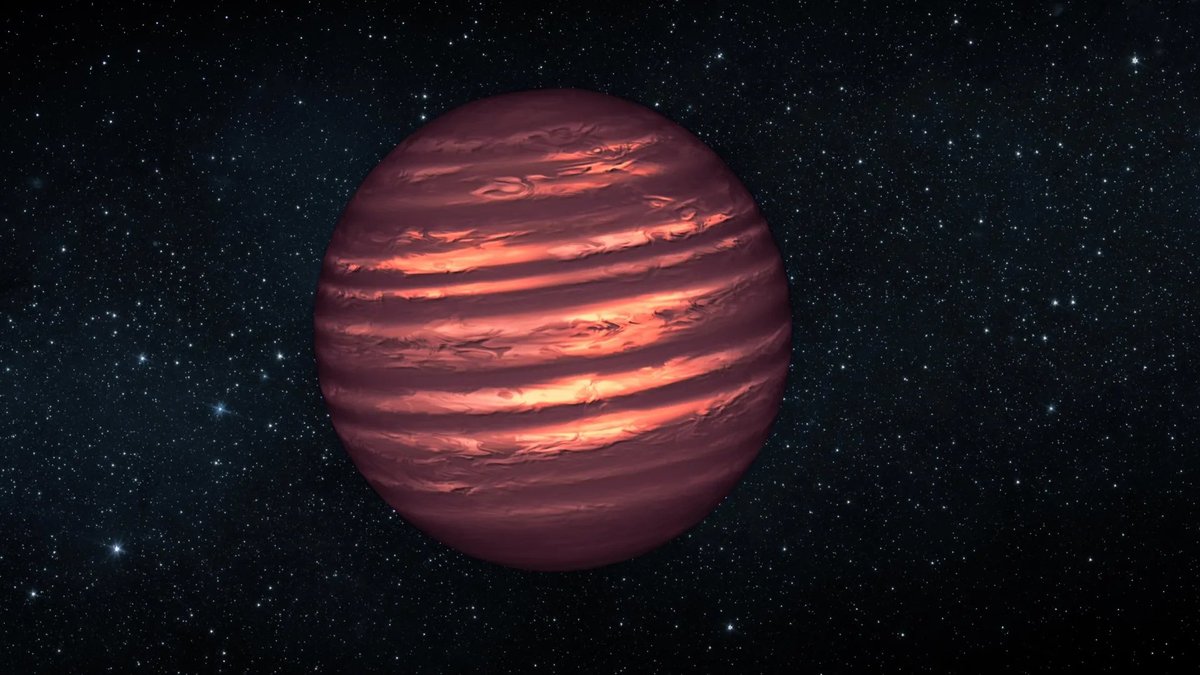
Researchers led by Northwestern University used Keck Observatory observations to uncover a striking pattern in the spins of distant worlds. Their study, published in The Astronomical Journal, found that giant gas planets tend to rotate faster than more massive brown dwarf companions after accounting for mass, size and age.
The finding gives astronomers a new way to probe how large planets form far from their stars. A world’s spin carries traces of its early history, including how much angular momentum it kept while growing inside a disk of gas and dust. That record can linger for tens to hundreds of millions of years.
“Spin is a fossil record of how a planet formed,” said Dino Chih-Chun Hsu, a researcher at Northwestern University’s Center for Interdisciplinary Exploration and Research in Astrophysics and lead author of the study.
The team used the Keck Planet Imager and Characterizer, known as KPIC, on Maunakea in Hawaiʻi. By separating the faint light of distant planets from the glare of their stars, KPIC allowed the researchers to measure rotation in worlds that are otherwise extremely difficult to study directly.
Keck survey finds a spin pattern
The survey focused on a large set of directly imaged companions beyond our Solar System. The researchers studied 32 objects with Keck, including 6 gas giant planets and 25 brown dwarf companions. These objects span a wide range of masses, from planets several times heavier than Jupiter to bodies massive enough to resemble small stellar companions.
After adding spin measurements from previous studies, the team built a broader comparison sample. It included 43 benchmark stellar and substellar companions, giant planets and 54 free-floating brown dwarfs and planetary-mass objects. That larger dataset helped the researchers look for patterns that would be hard to see in a smaller group.
The central result was unexpected in its clarity. When the team adjusted for mass, radius and age, giant planets showed faster rotation than heavier brown dwarf companions. That relationship points to different spin histories for objects that can look similar from a distance.
Our own Solar System offers a familiar starting point. Jupiter and Saturn are enormous compared with Earth, yet each completes a full rotation in about 10 hours. Their fast spins have long suggested that mass and rotation are linked, but distant exoplanets give astronomers a much larger testing ground.
The Keck study extends that question to worlds orbiting other stars. Many of the surveyed planets sit far from their host stars, at separations ranging from tens to hundreds of astronomical units. Those wide orbits make them valuable targets for direct imaging and useful laboratories for planet formation.
How astronomers measured alien rotation
Measuring the length of a day on a distant planet requires a subtle trick. Astronomers cannot watch cloud bands sweep across most exoplanets the way spacecraft can observe Jupiter. Instead, they read the planet’s spectrum, which carries tiny shifts caused by rotation.
As a planet spins, one side moves toward Earth while the other moves away. That motion broadens the planet’s spectral features. By measuring this broadening, the researchers can estimate the object’s projected rotation speed, often called rotational velocity.
KPIC made that measurement possible by combining adaptive optics with high-resolution spectroscopy. Adaptive optics corrects for the blurring caused by Earth’s atmosphere. High-resolution spectroscopy then spreads the planet’s light into fine detail, where the spin signal can be detected.
“With KPIC, we can detect these tiny signals that reveal a planet’s rotation around other nearby stars,” Hsu said.
This approach is especially powerful for worlds that have been directly imaged. These planets and brown dwarfs are separated enough from their stars that their own light can be isolated. That light contains clues about temperature, chemistry and now rotation, which turns a faint point into a physical world with a history.
Giant planets outspin brown dwarfs
One of the clearest examples comes from the HR 8799 system, a well-known family of giant planets. In that system, a gas giant with about 7 times Jupiter’s mass spins far faster than a brown dwarf companion with roughly 24 times Jupiter’s mass.
The contrast matters because heavier objects might seem likely to spin faster. The survey suggests a richer story. When the relevant physical factors are considered together, the lighter giant planets appear to retain a larger share of their rotational speed.
Brown dwarfs occupy an important middle ground in astronomy. They are more massive than planets, yet they share some planet-like properties in their atmospheres and temperatures. Studying their spins alongside giant planets helps researchers explore how formation pathways affect long-term evolution.
The team’s result suggests that the ratio between a planet’s mass and its star’s mass also helps shape the final spin. That ratio can influence the amount of material available during formation and the strength of interactions with nearby gas. Over time, those interactions can change how quickly a young world rotates.
For astronomers, spin becomes a diagnostic tool. A planet’s orbit, mass, atmosphere and rotation can be studied together to reconstruct how the object grew. Each measurement adds one piece to the early history of a planetary system.
Why early magnetic braking matters
The researchers point to magnetic braking as a likely part of the explanation. Young planets and brown dwarfs are surrounded by gas as they form. Their magnetic fields can interact with that material and transfer angular momentum away from the spinning object.
A stronger magnetic field can couple more tightly to a surrounding circumplanetary disk. That interaction acts like a brake during the object’s youth. If a more massive brown dwarf has a stronger magnetic field, it may lose more of its original spin before the disk disappears.
This idea helps explain why a heavier object can end up rotating more slowly than a smaller giant planet. The early disk environment matters as much as the mass itself. The final spin becomes the outcome of growth, contraction, disk interactions and magnetic forces.
The study also connects distant worlds to questions about our own planetary system. Angular momentum shaped the architecture of the Solar System, including the rotations of planets and the orbits they occupy. Even Earth’s spin and magnetic environment belong to that larger story.
Because the observed objects are young compared with many stars, they preserve relatively fresh clues from formation. Their spins offer a way to study processes that finished long ago and cannot be watched directly from start to finish.
What rogue planets could reveal next
The team plans to expand the work to free-floating planets, sometimes called rogue planets. These objects drift through space without an obvious host star. Their spins could help show whether they formed like planets in disks or through processes closer to star formation.
Chemistry is another target. By combining rotation measurements with atmospheric composition, astronomers can compare how different formation histories leave different chemical fingerprints. That approach could connect a planet’s spin, atmosphere and birthplace in a single picture.
Future instruments will sharpen the view. Keck Observatory’s upcoming High-resolution Infrared Spectrograph for Exoplanet Characterization, or HISPEC, is expected to improve sensitivity, spectral resolution and wavelength coverage. Those gains should expand the number of planets whose spins can be measured.
“We took the lessons learned from KPIC and put them into HISPEC,” said Jason Wang, an assistant professor at Northwestern University and a co-author of the study.
With better instruments and larger samples, astronomers may soon compare many more planets to Jupiter. That could reveal whether our Solar System’s largest planet is typical or unusual among gas giants. “We’re just beginning to explore what planetary spin can tell us,” Hsu said.