A study in Science Advances has found that the Moon’s enormous South Pole-Aitken basin may have been carved by a 260-kilometer differentiated impactor that struck from north to south. If the models are right, future Artemis astronauts near the lunar south pole could encounter rocks that began deep inside the Moon.
The work focuses on the largest and oldest known impact basin on the Moon. The South Pole-Aitken basin stretches across the lunar far side and reaches into a region now central to NASA’s plans for crewed exploration. Because the basin is so ancient, its buried debris may preserve a record from the Moon’s violent youth.
The finding comes from two companion studies involving researchers connected to the Center for Lunar Origin and Evolution, Southwest Research Institute’s team within NASA’s Solar System Exploration Research Virtual Institute. One study modeled the impact that formed the basin. The other used gravity data to trace where deeply sourced lunar material may be hidden today.
The Moon’s oldest giant scar
The Moon’s far side carries a vast depression known as the South Pole-Aitken basin. It is one of the most important impact structures in the solar system because it formed early and survived for billions of years. Its size gives scientists a rare window into the forces that shaped the Moon after its formation.
Most lunar samples in laboratories came from the Apollo landing sites on the near side. Those rocks transformed lunar science, yet they represent only a limited part of the Moon. The South Pole-Aitken basin offers a chance to study a far older and deeper wound.
Scientists are especially interested in the basin because a collision large enough to create it may have punched through the crust and into material below. That deeper material could include pieces of the lunar mantle, the rocky layer beneath the crust. A direct sample of that layer would help researchers test ideas about how the Moon cooled and separated into layers.
The basin’s location also matters. Areas near the lunar south pole are being studied for future Artemis activity because they combine scientific interest with exploration potential. If mantle-rich ejecta is present in those regions, astronauts could sample deep lunar history without traveling across the entire far side.
A shallow impact from the north
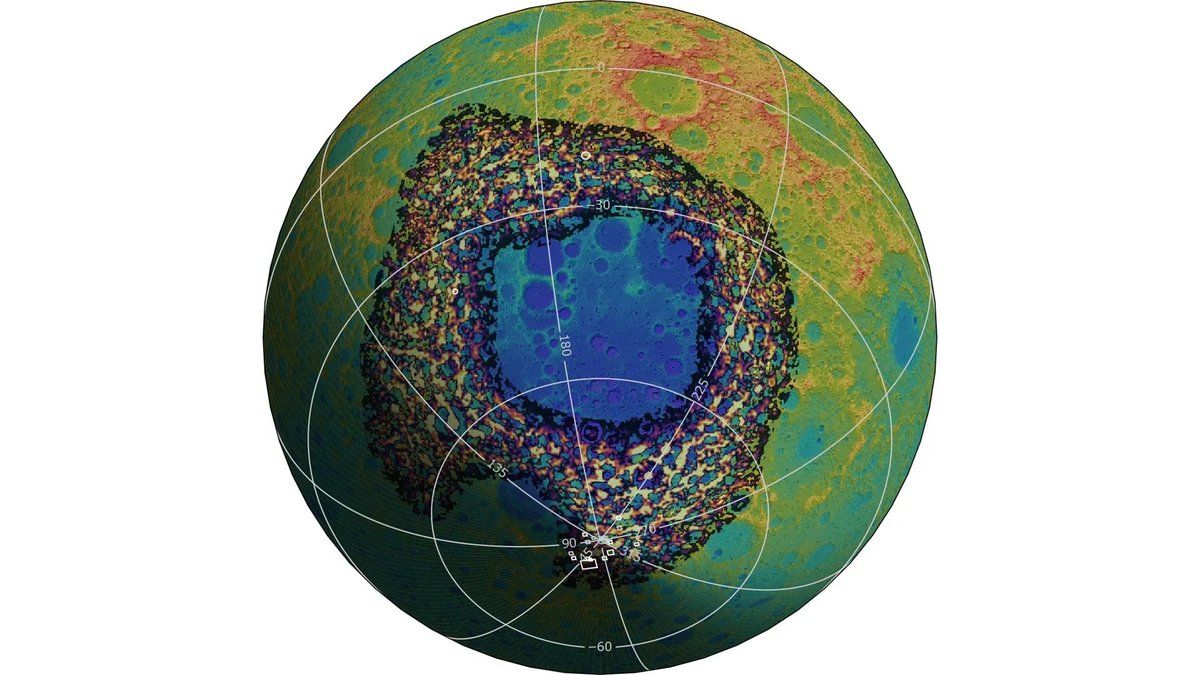
One striking clue comes from the basin’s shape. The South Pole-Aitken basin appears elongated and tapered, a geometry that points to an impact that arrived at a shallow angle. In the new modeling study, the best match came from an object traveling from the north toward the south.
Computer simulations allowed the researchers to test how different impact speeds, angles and directions would affect the basin. The goal was to reproduce the real shape and internal structure seen on the Moon today. The team found that a shallow, north-to-south collision could explain the basin’s tapered outline.
The study abstract describes the result this way: “SPA’s observed shape of an ellipse tapered toward the south is best reproduced by a 260-km-diameter differentiated impactor.” That sentence captures the central claim of the modeling work, which links the basin’s modern geometry to the ancient projectile’s size and direction.
The impact scenario also helps explain where debris went after the collision. A low-angle strike would have scattered material unevenly. Some material blasted outward. Some collapsed back into the basin. That mix of excavation and fallback is central to the new picture of where deep lunar material may be found today.
A vanished object with an iron core
The impactor in the simulation was a differentiated body. That means it had separated into layers before striking the Moon. Its interior likely included an iron-rich core surrounded by rock, much like a small protoplanet or a differentiated asteroid.
This detail matters because the projectile’s structure would have affected the collision. A layered object would deposit energy and material differently from a uniform rocky body. The modeled impact produced intense heating, deep excavation and a central region where rock melted.
The collision also would have been large enough to disturb both the lunar crust and material beneath it. The Moon’s surface was blasted open and debris from different depths became mixed. Over time, later impacts churned that material again and buried some of it beneath younger deposits.
That makes the modern basin a complicated archive. Rocks at or near the surface may have followed a long path. Some could have started deep below the crust, been launched by the South Pole-Aitken impact, fallen back and later been exposed by smaller craters. Each step changes the map that scientists must read.
Gravity maps reveal buried mantle material
The companion study in the Journal of Geophysical Research: Planets approached the same lunar mystery from a different direction. Instead of simulating the impact itself, researchers used gravity mapping to look for dense material hidden beneath the basin and its ejecta.
Gravity data can reveal buried structure because dense rocks tug slightly harder than less dense rocks. On the Moon, these tiny variations help researchers infer what lies beneath the surface. The team searched for patterns that could indicate material from deep inside the Moon mixed into the crust.
The analysis found an annular pattern of gravity anomalies around the basin’s rim region. The researchers interpreted this as evidence for an ejecta blanket enriched with dense, deeply sourced material. Their modeling suggested that the South Pole-Aitken ejecta blanket may contain millions of cubic kilometers of mantle-derived material.
Surface instruments can miss that kind of buried material. A thin covering of younger dust or impact debris can hide spectral signatures from orbit. Gravity offers a complementary view because it responds to mass below the surface, allowing researchers to look through the upper veneer of lunar regolith.
The study also reported that some later craters appear to have excavated into the sources of these gravity anomalies. That matters for future exploration because fresh crater walls and ejecta can act like natural drill sites. They may expose material that would otherwise remain buried.
Why Artemis landing sites matter
Future Artemis astronauts may work in a region where ancient basin debris, polar geology and exploration priorities overlap. The lunar south pole has attracted attention because some permanently shadowed areas may preserve volatile compounds. The new studies add another reason to care about the region, a possible connection to the Moon’s deep interior.
The modeling study suggests that Artemis landing sites near the south pole could contain abundant South Pole-Aitken ejecta. The gravity study also points to heterogeneity beneath the region. In simple terms, the ground may be a geologic mixture assembled by one of the largest collisions in lunar history.
That mixture could be scientifically valuable. If astronauts or robotic missions collect samples from the right sites, researchers may be able to identify material that originated below the crust. Even trace amounts could help reveal the chemistry of the lunar mantle.
The result also gives mission planners a sharper scientific map. Landing region studies already consider safety, lighting, communications, terrain and access to resources. Adding mantle-rich ejecta to the picture could help prioritize traverses, sampling stations and nearby craters worth visiting.
The studies remain model-based and data-driven interpretations. They point to promising targets rather than guaranteeing that astronauts will pick up pristine mantle rocks on the surface. Lunar material has been gardened by impacts for billions of years, so field context will be crucial.
Samples that could rewrite lunar history
Returned samples would provide the strongest test of the new picture. Laboratory measurements can determine mineral content, chemistry, ages and isotopic signatures with far greater precision than orbital data alone. If samples from Artemis regions contain South Pole-Aitken ejecta, they could anchor the basin’s formation age.
That age is a major prize. The South Pole-Aitken impact occurred early in lunar history, but pinning down the date would help calibrate the timeline of impacts across the inner solar system. The Moon preserves craters better than Earth because it lacks weather, oceans and plate tectonics.
Mantle-bearing samples would also speak to the Moon’s internal evolution. After the Moon formed, it likely had a global or near-global magma ocean. As that molten layer cooled, minerals crystallized and separated. The composition of mantle fragments could reveal how that process unfolded.
The findings also connect lunar geology with human exploration in a unusually direct way. The same region being considered for future crewed activity may contain debris from a basin-forming impact that reached deep into the Moon. That makes the south polar region a place where engineering goals and fundamental science could meet.
For now, the South Pole-Aitken basin remains a vast ancient scar with many buried secrets. The new simulations and gravity maps give scientists a more focused search plan. If Artemis astronauts collect the right rocks, they may bring home pieces of the Moon’s interior and a clearer story of how Earth’s nearest neighbor became the world we see today.