A study in Nature Astronomy has linked a high-energy neutrino detected by IceCube to a dust-hidden galaxy about 11 billion light-years away. The galaxy, formally known as JCMT0402−0424 and nicknamed Shadow Blaster, gives astronomers a striking new candidate for one of the Universe’s hardest-to-trace signals.
The finding matters because high-energy neutrinos are cosmic messengers that travel almost unhindered through space. They can point back to violent astrophysical engines, yet their sources are hard to pin down. In the paper’s words, “The origin of high-energy astrophysical neutrinos remains unresolved.”
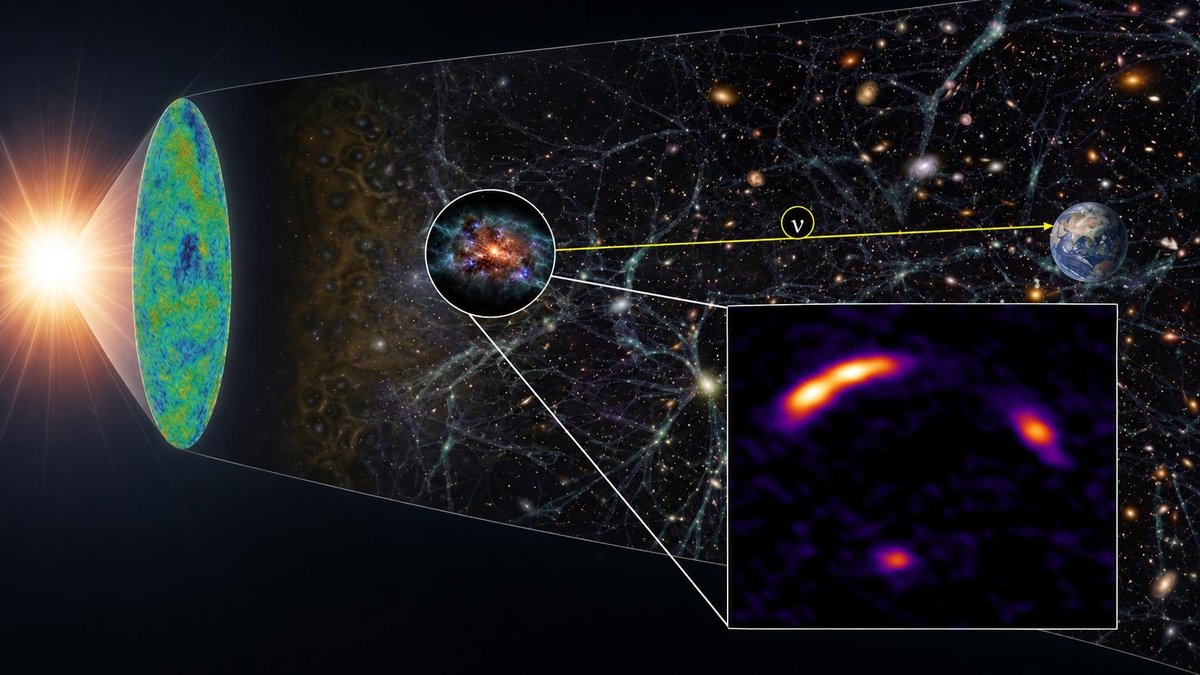
The international research team used ALMA, the Atacama Large Millimeter/submillimeter Array, along with other telescopes to follow up on the IceCube event IC 210922A. Their search led to a remarkably bright, dusty galaxy at a time known as cosmic noon, when star formation across the Universe was near its peak.
A neutrino trail leads to Shadow Blaster
The trail began with IceCube Neutrino Observatory, a detector buried deep in Antarctic ice. IceCube watches for faint flashes produced when neutrinos interact with matter near the detector. One such event, called IC 210922A, gave astronomers a patch of sky to investigate.
Within that region, the team identified JCMT0402−0424 as an unusually strong submillimeter source. Submillimeter light is especially useful for finding galaxies packed with dust. Visible light can be swallowed by that dust, while longer wavelengths escape and reveal the heat of hidden star-forming regions.
Shadow Blaster sits at a redshift of 2.988, which places its light roughly 11 billion years in the past. That distance makes the galaxy more than a target in the sky. It is a glimpse of an era when the Universe was building stars at a much faster pace than it does today.
The association is still framed carefully. The Nature Astronomy paper describes JCMT0402−0424 as the most plausible electromagnetic counterpart candidate within the IceCube localization. That language matters because neutrino astronomy often deals with large sky regions, rare events and faint follow-up signals.
ALMA used gravity as a cosmic magnifying glass
A fortunate alignment made Shadow Blaster easier to study. A galaxy between Earth and the distant source acts as a gravitational lens. Its gravity bends and amplifies the light from JCMT0402−0424, producing multiple enlarged images of the same background galaxy.
This lensing effect gave ALMA a natural boost. With the galaxy magnified, researchers could model its structure in far greater detail than distance alone would normally allow. The result was a sharper view of the galaxy’s dusty interior.
ALMA observes at millimeter and submillimeter wavelengths, which are well suited to cold dust and molecular gas. In galaxies like Shadow Blaster, those ingredients trace places where stars are forming behind thick curtains of material.
The team combined ALMA imaging with lens modeling to reconstruct the galaxy’s true shape and brightness. That step is essential because gravitational lenses distort what astronomers see. Once the distortion is modeled, the lens becomes a tool for studying a galaxy that would otherwise be far harder to resolve.
Star formation replaces the black hole clue
Known high-energy neutrino associations have often pointed astronomers toward active galactic nuclei. These are galaxies powered by feeding supermassive black holes. Such objects can launch jets and energize particles to extreme speeds.
Shadow Blaster followed a different physical path in the team’s interpretation. The observations highlighted intense star formation as the main source of the galaxy’s energy output. The paper reports a compact dusty star-forming galaxy with no bright gamma-ray or X-ray counterpart above the current sensitivity limits.
That matters because gamma rays and X-rays can reveal the energetic surroundings of a supermassive black hole. In this case, the multiwavelength evidence favored a galaxy whose dust and gas are being heated by furious star birth.
Starburst galaxies can also accelerate cosmic rays. When massive stars form rapidly, many soon explode as supernovae. Their shock waves can drive particles to high energies. In dense gas-rich environments, those particles can collide with matter and radiation, creating neutrinos as part of the particle cascade.
The key idea is simple. A compact starburst can act like a crowded particle factory. Cosmic rays have many chances to hit surrounding material before they escape, raising the likelihood that neutrinos will be produced.
A dense core may forge ghost particles
The ALMA data revealed a compact core inside Shadow Blaster. According to the study, a large amount of gas and dust is concentrated within a region about 1,500 light-years across. For a galaxy-scale structure, that is tightly packed.
Density is central to the proposed neutrino link. A diffuse galaxy lets more energetic particles leak away. A compact, dust-rich starburst gives those particles more targets. When high-speed cosmic rays encounter gas, they can generate unstable particles that decay into neutrinos.
Neutrinos are often called ghost particles because they barely interact with ordinary matter. Trillions pass through our bodies every second. That same elusive quality makes them valuable to astronomers. They can leave dense cosmic environments and travel across the Universe with little interference.
Shadow Blaster’s dusty nature also helps explain why such sources have been difficult to connect to neutrino events. Optical telescopes struggle when dust blocks starlight. Instruments such as ALMA can reveal the hidden heat and gas that define these galaxies.
The paper also places the galaxy in a broader population context. Compact-core dusty starbursts at cosmic noon may contribute a meaningful share of the diffuse high-energy neutrino background. The estimate discussed in the research reaches up to around 20% for this population.
A new path for neutrino astronomy
The discovery gives astronomers a new way to think about cosmic neutrinos. Instead of looking only for the brightest black-hole engines, researchers can also search for compact dusty starbursts that were common during the Universe’s peak star-forming era.
That shift expands the target list for future follow-up campaigns. When IceCube or future neutrino detectors spot an event, submillimeter observations may become especially important. A dusty galaxy can be faint in visible light while blazing in ALMA’s wavelength range.
The result also links particle astrophysics to galaxy evolution. Neutrinos could become probes of how stars, gas, dust and cosmic rays interacted billions of years ago. The paper describes the finding as “opening a new avenue to probe galaxy evolution and cosmic-ray acceleration across cosmic time.”
Several uncertainties remain. A single neutrino event and one plausible counterpart cannot define the whole population. The chance alignment probability, lensing reconstruction, source brightness and lack of stronger competing candidates all support the case for Shadow Blaster. More events will be needed to test how often compact dusty starbursts appear in neutrino localizations.
For now, Shadow Blaster gives astronomers a rare and vivid clue. A dust-wrapped galaxy from 11 billion years ago may be helping explain some of the most energetic particles ever detected on Earth and it shows how much of the high-energy Universe can stay hidden until the right wavelength finds it.