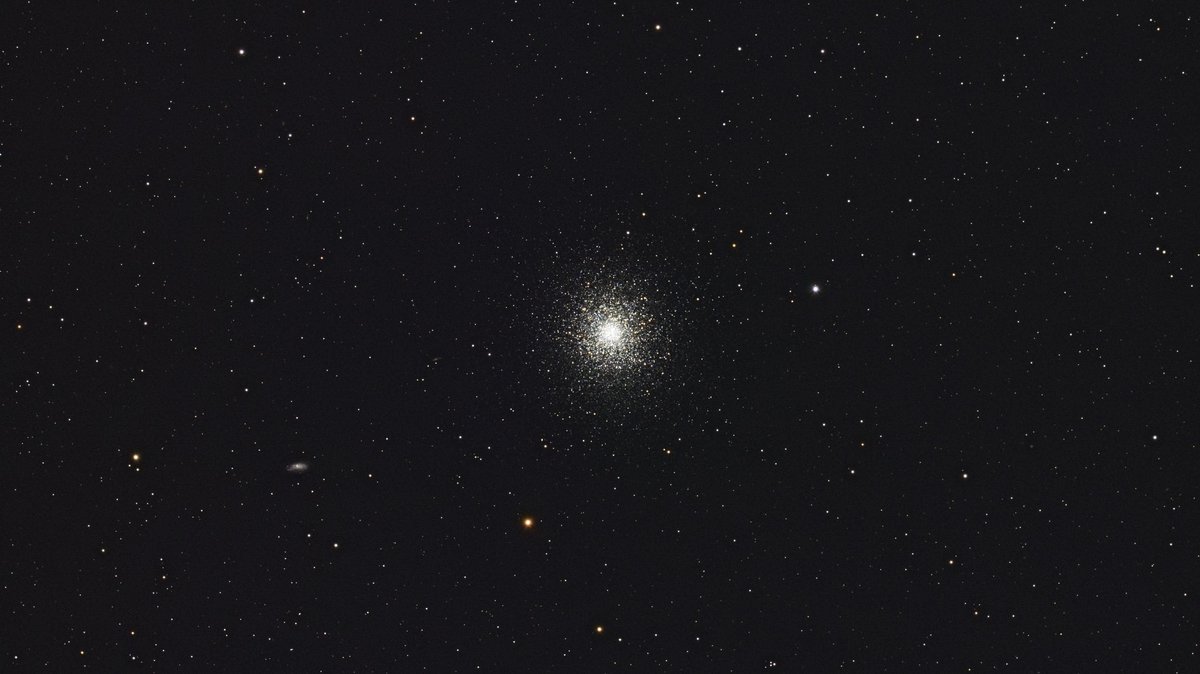
ESA/Hubble has released a new Hubble image of NGC 6723, a glittering globular cluster in Sagittarius that sits about 27,000 light-years from Earth. The scene looks delicate, but it belongs to one of the oldest classes of objects in the Milky Way. Inside its crowded glow, astronomers see evidence that this stellar “chandelier” formed through a more complicated history than a single burst of star birth.
The cluster, sometimes called the Chandelier Cluster, is packed with tens of thousands to millions of stars held together by gravity. Each point of light in the image is a star or a foreground object along the line of sight. Together they form a dense stellar swarm that has survived for more than 10 billion years.
Globular clusters like NGC 6723 matter because they act as ancient records. Their stars formed early in the Milky Way’s story, long before the galaxy settled into the familiar thin disk that contains the Sun. Hubble’s observations help astronomers read that record in color, brightness, chemistry and age.
A chandelier of stars 27,000 light-years away
At first glance, NGC 6723 earns its nickname easily. The Hubble view shows a field filled with bright points, some blue and concentrated toward the center, others orange and scattered toward the outskirts. The cluster appears like a hanging lamp studded with countless bulbs.
That glow comes from a real physical structure. A globular cluster is a tight collection of stars bound by their shared gravity. These systems are roughly spherical and their central regions can be so crowded that individual stars appear layered over one another from Earth’s point of view.
NGC 6723 lies in the constellation Sagittarius, the Archer. Its distance places it far across the galaxy from us, yet Hubble can still resolve many of its stars. That ability is essential because globular clusters reveal their history through the properties of individual stars.
The official ESA/Hubble release describes the object as an ancient inhabitant of our galaxy. That phrase fits the image well. The cluster shines with beauty and it also carries information from a time when the Milky Way was still assembling its earliest large stellar structures.
One of the Milky Way’s oldest stellar relics
More than 150 globular clusters are known in the Milky Way. Astronomers suspect additional ones may remain hidden behind thick dust or lost in crowded star fields. These clusters orbit in and around the galaxy and many belong to the oldest populations of stars we can study in detail.
NGC 6723 belongs to this ancient family. Globular clusters often have ages above 10 billion years and some approach the age of the universe itself. That makes them valuable cosmic clocks. Their stars preserve clues to the conditions that existed when the Milky Way was young.
For decades, astronomers often treated globular clusters as relatively simple systems. In that picture, the stars in a cluster formed together from the same original cloud of gas. A shared origin would mean similar ages and similar chemical compositions across the cluster.
Hubble and other telescopes have made that picture richer. Many globular clusters contain multiple stellar populations, which means their stars can carry subtle differences in chemistry or formation timing. Those differences give astronomers a way to reconstruct a cluster’s early life.
In NGC 6723, the mystery is especially compelling because the cluster looks orderly from afar. Hubble reveals that its smooth sparkle comes from stars with a layered past. The Chandelier Cluster is therefore both a showpiece and a scientific archive.
Hubble’s ultraviolet clue
One major step came from a broad Hubble observing program led by A. Sarajedini. That project used the telescope to study 65 Milky Way globular clusters in visible and near-infrared light. The survey gave astronomers a uniform way to compare many clusters across the galaxy.
Those observations helped researchers examine cluster ages and internal motion. They also supported studies of mass segregation, a process in which massive stars tend to sink toward a cluster’s center while lower-mass stars drift toward the outer regions. In a dense cluster, gravity slowly rearranges the stellar population over time.
A later Hubble program led by G. Piotto returned to many of the same clusters, including NGC 6723. This time, the work leaned on ultraviolet light. Ultraviolet observations are especially useful for teasing out faint chemical differences between stars that may look similar in visible light.
Hubble’s instruments captured the Chandelier Cluster through multiple filters, including ultraviolet wavelengths at 275 nanometers and optical bands at 336, 438, 606 and 814 nanometers. Combining those bands lets astronomers sort stars by color and brightness with exceptional precision.
That precision matters because chemistry leaves fingerprints in starlight. Small changes in a star’s ingredients can alter how it appears through different filters. When many stars in one cluster show patterned differences, researchers can infer that the cluster formed through more than one episode of star birth.
Two bursts of star birth inside one cluster
For NGC 6723, Hubble observations point to two closely spaced periods of star formation. According to ESA/Hubble, the second occurred within 634 million years of the first. In human terms, that is an immense span of time. For a cluster older than 10 billion years, it is a relatively short interval.
The result gives the Chandelier Cluster a two-part origin story. One generation of stars appears to have formed first, followed by another generation after the cluster had already begun its long life. The timing helps astronomers test ideas about how early star clusters retained or gathered gas.
This raises a key question. To make a second stellar generation, a cluster needs material that can cool and collapse into new stars. Astronomers study whether that material came from the first generation of stars, from gas left over after the first burst, or from gas pulled in later from the surrounding environment.
The details remain unsettled and that uncertainty is part of the importance of the finding. NGC 6723 gives researchers a concrete system where the evidence can be measured. Its stars preserve a timeline that telescopes can revisit with new tools and better models.
Hubble’s role is especially strong because it can separate stars in crowded fields and observe in ultraviolet light from above Earth’s atmosphere. Ground-based telescopes lose much of that ultraviolet information because our atmosphere absorbs it. In this case, space-based vision turns a crowded sparkle into a readable record.
Why globular clusters still puzzle astronomers
Globular clusters formed early, survived for billions of years and now orbit as dense stellar fossils. That combination makes them central to galactic archaeology. By studying clusters such as NGC 6723, astronomers probe how the Milky Way assembled its halo, bulge and older stellar populations.
Yet their formation remains difficult to explain in full. Clusters can contain multiple stellar populations, but they also appear compact and ancient. Any model must account for their old ages, their chemical patterns, their dense structure and their ability to survive repeated orbits through the galaxy.
The Chandelier Cluster adds another constraint. Its two periods of star formation were separated by less than 634 million years. That narrows the timeline for whatever process produced the second population. It also gives astronomers a way to compare NGC 6723 with other clusters studied in the same Hubble programs.
The scientific value of these Hubble surveys has been substantial. ESA/Hubble notes that the earlier survey inspired several hundred published research papers. A single beautiful image can therefore represent a much larger data set, one that continues to shape how researchers think about star clusters.
NGC 6723’s shimmering appearance makes it easy to admire. Its deeper value lies in the history encoded across thousands of stars. With ultraviolet measurements, visible-light images and careful comparisons across the Milky Way, Hubble is helping astronomers trace how some of the galaxy’s first stellar cities came to be.