Oceans

RSS Feed

Ocean science news, explainers, and statistics covering marine environments, currents, climate, coasts, seafloor research, and the changing global ocean.

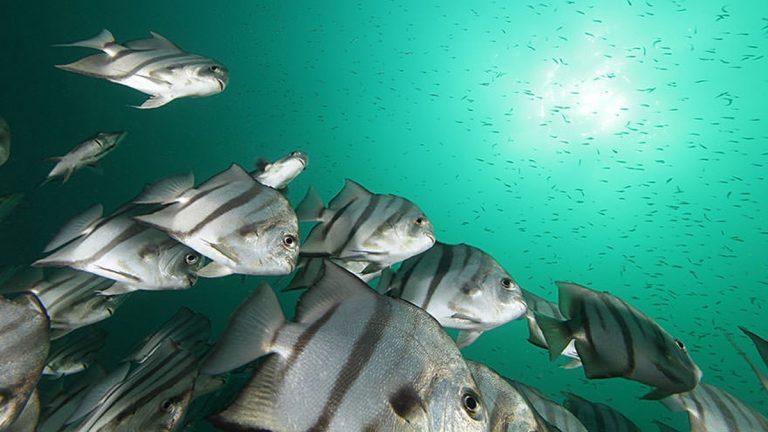
A school of reef fish swimming above corals in a marine ecosystem

Aquatic food chains

NOAA’s estuary food-pyramid material starts with a simple observation that governs ponds, rivers, marshes and seas: every bite carries energy that entered the ecosystem earlier. An aquatic food chain traces one possible route for that energy. A tiny alga may be eaten by a zooplankton animal, which may be eaten by a small fish, which…

More

More in Oceans

Aerial drone top down photo of beautiful paradise turquoise sea sandy beach and bay of Gidaki accessible by short hiking in beautiful Ionian island of Ithaki or Ithaca, Greece

What animals live on the beach?

At the edge of every wave, a busy animal community is easy to miss. Many beach residents are small, burrow quickly, or emerge after dark. Others arrive to feed, nest, rest, or pass through during migration. A beach is therefore more than open sand. It is a changing habitat shaped by tides, wind, salt and…

USS Thresher underway at sea on July 24, 1961

In 1963 USS Thresher disappeared during deep-diving tests 220 miles east of Cape Cod with 129 people aboard and the loss forced the U.S. Navy to rebuild submarine safety around SUBSAFE

One hundred twenty-nine people were aboard USS Thresher when the nuclear-powered attack submarine was lost in the Atlantic on April 10, 1963. The loss remains the deadliest accident in U.S. submarine history. It also left a lasting technical and human legacy, because the Navy rebuilt crucial parts of its approach to submarine design, repair, testing,…

Marie Tharp with Al Ballard and Marty Weiss during the 1968 USNS Kane expedition

In 1956, Marie Tharp published a hand-drawn North Atlantic seafloor map after recognizing a V-shaped rift in six depth profiles and its alignment with earthquake patterns helped reshape the evidence for a moving ocean floor

The Atlantic Ocean once hid its largest landscape in plain sight. Beneath the waves lay a long mountain chain, deep plains and a valley running along the middle of the ridge. In the early 1950s, Marie Tharp saw the clue in six ship-track profiles. Each showed a V-shaped dip near the center. Together, the marks…