Port is the left side of a vessel when you face forward toward the bow and starboard is the right side. The terms identify fixed sides of the boat, so they stay the same when a person turns around. Mariners use them for clear instructions and collision avoidance; the terms also appear on equipment labels and in reports where an ordinary “left” or “right” could depend on someone’s viewpoint.
NOAA’s port and starboard history explains that starboard grew from Old English words associated with steering and the side of a boat. Remember the orientation by standing as though you are looking in the vessel’s normal direction of travel. Port is left; starboard is right.
Why ships need fixed side names
Picture two crew members facing each other on deck. Each person’s left points in a different direction, while the vessel’s port side remains fixed. An instruction to move a line to port names one side regardless of where the speaker stands. The same clarity helps bridge teams describe another ship, a damaged compartment, or a person in the water.
Fixed terms also connect words to plans and equipment. Fire-control diagrams, ballast tanks, lifeboats, engines and navigation lights are labeled by vessel side. “Port engine” means the engine installed on the left when facing forward, even if a mechanic approaches it from the stern. Consistent labels reduce the mental conversion required during routine work and emergencies.
Bow and stern complete the basic orientation. The bow is forward and the stern is aft. A location can therefore be described as “port quarter,” meaning the rear area on the port side, or “starboard bow,” meaning the forward area on the right. Such combinations give a quick shared map without relying on a crew member’s current position.
Plans often add a centerline and numbered frames to make locations more exact. A report can place damage on the port side at a particular frame instead of sending a team to search an entire deck. The fixed vocabulary also carries from exterior spaces into compartments, where the bow may be out of sight and a person’s body orientation offers no reliable cue.
Where the words came from
Early vessels were often steered with a large oar mounted on the right side near the stern. Old English terms for steering and the side of a boat combined into the ancestor of starboard. Keeping that steering oar away from a quay made the opposite side the practical side for loading and unloading.
The left side was once called “larboard,” probably from a word connected with loading. Larboard sounded too much like starboard, especially in wind or noise, so “port” became the standard alternative. Port referred to the side commonly brought alongside the port for cargo work. The replacement reduced the chance that a shouted order would be misheard.
Modern ships usually steer with centerline rudders, azimuthing drives, or other systems, yet the older side names remain useful. Their survival comes from precision rather than nostalgia. The same vocabulary appears in maritime regulations and charts as well as radio calls and training across many vessel types and languages.
The loading-side explanation also clarifies why “port” replaced larboard without defining every ship’s docking practice today. Modern vessels can berth on either side as the terminal and operation require. The name remains a historical term for the vessel’s left side, while the actual berthing side changes from call to call.
Red and green identify the sides at night
Vessels underway display colored sidelights that reveal their orientation after dark or in restricted visibility. Under the U.S. Coast Guard’s navigation rules, the port sidelight is red and the starboard sidelight is green. Each covers a defined arc from directly ahead to slightly behind the beam on its own side.
Seeing only a red sidelight generally means the other vessel is showing its port side to you. A green sidelight presents its starboard side. Seeing both red and green near the bow indicates a vessel approaching from ahead. Masthead and stern lights add information and the full light pattern must be interpreted under the applicable collision regulations.
Color is a memory aid, but it is also an operating signal. “Red, right, returning” refers to buoyage in IALA Region B, not to the ship’s sidelights, so learners should keep the systems separate. The Coast Guard Light List guidance explains that red and green aids have lateral meaning in marked channels.
The formal sidelight arc is 112.5 degrees. Each light shines from directly ahead to 22.5 degrees abaft the beam on its own side. Beyond that point, a vessel’s white sternlight helps reveal the view from astern. Distance and background lights can make identification difficult, so a lookout considers the complete pattern and its movement over time.
Simple ways to remember port and starboard
The shortest mnemonic is that “port” and “left” each contain four letters. Many people also connect port with red wine, matching the red port light. Mnemonics help during learning, while regular use eventually makes the terms automatic. Always anchor the answer to a forward-facing view before applying the memory trick.
A practical exercise works better than memorizing words alone. Stand facing the bow, point left and say “port”; point right and say “starboard.” Repeat from several places while still imagining the forward view. Then identify the red and green sidelights. Physical orientation builds the mental map used when visibility, noise, or time pressure makes hesitation costly.
Models and diagrams should show the vessel from above with the bow clearly marked. Without a bow arrow, left and right on a page can be ambiguous. On a real boat, permanent labels and colored fittings offer cues, yet they should confirm an orientation already understood rather than replace it.
Another useful check is the sequence of a spoken instruction. Repeat the order using the same side word, then point or act only after the direction is clear. On professional vessels, closed-loop communication lets the person giving the order hear whether it was understood correctly. A mnemonic starts learning; standard phraseology carries the safety work.
How the terms are used underway
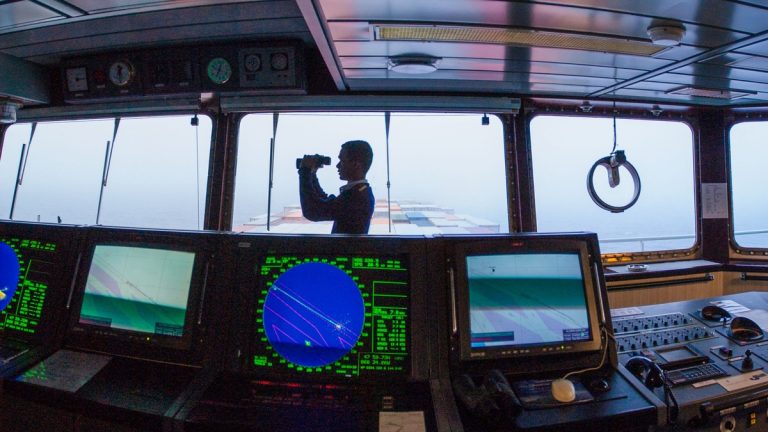
A helm order such as “starboard ten” tells the helmsman to apply a specified rudder angle toward starboard, subject to the vessel’s procedures. Lookouts report contacts by relative bearing or by side, such as a light off the port bow. Deck crews use the words when handling fenders, mooring lines, anchors and rescue equipment.
Passing situations add another layer. Mariners should follow the formal navigation rules instead of assuming that “pass on the left” describes the same maneuver from both vessels. Radio communication names the vessel, proposed action and relevant side clearly. Local rules and traffic services may provide additional instructions in busy waterways.
Passengers may hear “port side” in cabin directions or announcements. The definition is identical on a ferry, cruise ship, sailboat, kayak, or naval vessel. A boat’s direction of forward travel establishes the frame even when it is moving astern. Turning your body never swaps the vessel’s port and starboard sides.
The terms also remain fixed when a vessel changes heading. If a boat turns through 180 degrees, port still names the same physical side of its hull, even though that side now points toward a different compass direction. Relative orientation and compass bearing answer different questions, which is why mariners may state both when precision is needed.
The core answer stays compact: face the bow, then port is left and starboard is right. Their fixed meaning supports a wider safety language that covers lights and bearings as well as maneuvers and labeled systems. Once the forward frame is clear, every use follows from the same stable orientation.
Related reading: bathymetry and ocean depth and tide tables and tide charts.