The ocean carbon cycle moves carbon among the atmosphere, surface seawater, marine life, the deep ocean and seafloor sediments. Carbon dioxide crosses the air-sea boundary, reacts with seawater, enters food webs through photosynthesis and can sink in particles or travel downward with currents. Some returns quickly to the air, while some remains below for centuries or longer.
NOAA’s carbon cycle overview describes the ocean as a major carbon reservoir that continually exchanges carbon with the atmosphere. The cycle draws on physical and chemical processes as well as biology. Its pathways regulate climate and supply the raw material for life while linking changing atmospheric carbon dioxide to ocean acidification.
Carbon dioxide crosses the ocean surface
Gas molecules constantly move between air and water. The net direction of air-sea carbon exchange depends largely on the difference in carbon dioxide pressure across the surface. If surface seawater holds less carbon dioxide than the air would support, the ocean absorbs more. If it holds more, carbon dioxide escapes back into the atmosphere.
Wind and waves speed the exchange by renewing the thin layer at the surface. Temperature matters because cold water can hold more dissolved gas than warm water. High-latitude oceans therefore tend to absorb carbon effectively, although biology and circulation can reverse the local balance at different times of year.
NOAA’s Pacific Marine Environmental Laboratory explains air-sea gas exchange as a physical and chemical process influenced by concentration differences and the rate of transfer. Surface water does not equilibrate instantly. Seasonal plankton growth, mixing and currents create large regional changes in carbon dioxide.
Human emissions have raised atmospheric carbon dioxide, increasing the amount entering the sea. Ocean uptake slows the buildup in the atmosphere, but it changes seawater chemistry. The absorbed carbon remains part of an active system, not a permanently locked deposit. Its eventual path depends on reactions and transport below the surface.
Researchers estimate the net exchange by combining ship and buoy measurements with wind, temperature and atmospheric data. Coverage is uneven because the ocean is vast and conditions change quickly. Statistical maps fill gaps, while repeat observations test trends over time. Uncertainty is largest where sampling is sparse or strong seasonal swings are poorly resolved.
Seawater chemistry stores carbon in several forms
Dissolved carbon dioxide reacts with water to form carbonic acid, which can release hydrogen ions. Most dissolved inorganic carbon in seawater exists as bicarbonate ions, with smaller shares as carbonate ions and dissolved carbon dioxide. Chemical balance among the forms allows the ocean to hold far more carbon than simple gas dissolution alone would permit.
Total alkalinity describes seawater’s capacity to neutralize acid and helps determine how carbon is divided among chemical forms. It is influenced by salts, river inputs, biological production and seafloor processes. Scientists measure at least two carbonate-system variables, then calculate the others to characterize conditions with known chemical relationships.
As more carbon dioxide dissolves, hydrogen-ion concentration rises and pH falls. Hydrogen ions also react with carbonate, reducing the carbonate available to organisms that build calcium carbonate shells or skeletons. NOAA’s ocean acidification program tracks this linked chemical response in ocean observations.
The ocean remains alkaline on average, yet its direction of change is toward higher acidity. The pH scale is logarithmic, so a small numerical decline represents a larger proportional change in hydrogen ions. Carbon storage and acidification are therefore two consequences of the same uptake process, with different implications for climate and marine organisms.
The biological pump moves carbon downward
Phytoplankton use sunlight to convert carbon dioxide and water into organic matter. Some of that carbon passes to grazers and predators; much is respired back into carbon dioxide near the surface. Dead cells, fecal pellets and other particles sink, carrying a fraction below the sunlit layer. Scientists call this transfer the biological carbon pump.
Most sinking organic matter is eaten or decomposed before it reaches the seafloor. Microbial respiration releases dissolved carbon dioxide at depth, where it can remain isolated from the atmosphere until circulation returns the water upward. Fast-sinking particles and deeper remineralization generally extend the storage time.
Particle size and composition influence how far carbon sinks. Dense mineral fragments can add ballast, while grazing packages tiny cells into faster-sinking fecal pellets. Zooplankton also migrate downward and respire carbon at depth. Measurements from sediment traps capture part of the flux, but swimmers and currents can bias what a trap collects.
Some organisms build calcium carbonate. Their shells add dense mineral material to sinking particles, but calcification also changes surface carbonate chemistry and can release carbon dioxide locally. The carbonate counter pump means shell production cannot be counted as simple carbon removal without considering the full chemical balance.
Only a very small fraction of biological carbon becomes buried in marine sediment for geologic periods. Burial is slow but durable. Over millions of years, weathering, sediment formation, plate tectonics and volcanism connect ocean carbon with Earth’s rock cycle. The everyday ocean pump operates much faster than those geologic pathways.
Currents create a physical carbon pump
Cold surface water absorbs carbon dioxide and can become dense enough to sink at high latitudes. Deep and intermediate waters then carry dissolved carbon through the ocean interior. This solubility pump links gas exchange to overturning circulation. Carbon remains away from the atmosphere while the water mass travels below.
Ocean upwelling brings deep water back toward sunlight. Because respiration has enriched that water in dissolved carbon, some regions release carbon dioxide when it reaches the surface. Phytoplankton can consume part of the supply. The local result depends on temperature, wind, nutrient use and the carbon concentration of the arriving water.
Mixing also moves carbon across layers without a water mass sinking all the way from the surface. Storms deepen the mixed layer, eddies exchange water across fronts and small-scale turbulence crosses density boundaries. Models need observations of each process to estimate how quickly absorbed carbon enters long-term interior storage.
Storage time is a range rather than a single number. Carbon in surface water may return to the air within months, while carbon carried into the deep ocean may remain there for centuries. Burial in sediment can last far longer. Calling the ocean a sink describes a net transfer, not a guarantee about each carbon atom.
Coasts add blue carbon and complexity
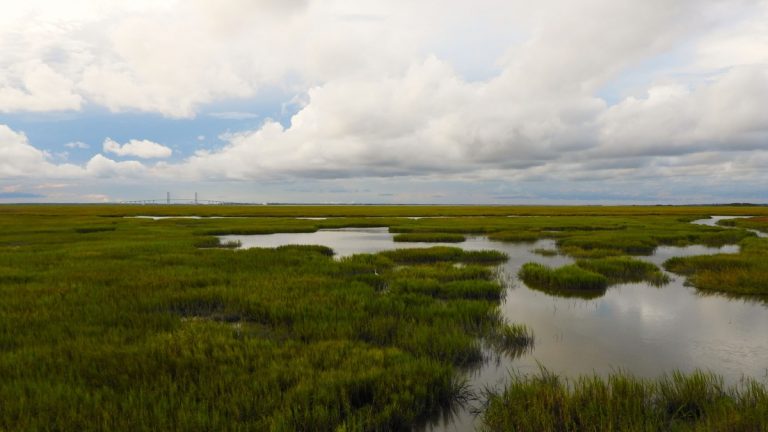
Mangroves, salt marshes and seagrass meadows capture carbon through photosynthesis and trap organic matter in waterlogged soils. Low-oxygen sediment can slow decomposition, allowing carbon to accumulate. This stored material is called coastal blue carbon. Protecting intact habitat helps preserve both continuing uptake and existing soil stocks.
Coastal waters also receive carbon and nutrients from rivers, groundwater, wetlands and human discharges. Tides move material between land and sea, while waves can erode sediment. A restored wetland may build soil in one place and export dissolved carbon elsewhere. Complete accounting must track boundaries and time scales carefully.
Damage to vegetated habitats can expose buried organic material to oxygen, accelerating decomposition and releasing carbon dioxide. Restoration can recover storage functions, but rates vary by ecosystem and site history. Methane and nitrous oxide may also influence the climate balance, particularly where salinity or nutrient conditions favor their production.
The ocean carbon cycle responds to warming, circulation change, ecosystem shifts and rising atmospheric carbon dioxide. Scientists monitor carbon with ships, buoys, autonomous vehicles, satellites and laboratory measurements. Following the full cycle prevents one pathway from being mistaken for the whole story and reveals where carbon moves after the ocean absorbs it.
Related reading: marine snow and coastal blue carbon.