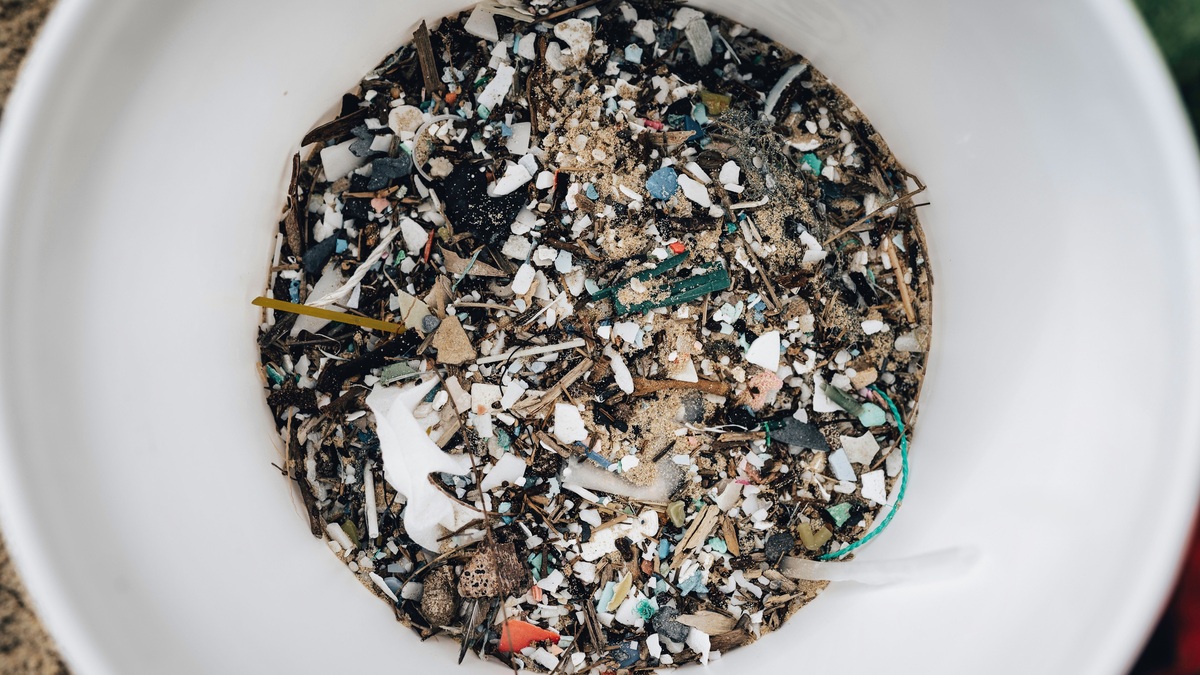
Microplastics are plastic particles smaller than five millimeters, roughly the width of a pencil eraser or less. Some are manufactured at a tiny size. Many begin as larger objects that crack and fragment under sunlight, heat, abrasion and mechanical stress.
NOAA uses the five-millimeter threshold in its microplastics definition. The category covers particles with different shapes, polymers and chemical additives. Their variety complicates efforts to compare how much is present or what biological effects a sample may cause.
These particles have been detected in seawater, freshwater, sediment and living organisms. Detection alone does not establish a particular health effect. Risk depends on exposure, particle properties and what happens after the material enters a body or ecosystem.
Primary and secondary particles have different origins
Primary microplastics are produced at a small size for a specific use. Examples include industrial resin pellets and some particles designed for products. U.S. law restricted plastic microbeads in rinse-off cosmetics, but primary particles still have other industrial sources.
Secondary microplastics form when larger plastic breaks apart. Ultraviolet light can weaken chemical bonds at an exposed surface. Waves and sand then flex or abrade the brittle item, producing progressively smaller fragments.
Synthetic textiles release fibers during wear and washing. Tires shed particles against roads and runoff can carry some of that material toward waterways. Paint, coatings and degraded fishing gear add particles with different compositions.
The distinction identifies a pathway rather than an appearance. Once weathered, a manufactured bead and a fragment may both be hard to trace to one product. Shape, polymer chemistry and additives provide clues, but source attribution often remains uncertain.
Size changes where particles travel
Density influences whether plastic floats, stays suspended or sinks. Polyethylene and polypropylene are less dense than seawater when clean, while other polymers sink more readily. Biological growth can coat a floating piece and increase its effective density.
Rivers and stormwater move land-based particles to coasts. Winds can transport lightweight fibers through the atmosphere. In the ocean, currents disperse material while convergence zones concentrate some floating fractions.
Wave mixing pushes particles beneath the surface and marine snow can carry them downward with organic matter. Bottom currents may later move sediment-bound plastic. A single particle can therefore change position as it weathers or gains and loses biological coating.
Further fragmentation creates nanoplastics. The U.S. Environmental Protection Agency’s microplastics research program describes nanoplastics as particles smaller than one micrometer. Their detection requires different instruments from those used for visible fragments.
Scientists need several methods to count them
Surface-water studies often tow a fine mesh net, then examine the retained material. The mesh misses particles smaller than its openings and may undercount fibers that pass through. Pumped samples can target smaller sizes but usually represent less water.
Sediment and biological samples contain organic material that must be separated without damaging the plastic. Density solutions, digestion and filtration prepare a sample. Researchers then use microscopy or spectroscopy to distinguish plastic from sand, shell and natural fibers.
Infrared and Raman spectroscopy identify polymers by how their molecules interact with light. Thermal methods measure characteristic breakdown products. Each technique has size limits and potential contamination, so clean blanks and standardized reporting are essential.
The EPA notes a pressing need for reproducible collection and identification methods. Results expressed as particles per liter cannot be compared directly when studies use different minimum sizes. Standardized sampling makes trend detection more reliable.
Animals encounter microplastics in food and water
Plankton, shellfish, fish and seabirds can ingest particles directly or through prey. The outcome varies from rapid passage to longer retention. Laboratory studies have reported physical or chemical effects under some conditions, but experimental concentrations do not always match environmental exposure.
Particle shape can influence interaction with tissue. Fibers behave differently from smooth beads and sharp fragments may create different mechanical stress. Polymer additives or pollutants attached to a surface add chemical questions beyond the particle itself.
Scientists also study effects on growth, reproduction, behavior and inflammation. A statistically detectable response in one species cannot automatically be applied to another. Field populations experience many pressures at once, which makes the contribution of microplastics difficult to isolate.
Human exposure occurs through food, water and air. Evidence that particles enter the body has prompted research, yet the dose and health significance remain active questions. Careful reporting separates detection from demonstrated harm.
Reducing inputs begins before fragmentation
Once plastic disperses at microscopic sizes, recovering it from open water is technically difficult and may disturb plankton. Measures closer to the source can intercept larger material before it fragments. Waste collection and litter prevention address multiple pathways at once.
Filters and improved treatment can capture some fibers or particles, although performance depends on size. Product redesign can reduce shedding. Management also targets lost fishing gear and pellets released during manufacturing or transport.
The UNEP global assessment emphasizes evidence about sources, fate and effects as a basis for policy. Controls work best when monitoring identifies the dominant local pathway rather than treating all microplastics as interchangeable.
Microplastics are defined by size, but their behavior depends on much more. Shape, chemistry and weathering influence transport and biological contact. Better measurement remains central to determining which sources create the greatest risk and whether prevention changes environmental concentrations.
Human health evidence is still developing
Researchers have detected plastic particles in human samples, but detection answers only the first question. A health assessment also needs reliable information about dose, particle size, route of exposure and biological response.
Nanoplastics may behave differently from larger microplastics because very small particles can interact with cells in different ways. Measuring them is difficult and contamination from laboratory air or equipment can create false signals without strict controls.
Experimental studies test possible inflammation, cellular uptake and clearance. A result at a high laboratory concentration does not establish harm from everyday exposure. Scientists compare experimental doses with measured environmental levels before drawing risk conclusions.
Public-health language should therefore separate presence, hazard and risk. A substance may produce an effect under certain conditions, while real-world risk also depends on how much exposure occurs. Dose-response evidence remains a major research need.
Policy can target a particle’s life cycle
Controls on intentionally added microbeads addressed a clearly defined product source. Fibers and tire wear are more diffuse because they arise during normal use. Their reduction may require changes in material design, capture technology and transport systems.
Wastewater treatment removes a large share of many particles, but captured material can move into sewage sludge. The final outcome depends on how sludge is managed. Stormwater often bypasses the same treatment steps.
Monitoring can show whether a measure reduces a specific polymer or shape. Counting every particle together may hide progress if one source falls while another rises. Source-focused indicators make policy evaluation more informative.
Labels such as biodegradable or compostable require the right conditions to describe real breakdown. A material designed for an industrial facility may persist in cold seawater. Testing should match the marine setting before a product claim is used to predict environmental fate.
International definitions also need compatible size ranges and units. Comparable data let researchers see whether a control changes concentrations across a watershed rather than at one sampling point. They also expose uncertainty instead of hiding it behind a single total. Laboratories can support comparison by reporting recovery tests, contamination blanks and the smallest particle their instruments reliably identify, details that determine what a published concentration actually represents. Without them, reported totals can look falsely precise to readers.
Related reading: how much plastic is in the ocean and flotsam and jetsam.