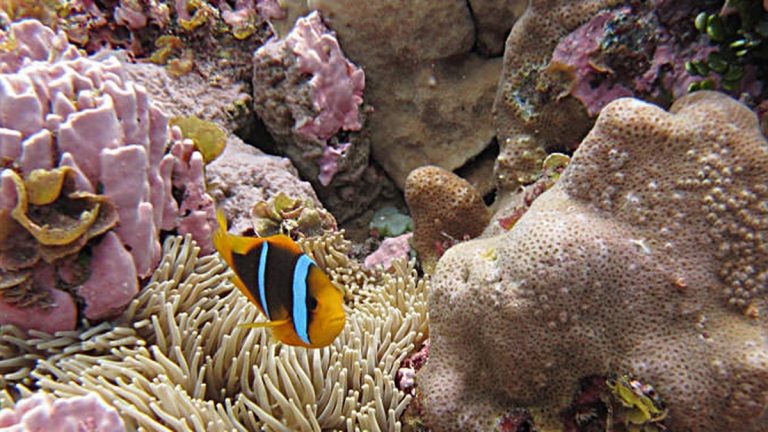
On certain nights, a reef that seemed still can release clouds of eggs and sperm into the water within minutes. This coordinated event is coral spawning, a form of sexual reproduction that lets attached colonies exchange genes across the reef. The timing concentrates compatible gametes in the same place before currents and predators remove them.
Broadcast spawning is only one route through the coral life cycle, but its scale makes it the most visible. NOAA’s coral spawning account describes buoyant gametes rising through the water and joining near the surface, where fertilized embryos begin developing into free-swimming larvae.
Attached animals solve a reproductive problem
Adult coral colonies remain fixed to the seabed, so they cannot travel to find mates. Many species solve this problem by releasing reproductive cells into the surrounding water. Eggs and sperm from different colonies can then meet outside the body, producing offspring with new combinations of genes.
A large share of stony coral species are broadcast spawners. Some colonies produce both eggs and sperm, often packaged together in bundles, while other species have separate male and female colonies. The details vary, but successful fertilization depends on compatible cells arriving close together in time.
Corals can also reproduce asexually when new polyps bud from existing ones. Fragmentation may allow part of a colony to establish elsewhere if it survives. Those clonal routes expand a successful genotype, while sexual reproduction creates genetic variation that can influence how future colonies respond to disease or environmental stress.
Some species package eggs and sperm together, while others release one type of gamete from each colony. Bundles float upward before separating, which can reduce immediate self-fertilization and place cells near gametes released by neighbors. Species-specific compatibility mechanisms further influence which encounters produce embryos.
Environmental cues set the calendar
Mass spawning is synchronized through a hierarchy of environmental signals. Seasonal water temperature and changing day length can help set the broad reproductive period. The lunar cycle narrows the window and the time after sunset can provide the final cue for release.
Different reefs spawn in different months because seasons and species composition vary across regions. Even neighboring species may release gametes on separate nights or at different times during the same evening. Such spacing can reduce crosses between incompatible species while preserving enough overlap for fertilization within a species.
The NOAA coral reproduction tutorial explains that long-term timing may involve temperature or day length, while lunar cues often guide short-term preparation. Sunset then helps coordinate the final release. Scientists still study how corals sense and combine those signals.
Light-sensitive proteins and internal biological clocks are likely parts of the mechanism, but the same cue does not control every coral. Local observations remain essential for predicting a specific reef’s spawning night.
Weather can complicate an otherwise reliable forecast. Wind and waves disperse surface slicks, while cloud cover changes nightly light. Researchers combine long-term observations with temperature records and lunar dates, then watch colonies for visible signs that egg-sperm bundles have moved toward the mouth.
Gametes rise and fertilization begins
Many coral eggs contain lipids that make them buoyant. After release, egg-sperm bundles float toward the surface and break apart, increasing contact among gametes from separate colonies. The water can fill with pale pink or colored particles that resemble an underwater snowstorm.
Synchrony raises the concentration of coral gametes during their brief period of viability. It can also overwhelm predators that eat eggs and larvae. Plenty are still lost, but mass release improves the odds that some sperm encounter eggs before both disperse too widely.
Fertilization produces an embryo that divides repeatedly and develops into a planula. Because fertilization and early development occur in open water for broadcast spawners, temperature, water quality and currents can strongly influence survival.
Eggs from the same colony may be poor matches for its own sperm, depending on the species. Dense synchronized release increases encounters among different parents and supports cross-fertilization. The resulting genetic recombination distinguishes sexually produced recruits from clonal fragments.
Currents carry the next generation
Surface slicks can drift away from the parent reef as fertilization continues. Their direction and speed offer a visible clue to dispersal, although larvae later swim vertically and experience changing currents. Oceanographic models help estimate which reefs may exchange offspring.
Sampling the slick lets researchers measure fertilization and early embryo development. Repeated collections through the night show whether development remains synchronized and whether heat or poor water quality coincides with abnormal cells.
Timing remains essential.
Fertilization requires compatible gametes to meet quickly.
Planula larvae search for a home
A planula larva is a small mobile stage covered with hairlike cilia. It can swim, respond to light and move vertically while currents carry it horizontally. Time in the plankton differs among species, ranging from a short local journey to dispersal across much greater distances.
Eventually, a larva must find hard substrate with suitable chemical and biological conditions. Crustose coralline algae and microbial films can provide settlement cues for some species. Thick sediment or unstable rubble makes attachment difficult, while competition from fleshy algae may reduce open space.
After settlement, the larva metamorphoses into a polyp and begins secreting skeleton. Budding adds genetically identical polyps and a colony slowly takes form. The Flower Garden Banks sanctuary describes connected polyps as a living mat over a shared calcium carbonate foundation.
Most larvae never reach a successful adult colony. Predation, starvation and unsuitable substrate take a heavy toll. Reef renewal depends on the small fraction that survive each transition.
Settlement is only the beginning. A new polyp must survive grazing, sediment and competition while building its first skeleton. Early mortality remains high after attachment, so scientists track recruits beyond the first appearance to measure whether successful recruitment is occurring.
Brooding corals follow a different route
Some coral species fertilize eggs internally and release developed planulae rather than broadcasting separate eggs and sperm. These brooding corals often release larvae that are ready to settle sooner, so their offspring may remain closer to the parent reef.
Broadcast spawning favors wide dispersal and large pulses of offspring, while brooding can provide more developed larvae with a shorter exposed period in the plankton. Neither strategy guarantees success. Each represents a different balance between offspring number, development and movement.
A reef may contain species using both strategies and some corals can vary reproductive mode. Restoration teams need species-specific knowledge when collecting spawn or choosing sites for larval settlement.
Spawning observations support reef restoration
Researchers predict spawning nights so they can collect gametes without removing adult colonies. Eggs and sperm from multiple parents can be mixed under controlled conditions and the resulting larvae are raised through their vulnerable early stages. Juvenile corals may then be settled on prepared surfaces for deployment to reefs.
Sexual propagation can preserve or expand genetic diversity, which is valuable when restoration has relied heavily on fragments from a small number of colonies. NOAA Fisheries’ coral restoration work combines propagation with efforts to recover threatened reef-building species.
Warm-water events can disrupt reproduction long before a colony dies. Bleaching reduces energy available for making gametes, while acidification may affect growth and early development. Poor water quality can also interfere with fertilization or larval settlement.
Watching a mass spawn therefore offers more than a spectacle. It reveals whether adult colonies remain reproductively active, supplies larvae for experiments and lets scientists test how well the next generation can establish. The brief release connects the visible reef to a long, uncertain process of renewal.
Related reading: mesophotic coral ecosystems and artificial reefs.