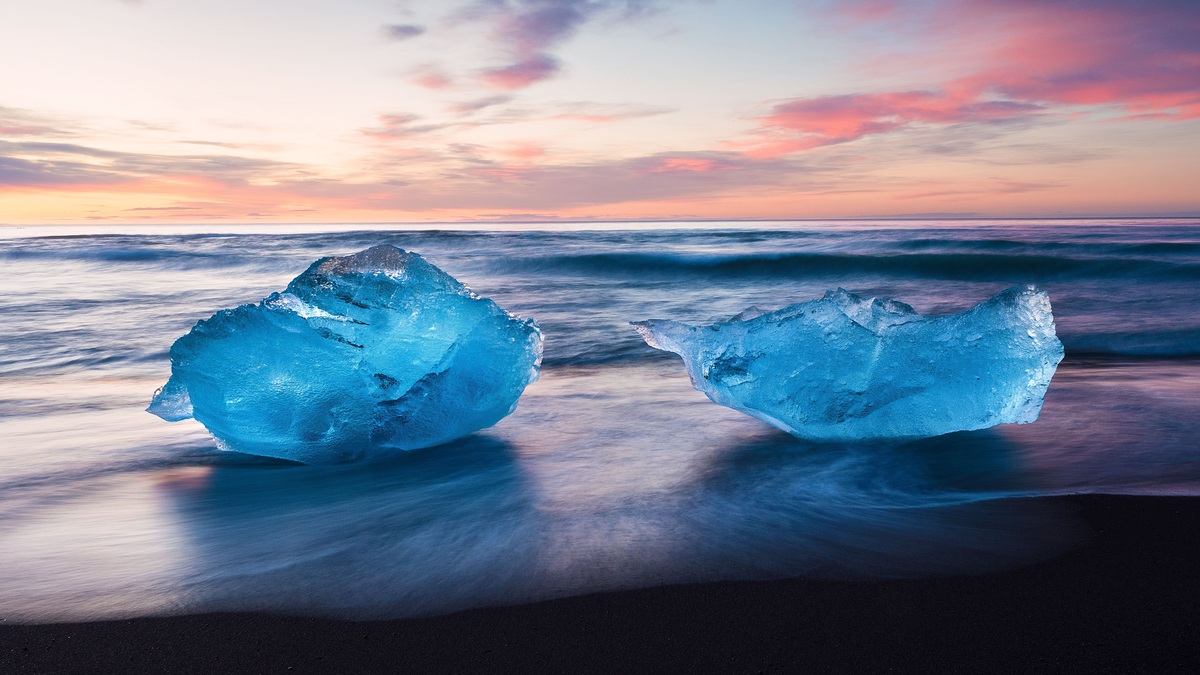
Most icebergs appear white, yet some glow blue, carry green bands, or show dark stripes of sediment. The colors record differences in air bubbles, crystal structure, algae, minerals and the path light takes through the ice. A berg’s appearance can therefore reveal something about the ice before it broke away from a glacier.
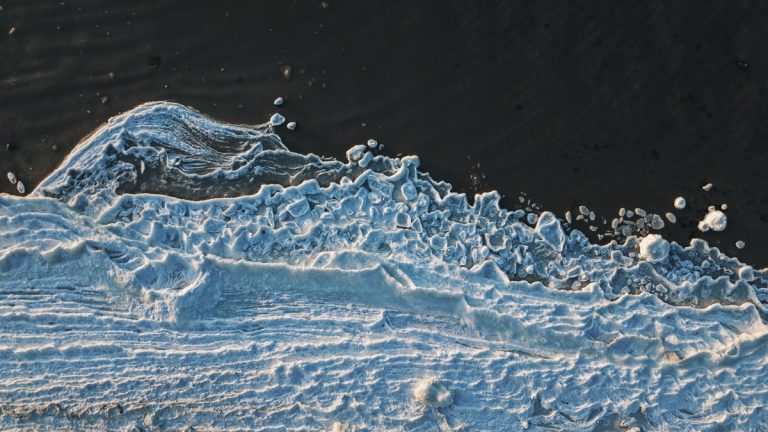
NOAA’s explanation begins with a simple contrast. Snow compressed near the surface contains many tiny bubbles and crystal boundaries that scatter visible wavelengths together, producing white. Dense glacial ice has lost much of that trapped air, allowing light to penetrate farther and favoring blue wavelengths.
Color can shift with weather and viewing conditions. Wet ice looks darker than dry snow, while low sunlight may add warm tones to a scene. The ocean and sky also influence photographs through reflections. Scientists distinguish these temporary optical effects from bands and layers held inside the ice itself.
Color changes as an iceberg moves
The visible face is only a changing sample of the iceberg. Waves melt an underwater notch, fractures spread and the berg may roll as its balance changes. A surface that was hidden below the sea can suddenly face the sun, exposing dense basal ice or material frozen onto the bottom of an ice shelf. The new orientation explains why one iceberg can present several colors during its life at sea.
Researchers read color together with texture and position. Smooth blue ice suggests a long path through compact crystals, while a green or brown band calls for chemical sampling. Spectrometers can measure which wavelengths a surface reflects and laboratory analysis can identify organic compounds or mineral grains. Visual evidence directs the investigation but rarely proves a cause alone.
Air bubbles make young ice look white
Fresh snow consists of delicate ice crystals with air filling the gaps. As more snow falls, pressure rounds the grains and transforms older layers into firn, an intermediate material between snow and glacier ice. Bubbles remain common during this stage and each boundary redirects incoming light.
When many wavelengths scatter back toward an observer in similar amounts, the combined light appears white. The same principle makes foam and clouds look pale even though water and clear ice are transparent. A white iceberg surface often contains recent snow, weathered ice, or a network of small cracks.
The National Snow and Ice Data Center notes that glacial ice often looks blue after it becomes dense and loses bubbles. Years of burial squeeze snow into a compact mass. Individual grains grow and join, leaving fewer internal surfaces that can scatter all colors back out.
Dense glacier ice filters light toward blue
Light entering bubble-poor glacial ice does not travel unchanged. Water molecules absorb longer visible wavelengths, especially toward the red end of the spectrum, more readily than shorter blue wavelengths. A thick path through bubble-poor ice removes enough red light for the returning light to look blue.
The blue-ice effect requires distance. A thin ice cube remains nearly colorless because light crosses only a short path. In a massive iceberg, light can travel through meters of ice before scattering back. Deeper blue often indicates dense, old ice with relatively few bubbles, although appearance alone cannot provide a precise age.
Cracks can produce vivid blue lines because meltwater fills an opening and later freezes with little air. Pressure can also expose older interior ice when a berg breaks or rolls. A newly exposed face may look much bluer than its snow-covered top.
Bubble content varies within a glacier as snowfall, temperature and compression change. The Australian Antarctic Program describes icebergs as pieces calved from glaciers or ice shelves. Their layered history travels with them after calving, creating differences across a single berg.
Green ice can contain organic matter or minerals
Green icebergs are rarer and have prompted several scientific explanations. Algae can grow on submerged ice and create greenish streaks. When an iceberg rolls, a layer that developed underwater may rise into view. Organic particles incorporated in marine ice can also change the way light is absorbed.
Some Antarctic ice shelves freeze seawater onto their undersides. This marine ice can trap dissolved organic matter and particles brought upward from the ocean. Research has linked green coloration in certain icebergs with iron-rich material originating from rock flour on the seafloor, although composition differs among samples.
Glaciers grind bedrock into fine rock flour as they move. Meltwater can carry the powder into cavities beneath an ice shelf, where it becomes enclosed as seawater freezes. Iron oxides absorb blue light and can shift the remaining transmitted or scattered light toward green.
A green band therefore needs chemical testing before its cause is assigned. Color photographs cannot reliably separate algae, organic matter and mineral particles. Researchers analyze ice cores or melted samples to measure compounds and determine where a layer formed.
The process may connect ice shelves with ocean nutrients. Iron is scarce in much of the Southern Ocean, where it can limit phytoplankton growth. A melting iceberg carrying iron-rich sediment may release some of that material, but the biological effect depends on its chemical availability and where melting occurs.
Dark stripes preserve a glacier’s contact with land
Dark sediment stripes usually come from rock and sediment. A glacier can pick up debris from valley walls or scrape it from the ground beneath the ice. Layers become folded as the glacier flows, then remain visible after a section reaches the sea and calves.
Volcanic ash offers another source of dark material. An eruption can spread a thin layer over a snowfield and later snowfall buries it. Compression preserves the ash as a time marker inside the glacier. Once an iceberg fractures, the layer may appear as a sharp line across its face.
Dirty ice absorbs more sunlight than clean snow, which can speed melting at the surface. The relationship is complex because a thick cover of debris may insulate the ice underneath. On an iceberg, cracks and sediment bands also weaken or redirect melting along particular planes.
Scientists use chemical composition and grain characteristics to trace sediment to its geological source. Ice cores contain further records of dust, sea salt and gases. The U.S. Ice Drilling Program explains how preserved layers help reconstruct past environments, although free-floating iceberg samples are usually less orderly than carefully drilled ice-sheet cores.
Color helps observers read an iceberg cautiously
The U.S. National Ice Center monitors ice conditions for navigation using satellite data and other observations. Shape and position matter more directly to ship safety than color. Even a striking blue berg has most of its mass underwater and its submerged outline may extend well beyond the visible section.
Blue ice suggests density and a long optical path. Green layers point investigators toward marine growth, organic matter, or minerals. Dark bands indicate debris. Each interpretation remains a hypothesis until measurements rule out lighting, surface water and camera effects.
Icebergs continually change as waves undercut their sides and sunlight melts their surfaces. An iceberg rollover can expose old basal ice, raise algae-coated areas, or reveal debris folded deep within the glacier. The apparent color may change abruptly even though the underlying materials were present for years.
White, blue, green and striped ice all begin with frozen water, but their histories differ. Bubble loss controls much of the shift from white to blue, while foreign material adds other hues. The palette visible above the waves offers a temporary cross section through snow accumulation, glacier flow, contact with rock and freezing beneath an ice shelf.
Related reading: why water freezes from the top down and how temperature and salinity affect seawater density.