Seaweed is the everyday name for many large algae that live in oceans and other waters. It is not one species and most seaweeds are not true plants. They lack the roots, stems, leaves and internal plumbing that define vascular plants, although their bodies can resemble all of those structures. Their shared name reflects human observation rather than one branch on the tree of life.
Green, red and brown seaweeds represent different evolutionary groups with distinct pigments and chemistry. They range from films on rock to giant kelps that form underwater forests. NOAA’s definition of seaweed notes that the term also covers algae growing in rivers, lakes and other water bodies.
Seaweed is a broad name, not a botanical group
The word groups organisms by visible form and habitat rather than close ancestry. Many are macroalgae, meaning algae large enough to see without a microscope. Some consist of one sheet of cells, while others build thick, branched bodies many meters long.
Botanists call the whole body a thallus. A holdfast may attach it to rock, but it does not absorb water and minerals like a root. A stipe can resemble a stem and blades can resemble leaves, yet nutrients move through the wet surface rather than a land plant’s vascular system.
Seaweeds photosynthesize and release oxygen, but that shared ability does not make them a single lineage. The category is useful in ecology, food and industry as long as its biological breadth remains clear.
Pigments help define green, red and brown groups
Green algae contain chlorophyll pigments that give many species their familiar color. They are especially common in shallow water where the available light resembles surface sunlight. Sea lettuce is a recognizable sheet-forming example.
Red algae possess accessory pigments that absorb wavelengths reaching farther through water. Many live below the shallowest green species, although depth alone never identifies a group. Nori and numerous coralline algae belong to the red lineage.
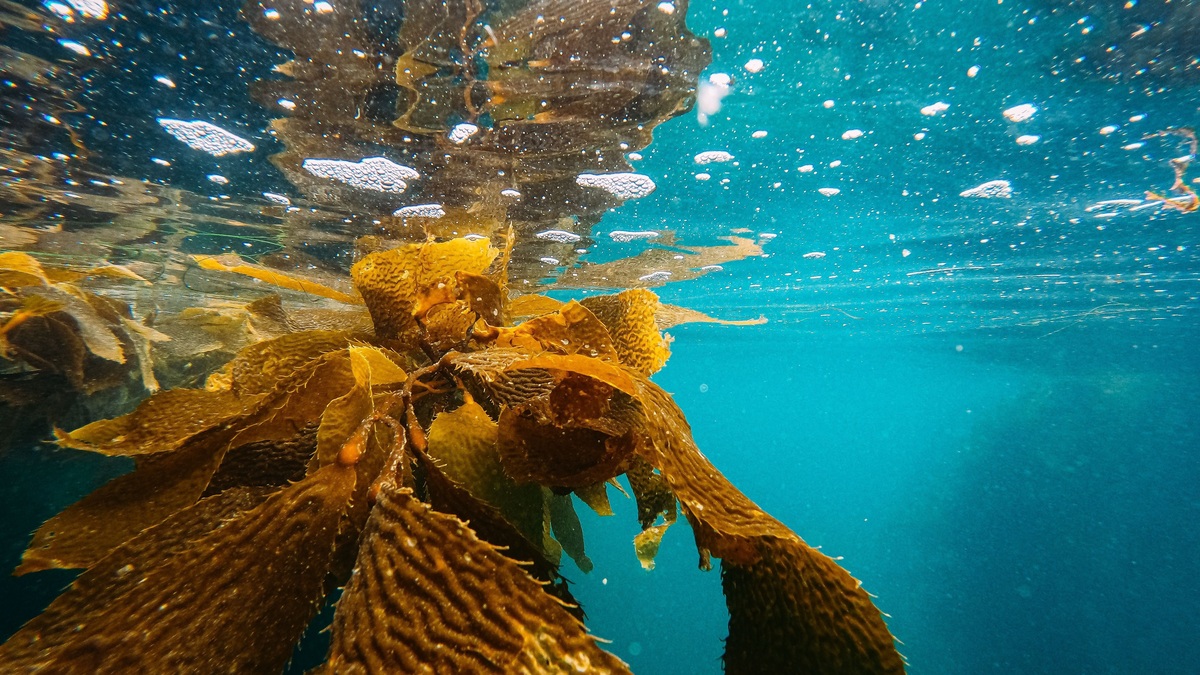
Brown algae include kelps, rockweeds and sargassum. The pigment fucoxanthin masks much of their green chlorophyll. Brown algae contain alginates that help provide flexibility and are useful as thickeners.
Color can vary with light, age and condition. A green alga may appear yellow, while a red species can look nearly black. Identification relies on body structure, reproductive features and often microscopy or genetics.
Seaweeds attach, float or drift
Many coastal species attach to hard surfaces where waves continually deliver nutrients. Flexible bodies bend under moving water, reducing the force they experience. Gas-filled structures lift some blades toward stronger light.
Other seaweeds are free-floating. Sargassum in the open Atlantic forms drifting habitat used by fishes, turtles and invertebrates. Onshore accumulations can provide food and shelter to beach communities, though unusually large decaying mats can create local nuisance and health concerns.
Growth depends on light, temperature, nutrients, salinity and grazing. A species that thrives on a wave-washed temperate reef may fail in warm, nutrient-poor water. Seasonal changes can make a shoreline appear bare in one month and densely covered in another.
Seaweed forms habitat and feeds coastal food webs
As primary producers, seaweeds convert light and carbon dioxide into tissue. Grazers eat living blades or microscopic growth on their surfaces. Detached fragments feed consumers after microbes soften and decompose them.
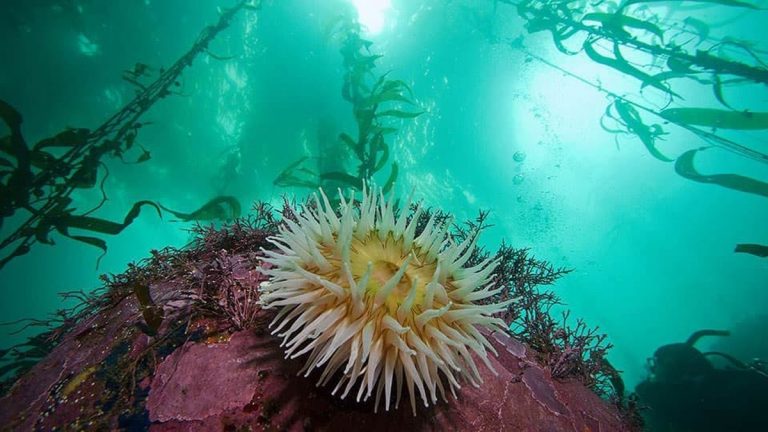
Large seaweeds add three-dimensional habitat. Kelp forests shelter fish and invertebrates, while smaller turf algae fill crevices. NOAA Fisheries describes how cultivated seaweed can also create structure used by mobile animals.
Seaweeds absorb dissolved nitrogen and phosphorus while growing. That uptake is part of ordinary nutrient cycling, not a license to release unlimited pollution. Excess nutrients can favor blooms whose decomposition reduces oxygen.
People eat and process many seaweeds
Coastal cultures have harvested seaweeds for centuries. Nori wraps food, kombu flavors broths, dulse is eaten dried or fresh and carrageenan-rich red algae enter processed foods. Species and preparation determine taste, texture and nutrition.
Compounds extracted from seaweed thicken, stabilize or gel products. Alginate comes from brown algae, carrageenan from red algae and agar from certain red groups. They appear in foods, laboratory media, cosmetics and industrial processes.
Seaweed is also used in fertilizer, animal feed research and emerging materials. NOAA Fisheries calls seaweed farming a rapidly growing aquaculture sector, while stressing siting, permitting and sustainable practice.
Products do not all have the same environmental footprint. Farming methods, transport, processing and effects on local habitat matter. Claims about climate benefits must account for what happens to harvested carbon rather than counting growth alone.
Seaweed is different from seagrass
Seagrasses are flowering plants descended from land plants that returned to the sea. They have true roots, veins, flowers and seeds. Seaweeds reproduce through spores or other algal life cycles and lack those plant structures.
The two can occupy neighboring habitats and both support wildlife. Seagrass roots stabilize sediment, while many seaweeds attach to rock or other firm material. Clear terminology helps explain why they respond differently to dredging, turbidity and nutrient pollution.
Blooms and invasive species require context
Rapid seaweed growth may be natural and seasonal, or it may follow altered nutrients and temperature. A dense mat can shade organisms below and consume oxygen as it decays. The ecological effect depends on species, scale and location.
Introduced seaweeds can spread through ship traffic, aquaculture or the aquarium trade. Some remain limited, while others compete with native habitat-formers. Management begins with correct identification and prevention rather than treating every abundant alga as invasive.
Seaweed is therefore best understood as a diverse ecological form. Its members build habitat, feed people and support industries, yet no single description fits them all. Recognizing the differences among green, red and brown algae makes the familiar shoreline term scientifically useful.
Collection also requires context. Removing a small amount of a common, fast-growing species differs from stripping holdfasts across a reef. Local rules may restrict harvest by area, season or method.
Seaweeds have complex life cycles
Many seaweeds alternate between microscopic and visible stages. The familiar blade may release spores that grow into a tiny generation, which later produces cells that unite and begin the large form again.
Other species reproduce through fragments or simpler cycles. The details vary sharply among green, red and brown algae, another reason the everyday category does not represent one biological lineage.
Temperature and day length can cue reproduction. A coast may therefore contain invisible juvenile stages even after seasonal blades disappear.
Farmers use this biology by collecting reproductive tissue and settling spores onto twine in nurseries. Controlled light and temperature help produce juvenile seaweed before lines move to open water.
Life-cycle knowledge also guides restoration. Outplanting adult fragments may fail if a species needs genetic mixing or a specific microscopic stage. Protecting reproductive timing supports seaweed population renewal beyond one growing season.
Seaweed chemistry reflects its surroundings
Algae absorb dissolved nutrients directly across their surfaces. Tissue composition therefore changes with nitrogen supply, temperature, light and growth rate.
Some species also accumulate metals or other contaminants. Food safety depends on testing the harvested material and choosing clean growing water, not on assuming a natural product is automatically safe.
The FDA’s arsenic research in food includes analytical work on seaweed. Producers must also consider microbial hazards and species-specific compounds.
Iodine is nutritionally necessary, yet amounts can be high and variable in brown seaweeds. Processing and portion size affect exposure, which is why nutrition claims should identify the product rather than generalize from all seaweed.
Chemical variation is useful as well as challenging. Farmers can adjust harvest timing for desired protein or alginate content, making quality control a biological part of responsible modern commercial production systems. Identifying the species, growing water and harvest season is what turns the broad label seaweed into a product with traceable qualities.
Related reading: coastal blue carbon habitats and marine biogeography.