Kelp forests shelter fish, worms, crustaceans, mollusks, sea stars, urchins, anemones, marine mammals and seabirds. No single list describes every forest because species change with latitude, depth and ocean basin. The shared feature is a layered habitat built by large brown algae. Water temperature and seasonal currents further alter which mobile species appear at a particular site.
Animals use the canopy, midwater fronds, holdfasts and rocky bottom in different ways. Some live there continuously, while others visit to feed or avoid predators. NOAA’s survey of kelp forest life includes bristle worms, prawns, snails, brittle stars, rockfish, seals, sea lions, whales and sea otters.
Holdfasts shelter small invertebrates
A kelp holdfast grips rock with a branching structure that resembles roots but does not absorb nutrients. Gaps among those branches create tiny protected spaces. Worms, amphipods, isopods, brittle stars and juvenile mollusks can occupy this concealed habitat.
These residents feed on algae, trapped particles, detritus or one another. Their abundance makes the holdfast a feeding site for larger predators. When kelp detaches, part of this community may travel with it or become food on the seafloor.
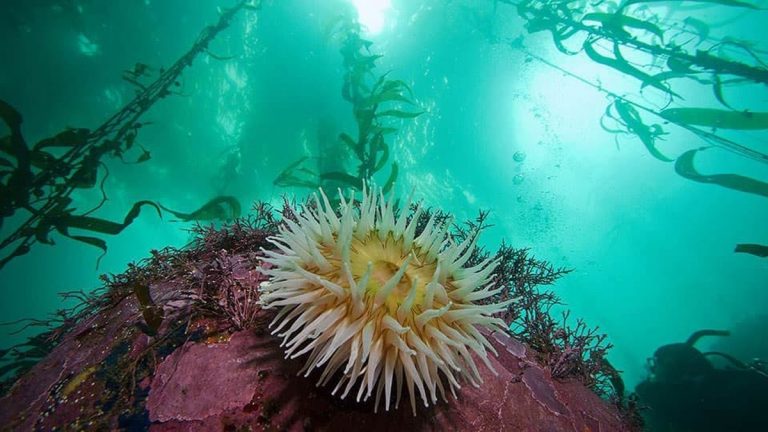
The rocky ground around holdfasts supports crabs, sea stars, anemones and nudibranchs. The sanctuary system’s kelp habitat guide describes the forest floor as a distinct layer beneath canopy and midwater zones.
Urchins and snails graze the forest
Sea urchins scrape kelp tissue and other algae with a hard feeding apparatus. At ordinary densities they are members of a diverse food web. Dense populations can consume young kelp or chew through holdfasts, leaving open areas called urchin barrens.
Snails and other grazers feed on blades, attached algae or films on rock. Grazing can clear space for new organisms, yet strong pressure limits kelp recruitment. The outcome depends on grazer abundance and the rate of kelp growth.
Predators influence these herbivores. Sea otters eat urchins in parts of the northeast Pacific. Sheephead, lobsters and sea stars can also affect grazers in their own regions, so the food web does not reduce to one universal otter-urchin relationship.
Fish divide the canopy and reef
Rockfish are among the best-known kelp residents on the Pacific coast. Different species occupy the canopy, midwater or bottom and shift habitat as they grow. Juveniles can use dense blades as refuge, while adults feed around reef structure.
Kelp bass, garibaldi and greenlings are other familiar examples in California forests. Farther north or in other ocean basins, the species list changes. Fish may remain in the forest, travel along its edge or visit only during one life stage.
NOAA Fisheries explains that kelp supports fish beyond the bed because animals produced there become prey elsewhere. Floating kelp paddies also shelter young fish in open water.
Structure does not guarantee safety. Predators use the same cover to approach prey. A complex forest offers many possible routes and hiding places, altering encounters rather than eliminating them.
Marine mammals feed, rest and seek cover
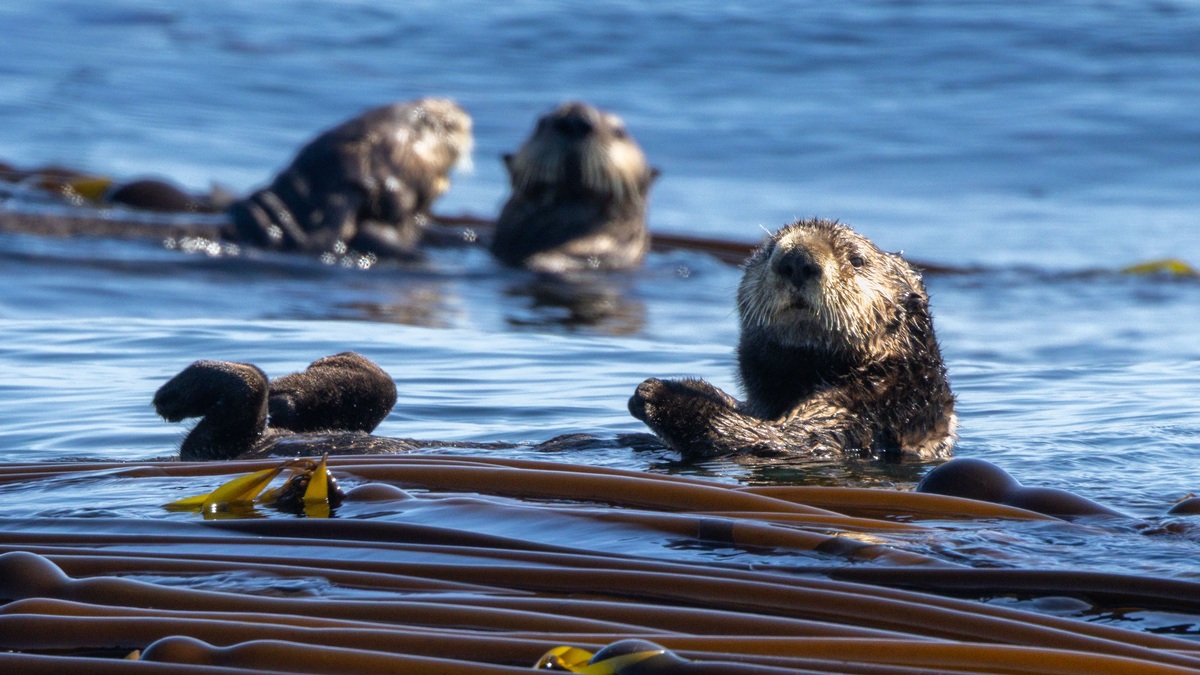
Sea otters rest at the surface and may wrap themselves in blades to reduce drifting. They forage on urchins, crabs and mollusks around the rocky bottom. Their effect on kelp varies with prey, location and the rest of the food web.
Seals and sea lions hunt fish in and around kelp. Their bodies move readily through flexible fronds and the forest edge can concentrate prey. They are visitors and predators rather than residents attached to one patch.
Gray whales have been observed in kelp forests, where they may feed on invertebrates or seek shelter. Observations do not mean every forest is whale habitat or that one purpose explains every visit.
Birds connect kelp to air and shore
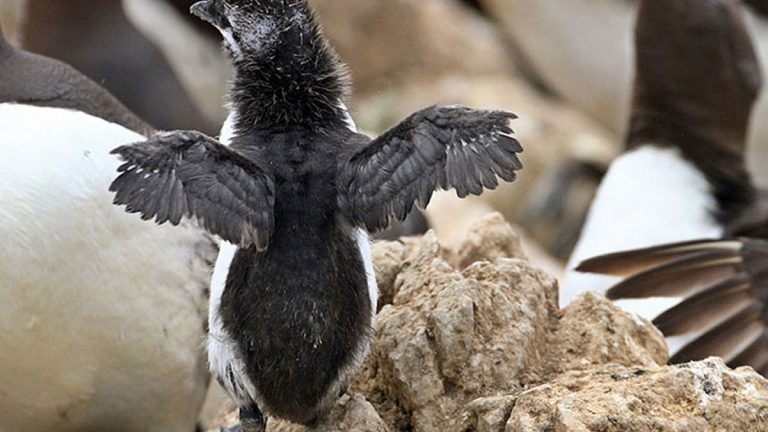
Cormorants, gulls, terns, egrets and herons hunt fish or invertebrates around kelp beds. Some dive through the canopy, while others forage at edges or on exposed drift. Small land birds may eat flies and crustaceans associated with stranded kelp.
Floating and beach-cast kelp thus connects submerged production to surface and shore food webs. Invertebrates colonize decaying wrack, attracting birds. Removing all wrack for a tidy beach can remove that natural food source.
Bird use changes with weather, migration and prey abundance. A forest should be seen as one part of a coastal mosaic that includes cliffs, beaches and open water.
Animals can help a forest persist or decline
Grazers remove tissue, predators consume grazers and filter feeders process particles. These interactions occur alongside temperature, nutrients, storms and disease. Biology can amplify physical stress without replacing it as an explanation.
When marine heat reduces kelp growth, surviving plants may be less able to replace tissue eaten by urchins. When predators recover, grazing may fall in some systems. Local monitoring is necessary because the same management action will not produce the same response everywhere.
Scientists survey fish and invertebrates with divers, cameras and acoustic methods. Canopy maps show kelp area, while animal counts reveal whether habitat structure and community composition are changing together.
A layered forest supports layered diversity
The animals of a kelp forest are distributed through a vertical landscape. Tiny crustaceans occupy holdfasts, fish move among stipes, otters rest in the surface canopy and birds hunt above it. Their connections make the habitat more than a list of species.
Protecting those animals requires protecting water quality, rocky substrate and the kelp itself. Fishing rules, marine protected areas and restoration may each address part of the system. Measures work best when they account for movement between kelp, reefs and neighboring open water.
A healthy forest need not contain every famous species. It should retain the processes that allow native grazers, predators and prey to coexist through changing seasons. That ecological variety is what makes kelp one of the ocean’s richest structured habitats.
Species lists also change after storms and during recruitment seasons. A survey that misses a mobile animal does not prove it never uses the habitat. Repeated observations provide a more reliable picture.
Different life stages use different forest layers
Young fish often need narrow refuge and abundant small prey, while larger individuals may move to reef edges or deeper water. The same species can therefore occupy a different zone as its body and diet change.
Larvae arriving in plankton must find suitable surfaces or hosts. Holdfasts and blades greatly increase the available settlement area compared with bare rock.
Seasonal migrants follow prey rather than kelp alone. Birds, sharks and marine mammals may appear briefly when local feeding conditions are favorable.
Tracking these shifts requires surveys across depth and time. A canopy count cannot represent animals hidden in holdfasts and a bottom transect misses species moving near the surface.
The strongest assessments pair species abundance with size or age information. That approach distinguishes a forest containing many juveniles from one supporting reproduction and survival through several animal life stages.
Drifting kelp carries animals beyond the forest
Storms and normal breakage detach blades or entire plants. Gas-filled structures keep some material afloat, creating a moving patch of shade and shelter.
Juvenile fish gather beneath these kelp paddies, while crabs and snails travel on the blades. Offshore predators may visit the concentrated community.
As the kelp ages, microbes and grazers break it down. A mat can eventually sink, delivering organic material and attached animals to deeper water.
Beach-cast kelp supports flies, amphipods and shorebirds. Removing every strand of wrack interrupts this transfer from subtidal forest to beach.
Drift shows why habitat boundaries are permeable. The standing forest generates mobile habitat whose influence can extend far beyond the reef where the kelp grew. Its animals may disperse, become prey or settle elsewhere naturally as currents carry the kelp offshore.
Related reading: coastal blue carbon habitats and marine biogeography.