A study in General Relativity and Gravitation proposes that a seven-dimensional form of spacetime geometry could leave black holes with tiny stable remnants, giving quantum information a place to survive after Hawking evaporation. The work, led by Richard Pinčák and colleagues, offers a theoretical route through one of the most famous conflicts between gravity and quantum physics.
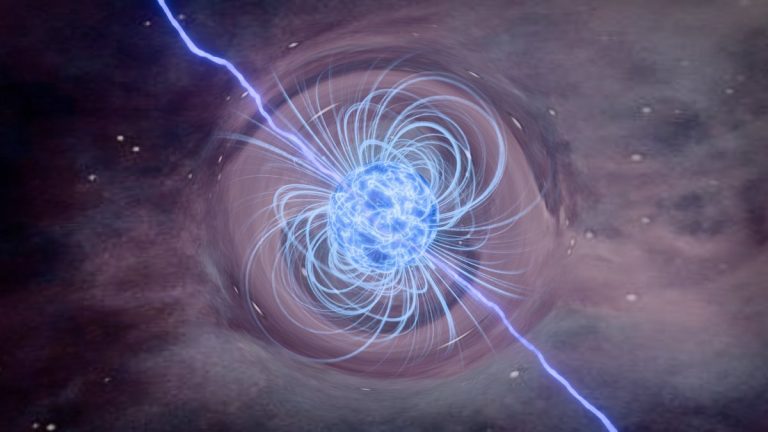
The idea centers on a version of gravity called Einstein-Cartan theory. In this framework, spacetime can curve and twist. That twist, known as torsion, becomes powerful at the extreme densities near the Planck scale. According to the researchers, it may create a repulsive effect that halts the final disappearance of an evaporating black hole.
If the model is correct, a black hole would end as a stable relic with a mass of about 9 × 10-41 kilograms. That number is almost unimaginably small. Still, the team argues that such a remnant could store the information needed to preserve the history of everything that fell in.
A black hole that never fully disappears
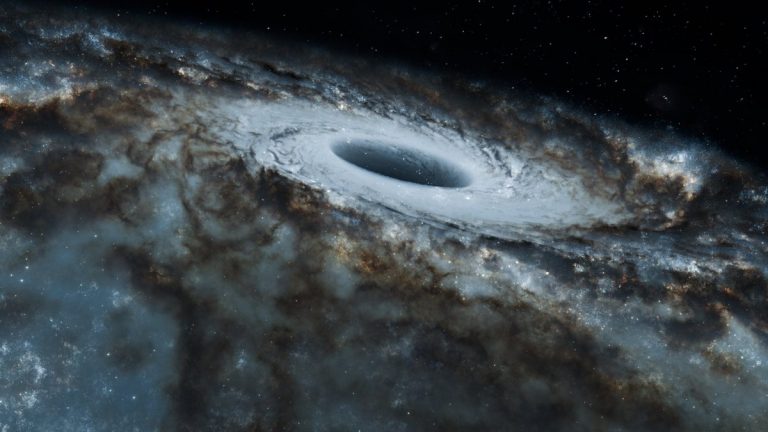
Stephen Hawking’s calculations in the 1970s changed the way physicists think about black holes. A black hole can emit faint thermal radiation, now known as Hawking radiation. Over vast spans of time, that radiation carries energy away and causes the black hole to shrink.
The puzzle begins at the end of that process. Quantum mechanics says information is preserved. A complete evaporation scenario raises a problem because the details of swallowed matter seem to vanish with the black hole.
Pinčák and his co-authors propose a different final state. Their model predicts that evaporation stops before total disappearance. The result is a stable remnant whose existence depends on the geometry of a higher-dimensional universe.
This is a theoretical result and it depends on a specific mathematical framework. The study presents a possible mechanism rather than an observation of black hole remnants. Even so, the proposal is striking because it gives the information paradox a concrete object to work with.
How twisted spacetime changes the ending
At the heart of the study is a seven-dimensional version of gravity built on a mathematical structure called a G2-manifold. This geometry appears in advanced theories that try to connect gravity with particle physics. In the team’s model, the extra dimensions are compact and strongly shaped by torsion.
General relativity describes gravity through the curvature of spacetime. Einstein-Cartan theory adds another ingredient, the ability of spacetime to twist. That torsion can interact with matter under extreme conditions.
Near the Planck scale, ordinary descriptions of gravity lose their reliability. The densities become so high that quantum gravity effects are expected to matter. In the new model, torsion supplies a repulsive contribution that counteracts further collapse.
The researchers calculate that this effect naturally produces a nonzero residual mass. In simple terms, the black hole runs out of room to keep shrinking. Its final state becomes a Planck-scale remnant stabilized by the hidden geometry.
That ending would rewrite the last moments of evaporation. The black hole would become a tiny relic with an internal structure shaped by torsion. This structure is where the team locates the missing quantum information.
Where the missing information could hide
The information paradox asks what happens to the quantum description of matter after it crosses an event horizon. In quantum physics, information cannot simply drop out of reality. A successful model must explain where that information goes.
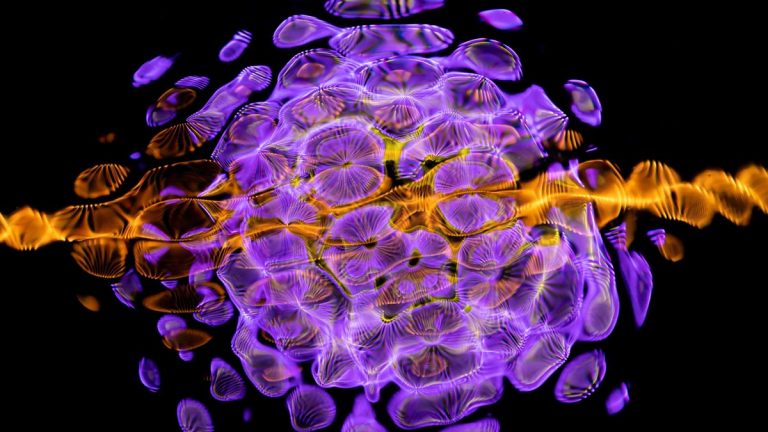
In the new study, the answer lies in long-lived patterns inside the remnant. The authors describe information as being encoded in a spectrum of quasi-normal modes. These can be thought of as characteristic vibrations of the remnant’s geometry.
For a black hole with the mass of the Sun, the researchers estimate an information capacity of about 1.515 × 1077 qubits. That is an enormous amount of quantum information. According to their calculations, it is enough to preserve the information associated with the original black hole.
The concept has a useful analogy. A bell carries information about its shape through the way it rings. In this model, the remnant carries information through the way torsion can vibrate within its geometry.
That does not make the remnant easy to detect. Its predicted mass is far below everyday scales. The significance is mathematical first, because the model gives the paradox a storage mechanism that remains inside the laws of quantum theory.
A surprise link to the Higgs field
The same geometry used to stabilize black holes also leads the researchers toward particle physics. When the seven-dimensional model is reduced to the four dimensions we experience, it produces a scale close to the electroweak scale.
That scale, about 246 GeV, is closely associated with the Higgs field. In modern physics, the Higgs field helps explain how elementary particles acquire mass. The value of its vacuum expectation is one of the key numbers in the Standard Model.
Pinčák and colleagues argue that the vacuum expectation value of the torsion field can be dynamically identified with this electroweak scale. In their framework, geometry gives rise to a value that particle physics already uses.
This makes the proposal more ambitious than a black hole model alone. It links black hole information, extra dimensions, torsion and the origin of particle masses. A single geometric mechanism would then connect physics at the smallest black hole scales with the physics of the weak nuclear force.
The study also addresses why the extra dimensions would remain hidden from current experiments. The associated Kaluza-Klein excitations are predicted to have masses near 8.6 × 10¹⁵ GeV. That is far above the energy reach of the Large Hadron Collider.
How astronomers might test the idea
The model’s energy scale makes direct production in particle accelerators unrealistic with current technology. The authors still point to possible observational signatures. Some would come from cosmology and others would come from compact relics in space.
One possibility involves the predicted remnants themselves. If stable black hole relics formed in the early universe, they could contribute to dark matter. Their gravitational effects might then leave measurable traces, even if individual remnants are far too small to see.
Another route involves the cosmic afterglow of the early universe. The study suggests that the proposed seven-dimensional geometry could have left subtle fingerprints in the cosmic microwave background. Primordial gravitational waves could also carry clues from the high-energy conditions where torsion mattered most.
The quasi-normal modes of the remnants provide a more mathematical signature. Competing theories predict different ways for black holes to preserve information. The torsion model stands out by tying the storage capacity to a specific seven-dimensional geometry.
For now, the proposal remains a theoretical advance. Its value lies in connecting several hard problems through one framework and making predictions that researchers can examine further. If future observations support stable remnants or torsion-like signatures, Hawking’s famous paradox could point toward a deeper geometric layer of reality.