Researchers using China’s FAST telescope have searched two nearby neutron stars for one of physics’ most elusive suspects, axion dark matter. The study turned the magnetic environments around dead stars into natural detectors, then used radio observations to listen for a faint signal that would betray a hidden particle.
The team, Sinuo Gao, Chen Wang and Maoyuan Liu, reported a quiet result. Yet that silence still tightens the map. Their analysis sets new limits on how strongly axions in a narrow mass range could interact with light.
Dark matter remains invisible by ordinary means. Astronomers see its gravitational influence in galaxies and clusters, while its particle identity remains open. The FAST search shows how astronomers can use extreme cosmic objects to test ideas that remain far beyond direct laboratory reach.
FAST scans two dead stars
FAST radio telescope, the Five-hundred-meter Aperture Spherical radio Telescope in Guizhou, China, is one of the world’s most powerful instruments for catching faint radio signals from deep space. Its huge collecting area makes it useful for searches where the expected signal is thin, narrow and easy to lose inside background noise.
The study focused on two X-ray dim isolated neutron stars, RXJ1605.3+3249 and RXJ1308.6+2127. These compact stellar remnants were chosen because theoretical models predicted that they could produce strong axion-conversion radio lines within FAST’s view of the sky.
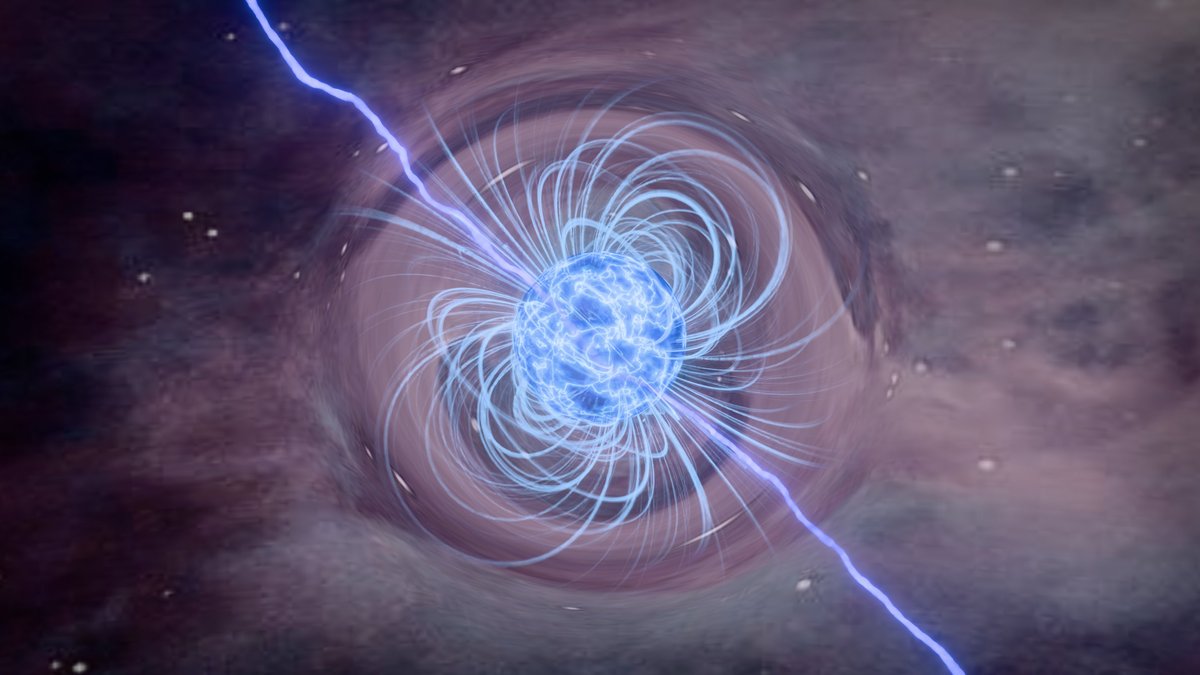
Neutron stars are the crushed cores left behind after massive stars explode. They pack more mass than the Sun into a sphere about the size of a city. Their magnetic fields can be enormous, which makes neutron star magnetospheres promising places to search for unusual particle effects.
The authors’ affiliations connect the work to Tibet University and the Chinese Academy of Sciences research network. The paper lists ties to the National Astronomical Observatories, the University of Chinese Academy of Sciences and the Key Laboratory of Radio Astronomy and Technology.
The axion signal scientists hunted
The particle at the center of the search is the axion. Physicists proposed axions as a possible solution to a long-standing puzzle in particle physics and they later became a serious candidate for dark matter. In this scenario, axion dark matter would be extremely light and interact only weakly with ordinary matter.
The trick is that axions may sometimes transform into photons. A photon is a packet of light and radio waves are a form of light with long wavelengths. In the right magnetic environment, an axion passing through a neutron star’s surroundings could become a radio photon.
This process is linked to the Primakoff effect, where particles and light can convert in the presence of strong electromagnetic fields. Around a neutron star, the magnetic field and plasma can create a special region where that conversion becomes especially efficient.
For radio astronomers, the expected signature is a narrow radio line. It would look like a clean spike at a specific frequency, set by the axion’s mass. That makes the search a little like scanning a radio dial for a whistle buried beneath static.
The FAST observations used the L-band receiver, covering radio frequencies from 1.0 to 1.5 gigahertz. That frequency range corresponds to axion masses from 4.14 to 6.20 microelectronvolts, an extremely small mass scale by everyday standards.
A quiet result with sharp limits
The result came from hours of careful listening. The team observed one neutron star for a total of 4.2 hours and the other for about 2.2 hours. During the search, the telescope alternated between the target region and nearby blank sky.
That observing strategy helps remove unwanted signals. Radio astronomy often has to deal with instrumental drift, atmospheric effects and human-made interference. Comparing the neutron-star direction with nearby sky gives researchers a cleaner way to isolate anything unusual.
The study abstract states that “no significant signal was detected at the 5 sigma confidence level.” In physics and astronomy, 5-sigma is a demanding threshold. It is designed to make random noise far less likely to masquerade as a real discovery.
The team then converted the quiet result into a numerical boundary. They set an upper limit on the axion-photon coupling, which describes how strongly axions could interact with photons. In the studied mass range, the limit is roughly at or below 5 x 10^-12 GeV^-1.
That number matters because it trims the allowed space for axion models. A weaker possible interaction can still remain hidden. A stronger interaction in this mass band becomes harder to reconcile with the FAST data under the assumptions used by the researchers.
Why the missing signal matters
A null result can still be a scientific result when the experiment is sensitive enough. Here, the absence of a candidate line rules out some combinations of axion mass and photon coupling. It gives future searches a clearer target map.
The authors report that their constraint is the tightest so far in this axion mass range among searches using the same neutron-star radio-line method. That places the FAST study within a growing effort to use astronomy as a dark matter laboratory.
The neutron-star approach has a special appeal. Laboratory experiments offer controlled conditions and repeated measurements. Neutron stars supply magnetic fields that no Earth-based instrument can reproduce.
Earlier theoretical work helped build the case for this search strategy. In 2018, researchers argued that axion dark matter could produce narrow radio lines from neutron star magnetospheres. Later observations with the Green Bank and Effelsberg radio telescopes also looked for this type of signal.
FAST adds another powerful data point. Its large dish makes it particularly sensitive to weak radio emission. That sensitivity helps researchers test smaller axion-photon couplings, especially when the expected signal sits in a well-defined frequency range.
What comes next for cosmic dark matter searches
The FAST result leaves many versions of axion dark matter available for future tests. It covers one mass window, one observing band and a specific set of model assumptions. Dark matter searches usually advance by closing one window at a time.
Longer observations are an obvious next step. More time on target can improve sensitivity, especially if the signal is stable and narrow. Other neutron stars may also become attractive targets as astronomers refine their models of where the brightest conversion lines should appear.
The paper also points toward better modeling. Neutron star plasma is complicated and the predicted signal depends on how radio waves move through that plasma. Details such as line brightness, polarization and bending of radio waves could change how future searches are designed.
Those improvements bring new challenges. A more realistic model can sharpen predictions, while adding more assumptions that need to be tested. That balance is a familiar part of work at the boundary between particle physics and astrophysics.
For now, FAST has shown that dead stars can help probe a living mystery. If axions make up dark matter, their faint radio fingerprints may still be waiting near a magnetized stellar remnant. The latest search tells scientists where the universe has already stayed quiet and where the next careful listen should begin.