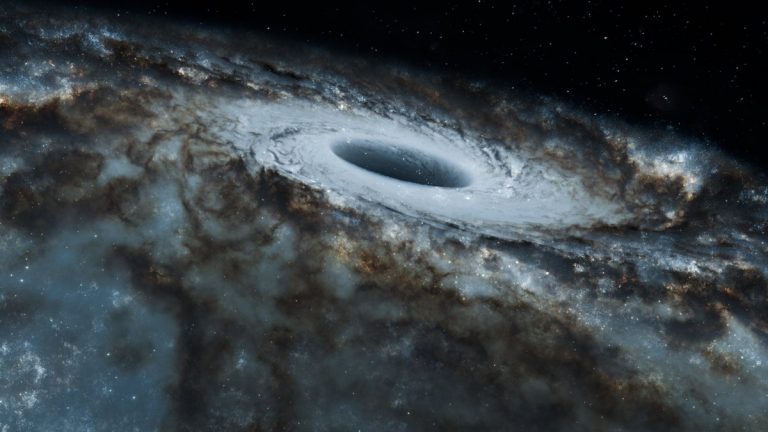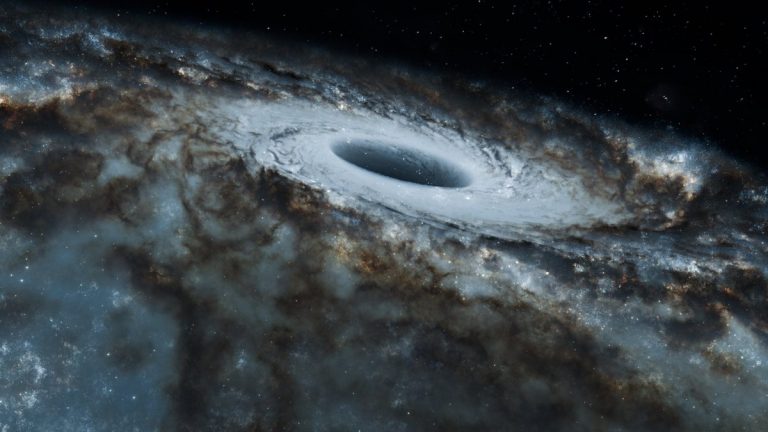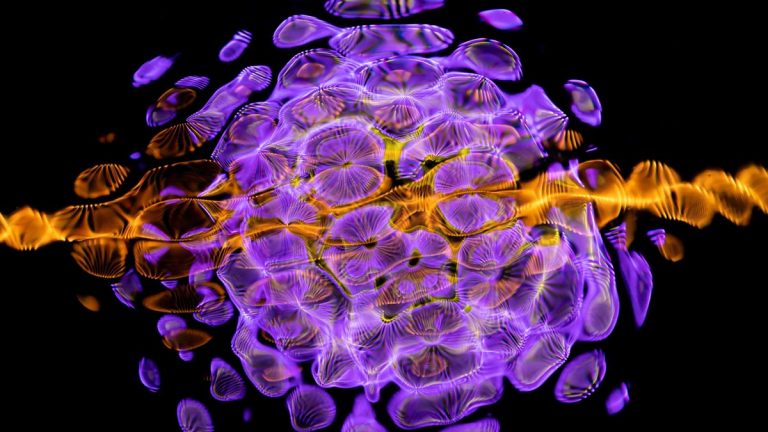
A study in Nature has reported observational evidence of a hidden gravitational-wave component in GW250114, the loudest binary black hole merger detected so far. By pulling out this faint signal from the merger’s aftermath, researchers have found a new way to probe the region just outside a newly formed black hole’s event horizon.
The work was led by scientists from the ARC Centre of Excellence for Gravitational Wave Discovery, known as OzGrav and the Australian National University. Their analysis suggests that gravitational waves can carry more detailed information from the edge of a black hole than previous observations had revealed.
In the Nature paper, the authors write, “Here we report observational evidence of a direct wave in GW250114.” That direct wave is the key advance. It acts like a final trace from the violent instant after two black holes merge and before the remnant settles into a simpler, quieter state.
The loudest black hole merger yet
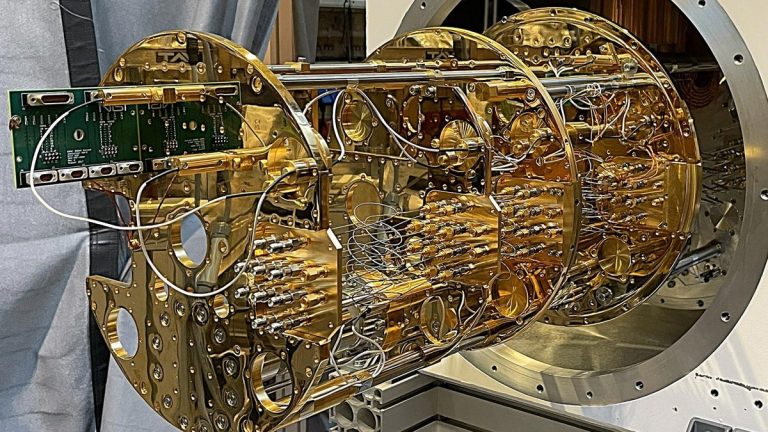
GW250114 was detected in 2025 by the two Laser Interferometer Gravitational-Wave Observatory detectors in the United States. The event came from a binary black hole merger, where two black holes spiraled together and formed a single remnant black hole.
For gravitational-wave astronomers, the signal’s strength made it unusually valuable. Dr. Ling Sun described its importance directly, saying, “We studied GW250114, the loudest binary black hole signal observed to date.” The event was about three times louder than the first gravitational-wave signal detected a decade earlier.
A louder signal gives scientists more structure to examine. In a faint detection, subtle features can be buried in detector noise. In this case, the strength of the wave allowed the team to search for details in the merger phase itself, where the newly formed black hole was still ringing from the collision.
The signal was recorded by both LIGO Hanford and LIGO Livingston. Having two detectors observe the same event helped researchers compare the data and isolate features that appeared in the gravitational waves themselves.
A faint signal near the event horizon
The feature at the center of the study is known as a direct wave. It is a faint component within the gravitational-wave signal that comes from the region near the remnant black hole’s horizon.
In the paper’s abstract, the authors describe the horizon as “the ‘surface of no return.'” That phrase captures the essential idea. The event horizon is the boundary where escape becomes impossible because the required escape speed reaches the speed of light.
The direct wave carries information from just outside that boundary. The team found that this component can be separated from the rest of the waveform, giving scientists access to a part of the signal that had remained difficult to interpret.
Neil Lu, a Ph.D. candidate at OzGrav and the Australian National University, emphasized the analytical step that made the work possible. “Our new analysis allows us to decipher this component,” Lu said.
That component is small compared with the main merger signal. Even so, it contains a distinctive pattern tied to the physics of the newly formed black hole.
Two properties hidden in the waves
The researchers used the direct wave to measure two fundamental properties of the remnant black hole. These are its rotation frequency and surface gravity.
Rotation frequency describes how the black hole’s horizon spins. In the extreme gravity near a rotating black hole, spacetime itself is dragged around with the spin. This effect is known as frame dragging and it is one of the most striking predictions of Einstein’s theory.
Surface gravity describes how strongly gravity acts at the horizon. For a black hole, it also helps control how signals from near the horizon fade as they struggle outward through intense gravitational redshift.
Together, these two quantities define key behavior at the horizon. In the Nature study, the direct wave oscillated and decayed in ways that reflected those properties. The pattern gave researchers a route to measuring the horizon without touching it or seeing it directly.
That’s the power of gravitational waves. They let scientists study objects that emit no light by reading ripples in spacetime from their motion and collisions.
Why direct waves matter
Direct waves give researchers a new handle on the brief and violent moment just after a black hole merger. During that instant, the newborn black hole has a horizon, spin and intense gravity. It also carries the imprint of the crash that created it.
Until now, much of black hole merger analysis has focused on the inspiral before collision and the ringing afterward. GW250114 allowed the team to examine a more subtle part of the waveform from the merger phase itself. That part appears to contain information from the region closest to the horizon.
The direct wave is especially interesting because it links the observed signal to physical conditions near the black hole’s edge. Its oscillation reflects the rotating horizon. Its fading pattern reflects gravitational redshift and the strong curvature around the black hole.
These measurements mark an early step toward using direct waves as tools for black hole physics. Future gravitational-wave detections with strong signals may allow researchers to repeat the method across different mergers.
A new test for Einstein’s gravity
The study also points toward future tests of general relativity. Einstein’s theory predicts how black holes should behave, including how their horizons spin and how waves should fade near them.
By measuring horizon properties through direct waves, scientists can compare real events with those predictions. If future observations show the same patterns across many mergers, they will strengthen the case that current black hole models describe nature well.
Stronger detectors will make this approach more powerful. As gravitational-wave observatories improve, researchers may find more events like GW250114. Each one could add another measurement of the near-horizon region.
The findings also bring black hole physics closer to questions at the boundary between gravity and quantum theory. Event horizons sit at the center of some of the deepest problems in modern physics. Direct waves may offer a new observational path into that extreme regime.
For now, the discovery shows that the loudest gravitational-wave signal yet carried a hidden message. In that faint pattern, scientists found a way to listen closer to the edge of a black hole than ever before.