NASA’s official Cold Atom Lab announcement points to one of the strangest laboratories ever flown in orbit. A compact quantum physics facility aboard the International Space Station is back in operation after an upgrade, giving researchers a sharper tool for studying matter at temperatures close to absolute zero.
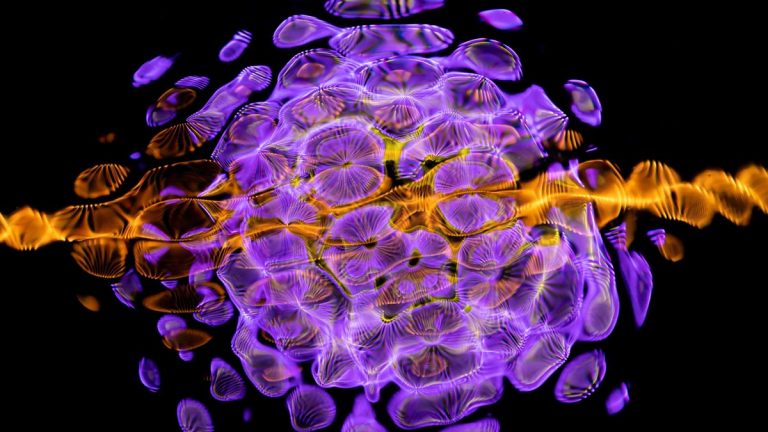
The facility is designed to create Bose-Einstein condensates, an unusual state of matter that forms when atoms are chilled until their quantum behavior becomes visible on a larger scale. In that state, atoms begin to act less like separate particles and more like overlapping waves. Space makes the effect easier to study because microgravity lets the fragile atomic clouds expand and persist for longer periods.
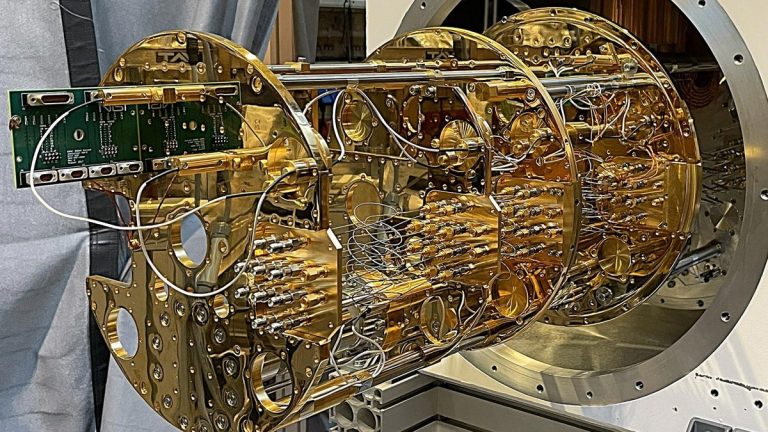
NASA’s Cold Atom Lab is about the size of a mini refrigerator. From its perch on the space station, it lets scientists run experiments that would be far harder in a ground laboratory. The new hardware expands what researchers can do with ultracold atoms, while also advancing quantum tools that could one day help measure gravity, motion and time with extreme precision.
A quantum lab back in orbit
The upgraded facility returned to service after a new science module reached the space station on April 11 aboard a Commercial Resupply Services mission. Once installed, the module opened a fresh set of possibilities for scientists who use the orbiting lab to probe the behavior of matter in its coldest and most delicate forms.
Cold Atom Lab supports five international research teams. Their work falls within fundamental physics, yet the long-range goals stretch well beyond pure curiosity. Quantum instruments built on this kind of research could support future space missions, Earth science measurements and navigation systems that rely on the precise behavior of atoms.
At the heart of the project is a simple idea with extraordinary consequences. When atoms are cooled enough, they slow down. At temperatures near absolute zero, their wave-like nature becomes dominant. “At the coldest temperatures, matter behaves drastically different from anything we have experienced,” said Jason Williams, project scientist for Cold Atom Lab at NASA’s Jet Propulsion Laboratory in Southern California.
That makes the International Space Station a valuable platform for quantum science. On Earth, gravity quickly pulls the cold atoms downward. In orbit, the atoms can drift in microgravity. Researchers gain more time to watch them expand, interact and reveal subtle quantum effects.
How atoms become matter waves
Atoms are often imagined as tiny spheres. Quantum physics gives a richer picture. At very small scales, matter can behave like a wave and that wave behavior becomes easier to see when atoms lose almost all of their thermal motion.
Inside Cold Atom Lab, researchers begin with strips of rubidium or potassium metal. The system heats the metal to create a gas inside a vacuum chamber. Carefully tuned lasers then remove energy from the atoms. As the atoms lose energy, they slow dramatically.
After laser cooling, magnetic fields hold the atoms in place. Additional cooling steps bring the cloud even closer to a standstill. When the conditions are right, many atoms enter the same quantum state and form a fifth state of matter known as a Bose-Einstein condensate.
In that state, the atoms behave as matter waves. The waves can overlap and spread across a region much larger than a single atom. Williams summarized the shift in plain terms: “The wavelike nature of matter dominates.”
This is why a Bose-Einstein condensate is so useful for scientists. It makes quantum behavior easier to study as a collective object. The condensate still obeys quantum rules, while becoming large enough for carefully designed instruments to manipulate and observe.
Why microgravity changes the experiment
Microgravity gives Cold Atom Lab an advantage that ordinary laboratories struggle to match. On Earth, ultracold atom clouds fall as soon as they are released. Scientists can still study them, but gravity limits the observation time and affects how the clouds expand.
On the space station, the atomic clouds float. That extra freedom lets matter waves grow larger and remain available for longer measurements. The conditions also help researchers cool quantum gases to extremely low temperatures, because the atoms can be handled gently after the main cooling stages.
The difference matters because quantum experiments often depend on patience. A tiny shift in a matter wave can carry information about gravity, acceleration, or other forces. More observation time can make those signals easier to measure.
Cold Atom Lab also shows how much engineering is hidden behind modern quantum science. A room-sized atomic physics laboratory on Earth can be filled with lasers, optics, vacuum systems and magnetic equipment. NASA and its partners compressed that capability into a system that fits inside an experiment rack on the station.
The result is a remotely operated orbital laboratory. Scientists on Earth design and command experiments, while the station provides the microgravity environment. Astronauts step in when hardware needs attention, as they did for the latest upgrade.
The new Cold Atom Lab upgrade
The latest enhancement is the fourth major upgrade since Cold Atom Lab was installed on the International Space Station in 2018. The new science module expands the kinds of atom experiments researchers can run and it gives them more control over the shape of quantum gas clouds.
One important change is a redesigned magnetic trap. This trap uses magnetic fields to confine and shape ultracold atoms. By changing the geometry of the cloud, researchers can ask new questions about how quantum gases behave under different conditions.
The upgrade also includes redesigned metal atom sources. These sources help create the gas clouds used in experiments with rubidium and potassium. Better sources can improve how researchers prepare the atoms before cooling, trapping and studying them.
“It’s the closest thing we have to controlling the boundary of the quantum world,” said Kamal Oudrhiri, project manager of Cold Atom Lab at JPL. His comment points to the central challenge of the facility. Researchers are pushing matter into a regime where everyday intuition gives way to quantum behavior.
The facility’s compact design adds another layer of importance. Instead of returning the entire lab to Earth for major changes, NASA can upgrade the orbiting system with new modules. That approach allows the space station to function as a long-running testbed for space-based quantum technology.
Quantum tools for future missions
Cold Atom Lab’s science is rooted in basic physics, but NASA also sees it as a path toward future instruments. Matter-wave devices may someday help spacecraft measure gravity fields, track motion and maintain timing with high accuracy. Those capabilities could matter for Earth science, lunar missions and deep-space navigation.
One promising class of instruments is the matter-wave interferometer. These devices split and recombine atom waves. When the waves come back together, tiny changes in their pattern can reveal information about forces that acted on them along the way.
In space, such instruments could take advantage of long free-fall times and quiet measurement conditions. They might be used to sense subtle gravity changes around Earth, the Moon, or other worlds. They may also support tests of fundamental physics, including questions linked to general relativity.
“We’re demonstrating that we can make quantum technology work reliably in space,” said Ethan Elliott, deputy project scientist for Cold Atom Lab at JPL. He described the work as “quantum 2.0,” meaning the direct manipulation of large quantum states rather than the indirect use of quantum effects in older technologies.
NASA’s Jet Propulsion Laboratory designed, built and operates Cold Atom Lab. The facility is managed by Caltech in Pasadena and the project is sponsored by the Biological and Physical Sciences division within NASA’s Science Mission Directorate. Together, those groups are using the space station as a place where matter can be slowed, shaped and studied at the edge of quantum behavior.
The upgraded Cold Atom Lab now gives researchers more ways to explore that edge. In a freezer-cold cloud of atoms above Earth, NASA is testing how far quantum science can go when gravity steps back and matter begins to move like a wave.