A study in Physical Review Research reports that 24,000 ultracold atoms can behave like a tiny laboratory universe in which events are ordered from inside the system. The work, led by Giovanni Barontini at the University of Birmingham, tests a striking idea from quantum cosmology: time may emerge from the relationships between parts of a system.
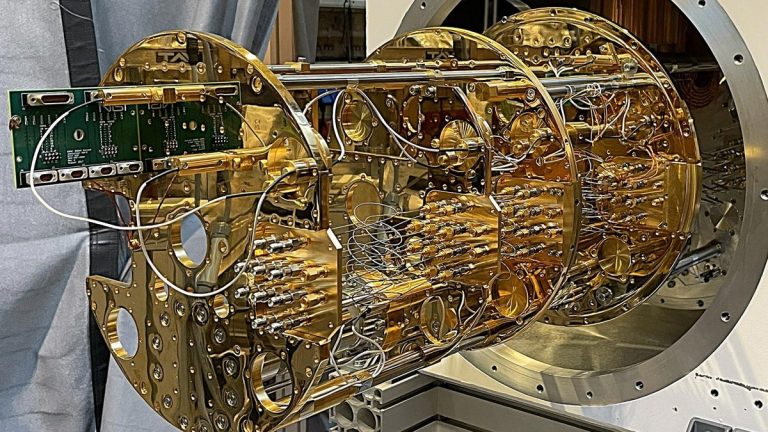
The experiment used a cloud of rubidium atoms cooled to a few billionths of a degree above absolute zero. In that extreme state, the atoms formed a carefully controlled quantum system that could expand, contract and redistribute itself. Barontini then asked whether the system could tell its own sequence of events without using an outside clock.
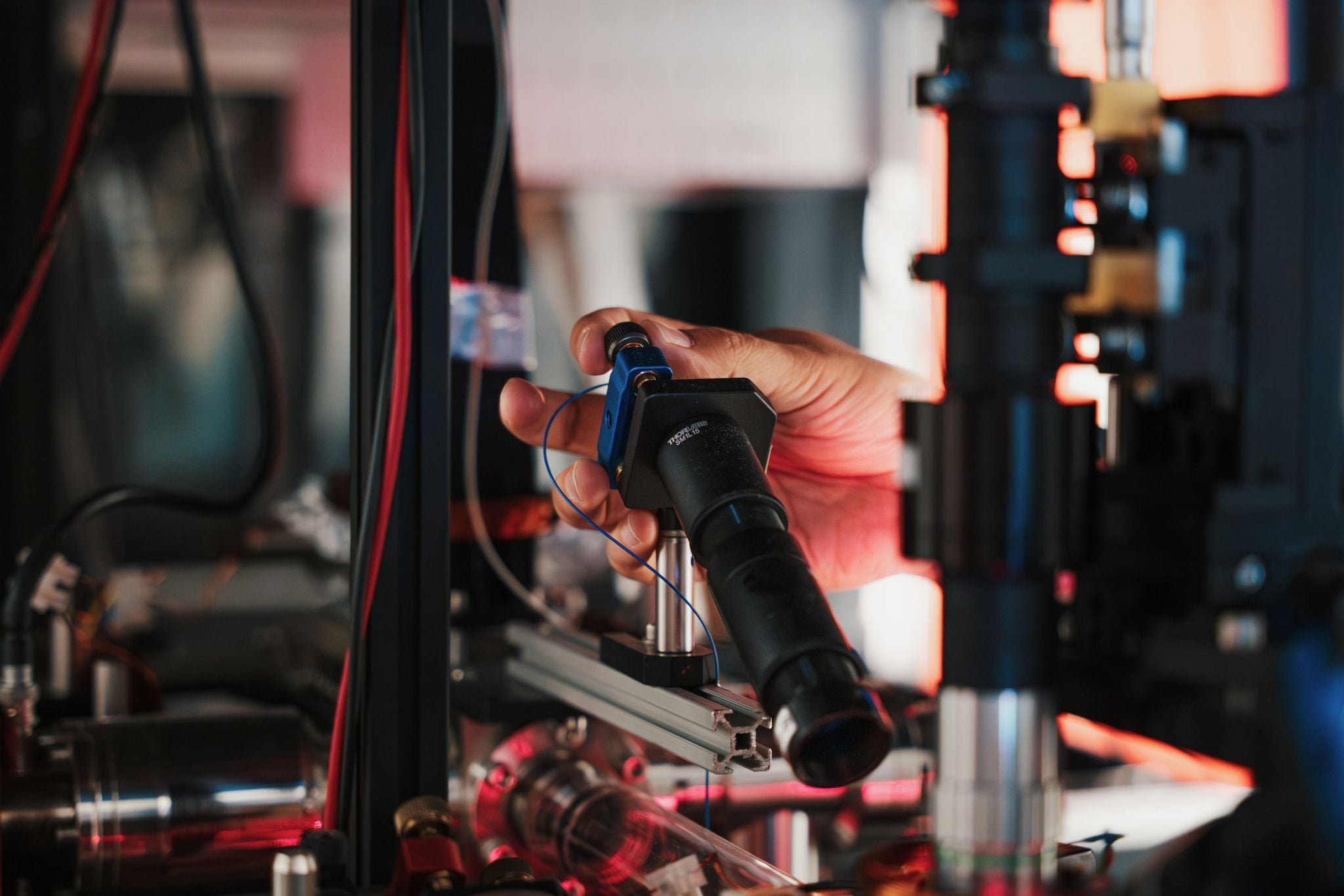
The result gives physicists a rare experimental handle on a problem that usually lives in equations about the whole universe. Some approaches to quantum gravity describe the universe with no built-in time. Barontini’s cold-atom setup brings that abstract problem into the lab, where lasers, traps and measurements can test how an internal sense of time might arise.
A Mini Universe Made From Ultracold Atoms
The experiment began with rubidium atoms cooled close to absolute zero. At such low temperatures, atoms can enter a state where quantum behavior becomes visible across the whole cloud. This state is called a Bose-Einstein condensate and it lets physicists treat many atoms as one highly controlled quantum object.
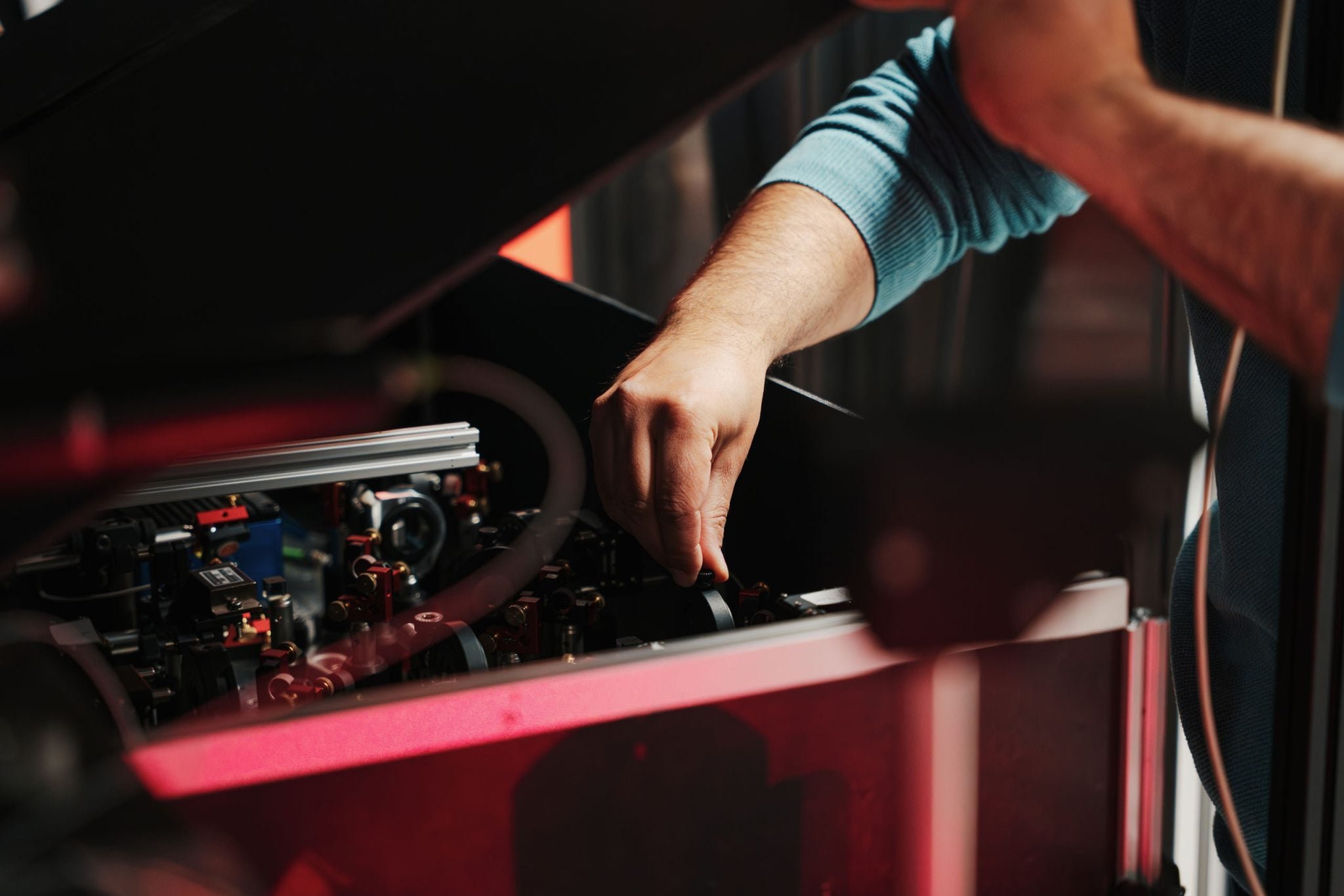
Barontini trapped the atoms in a conservative potential, which means the cloud could evolve with very little energy leaking away during the experiment. That isolation mattered. A clockless test of time needs a system whose behavior comes mostly from its own internal dynamics.
The atom cloud was divided by a thin optical barrier made with laser beams. One side became the observed “bright” region, while the other became the unobserved “dark” region. Atoms could move between the two regions, changing how particles were distributed across the system.
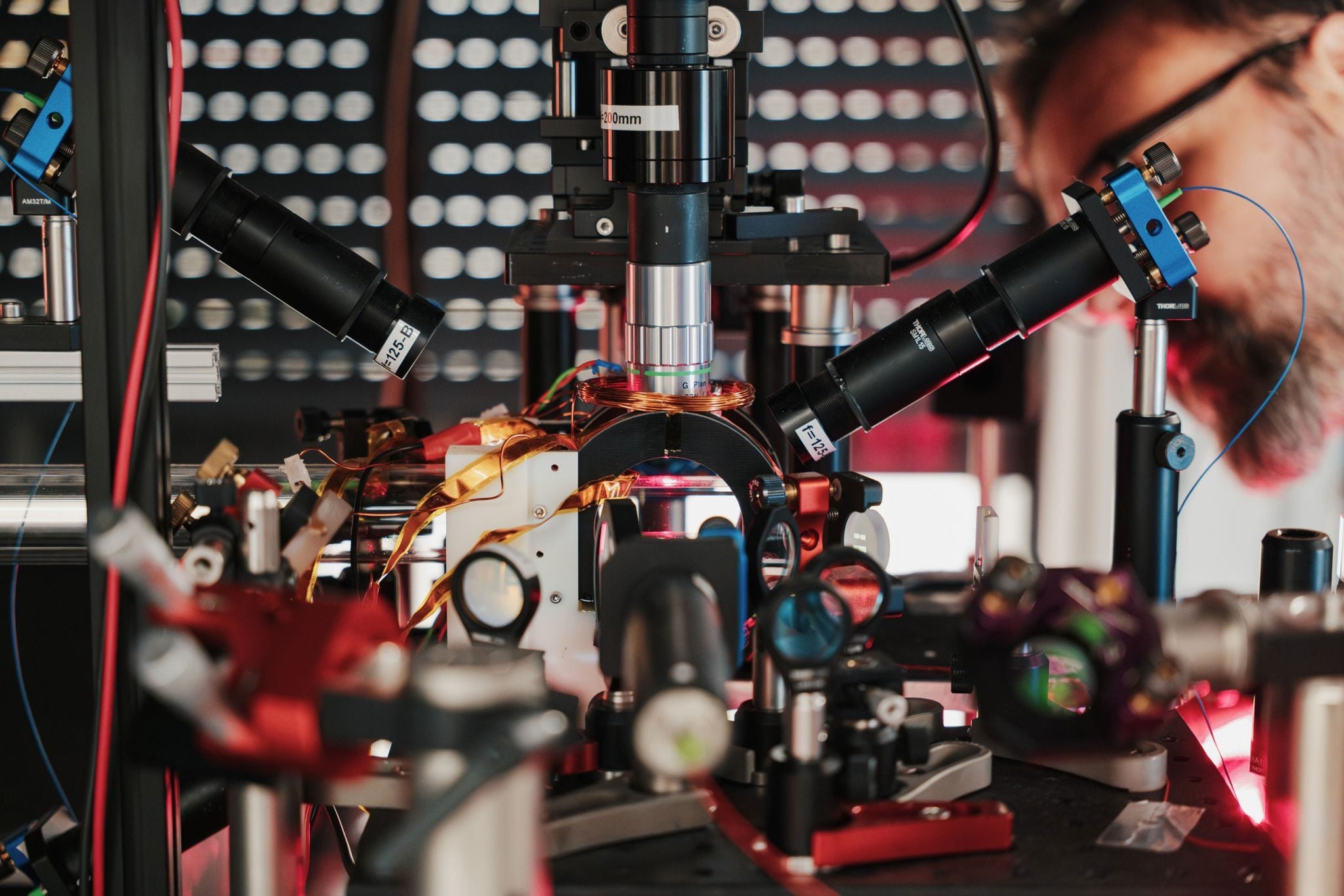
In this simplified world, the bright region played the role of the part of the universe an observer can access. The dark region served as everything outside that observer’s direct view. The setup gave the researchers a clean way to ask how an observer could reconstruct time from changes inside a sealed quantum system.
How Time Appeared Inside the System
Inside the bright region, the atoms repeatedly spread out and came back together. The motion resembled a miniature cycle of expansion and recollapse. In broad cosmological language, that pattern echoes a Big Bang followed by a Big Crunch.
The key point was the order of events. The researchers could reconstruct the system’s history by watching how the bright region changed. The sequence did not require a clock sitting outside the atomic cloud. The changes inside the system carried enough information to arrange events in a meaningful order.
This is where the experiment touches one of physics’ deepest puzzles. In everyday life, time feels like a steady flow from earlier to later. Many fundamental equations can run forward or backward with equal validity. Barontini’s experiment explored how a direction of time can appear in a quantum system whose overall laws remain highly controlled.
Professor Barontini described the puzzle clearly: “In some theories of the universe, especially quantum gravity, time doesn’t appear as a built‑in feature.” That sentence points to the heart of the problem. If the most basic description of the universe lacks an external clock, physicists still need a way to explain why events seem ordered.
The laboratory system offered a practical answer. The observed region changed in a way that let researchers mark “before” and “after” from within the experiment. That internal ordering is the central idea behind relational time, where time is inferred from how parts of a system change relative to each other.
Entropy Becomes a Clock
Barontini’s study focused on entropy, a measure linked to how particles spread among possible arrangements. In simple terms, entropy tracks how much information is needed to describe the system’s visible state. When atoms moved between the bright and dark regions, the entropy of the observed region changed.
Those entropy changes became a kind of internal clock. When the particle distribution in the bright region shifted, the system advanced through a sequence of states. When the distribution stopped changing, the internal measure of time stopped advancing as well.
This form of entropic time has several useful features. It moves in one direction for the observed region. It can order events during both expansion and recollapse. It can also speed up or slow down depending on how quickly entropy is redistributed inside the atom cloud.
Barontini connected that behavior to ordinary experience with another short observation: “Yet in everyday life, time flows from past to future.” The experiment asks how that flow could emerge from the behavior of matter itself. It does so with atoms that can be trapped, tuned and measured under laboratory conditions.
The idea is subtle because the whole quantum system remains carefully isolated. The bright region still behaves as though it has a time direction because it exchanges atoms and information with the dark region. In that sense, the arrow of time comes from the relationship between what is observed and what remains hidden.
A Quantum Test of an Old Cosmology Problem
The physics question behind the work is often called the problem of time. It appears in attempts to combine quantum mechanics with gravity. One famous example is the Wheeler-DeWitt framework, where the universe can be described by a quantum state with no external time parameter.
That creates a challenge for physicists. If the universe as a whole has no outside clock, then time must be recovered from relationships within the universe. A planet’s orbit, an atom’s transition, or a change in entropy can act as a marker only because it changes relative to something else.
Barontini’s experiment tested this idea with cold atoms instead of the entire cosmos. The system was small, controlled and repeatable. That makes it valuable, because theories of quantum cosmology often reach beyond direct observation.
The study abstract summarizes the aim with unusual directness: “We realize a cold-atom system to quantitatively test relational constructions of time.” In the experiment, this meant building a physical system where internal degrees of freedom could be used to order events.
Repeated cycles of expansion and recollapse strengthened the test. The observed region went through changing states again and again. Entropic time still arranged those events consistently, which suggests that the internal measure worked across more than a single simple motion.
Why the Schrödinger Equation Still Works
The study also tackled a key technical question. Quantum mechanics relies on the Schrödinger equation to describe how a system’s probability cloud evolves. That equation usually uses time as an input. Barontini showed that a version of the equation can be written using the system’s internal entropic time.
This matters because it connects the clockless idea to standard quantum physics. The atom cloud did not merely produce a philosophical picture of time. Its measured evolution could still be reproduced with a familiar quantum framework once entropic time was used as the parameter.
For general readers, the probability cloud can be thought of as the map of where particles are likely to be found. In the experiment, that map changed as atoms moved through the trap. The researchers found that those changes could be described using the internally defined time.
The result helps keep the proposal grounded. A theory of emergent time needs to do more than arrange events after the fact. It should also help predict how the system changes. The effective Schrödinger equation gave the researchers a way to compare their internal-time description with actual measurements.
That comparison is important for future work. A laboratory model gains scientific power when it produces numbers that can be tested. In this case, entropic time became a tool for predicting quantum evolution, rather than only a metaphor for time’s arrow.
What This Could Mean for Black Holes and the Early Universe
The experiment does not recreate the real universe. It offers a controlled platform for testing ideas inspired by quantum cosmology. That distinction matters because the cold-atom system is a model and its value comes from how precisely physicists can manipulate it.
Even so, the implications are wide. The method could be extended to more complex systems, where researchers can study richer forms of internal dynamics. That may help physicists probe questions linked to the early universe, cosmic expansion, recollapse scenarios and black-hole analogs.
Laboratory analogs have become useful across modern physics. They let researchers explore difficult gravitational or cosmological ideas using systems that obey related mathematical rules. In this case, the analog is built from a Bose-Einstein condensate, laser barriers and a carefully isolated atomic cloud.
The work also gives quantum gravity researchers a rare experimental test bed. Many proposed ideas about time are difficult to check because they concern the universe as a whole. A cold-atom platform can be adjusted and repeated, which makes it attractive for comparing different models of how time might emerge.
Future versions may involve larger or more intricate quantum systems. Researchers could change the barrier, tune the interactions, or alter how the observed and unobserved regions exchange atoms. Each version would test how robust internal time is under new conditions.
For now, the University of Birmingham experiment turns a cosmic question into a lab measurement. A tiny cloud of atoms showed that a system can order its own events through internal change. That makes emergent time something physicists can investigate with instruments, data and repeatable quantum experiments.