Researchers with the Pierre Auger Collaboration have used 15 years of observations to investigate two mysterious radio signals recorded above Antarctica. According to a Penn State announcement, the analysis found no comparable upward-going particle showers in data from the vast Pierre Auger Observatory. That result sharply narrows one of the leading explanations for the decades-old puzzle.
The signals were detected by NASA’s Antarctic Impulsive Transient Antenna, known as ANITA, during balloon flights in 2006 and 2014. Both bursts appeared to rise from deep below the horizon at steep angles. Their geometry implied that an energetic particle had crossed thousands of kilometers of solid Earth before producing a shower of secondary particles in the atmosphere.
Known particles struggle to make such a journey at the estimated energies. Even neutrinos, which usually pass through matter with ease, become more likely to collide with atoms as their energy rises. Physicists have spent years testing particle models and unusual effects in Antarctic ice, yet the origin of the two bursts remains unsettled.
What ANITA detected above Antarctica
ANITA was built to search for ultrahigh-energy neutrinos arriving from some of the most violent environments in the universe. Its radio antennas hung beneath a balloon that drifted roughly 37 to 40 kilometers above Antarctica. From that height, the instrument could monitor an immense area of ice.
When a sufficiently energetic particle strikes matter, the collision can create a cascade of secondary particles called an air shower. The charged particles in that shower generate a brief radio flash. ANITA listened for those flashes in the atmosphere and within the ice below.
Most cosmic-ray events recorded by the instrument followed familiar patterns. Downward-moving cosmic rays produced air showers whose radio waves bounced from the ice before reaching the balloon. Two steep events looked different. Their waveforms carried the signature expected from signals moving upward toward the detector.
Those two detections were rare. They appeared during separate flights eight years apart, which reduced the information available for comparison. Each pulse lasted only a tiny fraction of a second, yet its direction and waveform created a problem that has persisted for nearly two decades.
Why the signals appeared impossible
The key clue lies in radio pulse polarity. A radio wave reflected from the Antarctic surface usually undergoes a predictable phase reversal. Physicists can use that reversal to distinguish a reflected downward shower from a pulse that reaches the antennas directly.
The two anomalous events lacked the expected reflection signature. Their waveforms suggested that the radio emission had traveled straight toward ANITA from below. The inferred arrival angles were especially steep, reaching about 30 degrees below the horizon.
“The radio waves that we detected nearly a decade ago were at really steep angles, like 30 degrees below the surface of the ice,” said Stephanie Wissel, a Penn State physicist who worked on ANITA.
At that angle, the particle associated with the signal would have needed to pass through a large portion of Earth. The problem grows more severe at energies near 0.6 exa-electronvolts. A particle carrying that much energy has a greater chance of interacting with matter during its passage through the planet.
The 6,000-kilometer journey through Earth
Earth’s diameter is about 12,700 kilometers. The trajectories reconstructed from the ANITA events suggest paths through roughly 6,000 kilometers of rock and other dense material. Ordinary cosmic rays would be stopped long before completing that route.
Photons, electrons and protons interact readily with matter. Muons can penetrate substantial distances under some conditions, yet they also lose energy and decay. None offers a straightforward explanation for the observed geometry and energy.
Neutrinos are much more elusive. Trillions pass through the human body every second because they rarely interact with atoms. Their behavior changes at extreme energies. An ultrahigh-energy neutrino crossing thousands of kilometers of Earth faces a significant probability of being absorbed before it can emerge.
This makes the ANITA events difficult to place within the Standard Model, the framework describing known fundamental particles and their interactions. The recorded pulses have recognizable air-shower features, while their apparent paths create severe problems for conventional particle physics.
How scientists tested the neutrino explanation
One prominent hypothesis involved tau neutrinos. When a tau neutrino interacts with matter, it can produce a short-lived particle called a tau lepton. If that lepton emerges from the ground and decays in the atmosphere, it can generate an upward-moving air shower.
The mechanism provides a natural way to create a radio burst that appears to rise from Earth. It works best for trajectories that skim the planet’s surface. The steep angles measured by ANITA require a much longer passage through dense material, which makes survival increasingly unlikely.
Scientists could test the idea by examining data from other observatories. A particle population intense enough to produce ANITA’s events should leave related signatures in detectors with long observing times and large collection areas.
IceCube at the South Pole and the Pierre Auger Observatory in Argentina offered independent checks. Both experiments observe high-energy particles through different detection methods. Their records provide an important test of whether ANITA sampled a broader population of upward-going showers.
What Pierre Auger found after 15 years
The Pierre Auger Observatory covers about 3,000 square kilometers in Argentina. Its detectors measure extensive air showers created when energetic particles enter the atmosphere. The observatory’s long exposure makes it a powerful tool for searching for exceptionally rare events.
Researchers examined 15 years of Auger data for upward-going showers resembling the signals inferred from ANITA. They found no matching events that could account for the Antarctic anomalies. The absence places strong constraints on models that predict a substantial flux of ultrahigh-energy tau neutrinos.
Auger’s result does not identify the origin of the two radio bursts. It reduces the likelihood that a conventional population of cosmic neutrinos produced them. Any successful explanation must account for ANITA’s detections and the silence of other major observatories.
“It’s an interesting problem because we still don’t actually have an explanation for what those anomalies are,” Wissel said. The limited sample prevents researchers from building a detailed statistical picture of the phenomenon.
Could Antarctic ice produce the signals?
Some proposed explanations focus on Antarctica itself. The upper layers of the ice sheet contain compacted snow called firn. Density and refractive properties change with depth, creating boundaries that can bend or reflect radio waves in complicated ways.
A downward cosmic-ray signal could potentially follow an unexpected route through these layers. Under the right conditions, a subsurface reflection might produce a waveform that resembles a direct upward event. Researchers have also considered transition radiation, which can appear when charged particles cross boundaries between materials with different electromagnetic properties.
The relevant geometry is challenging to reproduce. Any ice-based model must generate the correct arrival angle, pulse shape and polarity while remaining consistent with the many ordinary events ANITA detected. Local surface features and poorly mapped internal layers may also influence radio propagation.
“My guess is that some interesting radio propagation effect occurs near ice and also near the horizon that I don’t fully understand,” Wissel said. Continued laboratory measurements and field observations could reveal whether an overlooked ice mechanism can mimic the anomalous signals.
Particles beyond the Standard Model
The unresolved geometry has inspired models involving particles that interact even more weakly than known neutrinos. One candidate is the sterile neutrino, a hypothetical particle that could travel through Earth with a lower chance of absorption. Physicists have searched for sterile neutrinos in many experiments, with no conclusive detection so far.
Other proposals involve supersymmetry. In some versions of that framework, a long-lived partner of the tau lepton could cross dense matter and later decay into visible particles. Dark matter decay inside Earth and hypothetical magnetic monopoles have also appeared in theoretical studies of the ANITA events.
These ideas remain speculative. Each requires assumptions about particles that have yet to be independently observed. A credible new physics explanation would also need to match the measured waveforms and explain why similar events have remained absent from larger datasets.
The unusual signals therefore serve as motivation for careful testing rather than evidence for a particular undiscovered particle. Confirmation by another detector would transform the discussion. A conventional radio explanation would provide valuable information about how signals travel through polar ice.
Why two events remain so difficult to explain
Two detections offer very little statistical leverage. Researchers cannot map changes in direction, energy or local ice conditions across a large sample. A rare instrumental effect can also be difficult to identify when it occurs only once during a flight.
ANITA’s unusual observing environment adds further complications. The balloon moved continuously above a continent with ridges, buried layers and changing surface conditions. Radio waves could encounter complex paths before reaching its antennas. Simulations can explore those possibilities, but their accuracy depends on detailed knowledge of the ice.
Independent observatories face a different challenge. Their failure to detect matching showers constrains the particle interpretation, yet each instrument has its own energy range and viewing geometry. Comparing them requires models of how often the proposed particles should appear in each detector.
The anomaly has endured because the original events remain plausible radio detections while every major interpretation carries difficulties. The data preserve enough structure to invite physical explanations and too few examples to identify a unique cause.
How PUEO could solve the mystery
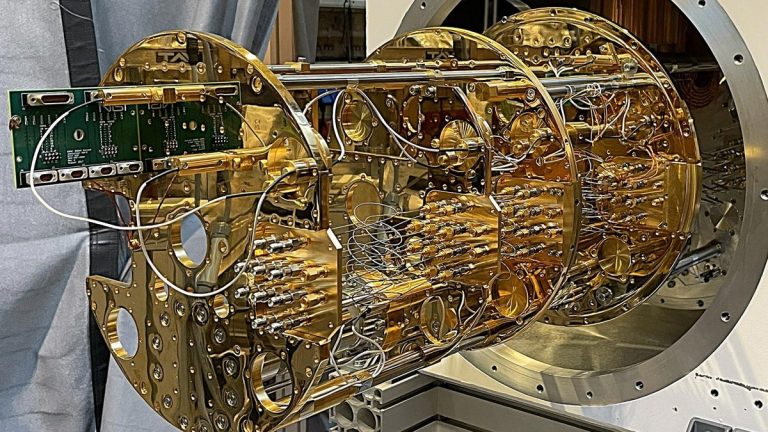
A planned successor called the PUEO balloon experiment, short for Payload for Ultrahigh Energy Observations, is designed to search the Antarctic ice with greater sensitivity. The international project includes researchers from Penn State, the University of Chicago and several other institutions.
PUEO will use a larger and more capable radio instrument than ANITA. Improved sensitivity should allow it to detect fainter neutrino signals and collect a larger sample of cosmic-ray events. It will also be better equipped to test whether steep upward-looking pulses recur.
A repeat detection would give physicists new waveforms, directions and environmental conditions to compare. Several matching events could reveal whether the phenomenon follows a particle-like distribution or tracks particular features in the ice. A long search with no recurrence would place tighter limits on many proposed explanations.
“In principle, we should be able to better understand these anomalies which will go a long way to understanding our backgrounds and ultimately detecting neutrinos in the future,” Wissel said. Future observations could turn two fleeting pulses into evidence for an unexpected radio effect or a deeper discovery about fundamental particles. Until then, the Antarctic signals remain among the most persistent puzzles in ultrahigh-energy particle physics.