CERN has brought the Large Hadron Collider’s latest physics run to a close, according to an official CERN announcement, as the world’s most powerful particle accelerator prepares for a four-year transformation into the High-Luminosity LHC. The upgraded machine is scheduled to begin operation in June 2030, with far more particle collisions and a sharper view of rare physics events.
The shutdown marks a major turning point for the 27-kilometer ring beneath the French-Swiss border near Geneva. After years of smashing protons together at extreme energies, the Large Hadron Collider is being rebuilt in key sections so it can collect vastly more data. Scientists hope that flood of collisions will help them study the Higgs boson in finer detail and search for hints of dark matter.
For particle physicists, the upgrade is a bet on patience and precision. Rare events can hide inside billions of ordinary collisions. By increasing the collision rate, CERN is giving its experiments more chances to catch signals that have remained out of reach.
The LHC enters a four-year transformation
The LHC’s current physics run ended in June 2026, followed by high-intensity beam tests before the full shutdown. The long pause will allow engineers and physicists to replace equipment, install new systems and prepare the machine for its next era.
CERN calls this next machine the High-Luminosity LHC, often shortened to HL-LHC. In particle physics, luminosity describes how many collisions a collider can produce over time. A higher-luminosity machine gives detectors more events to study.
Gautier Hamel de Monchenault, CERN Director for Research and Computing, described the moment as a transition for the laboratory. “We are turning a page, but the LHC data is far from having yielded all its results,” he said.
That point matters because the end of collisions does mean the end of discovery work from the current run. Existing data will keep physicists busy for years as collaborations refine measurements and search for unusual patterns. Hamel de Monchenault added that the data “will continue to be analysed by our collaborations in the years ahead.”
The physical upgrade will focus on the sections of the machine that control and squeeze the particle beams before they collide. Once the work is finished, CERN expects the accelerator to run for about a decade in its high-luminosity configuration.
Why more collisions matter
Particle physics often advances by collecting enough data to see something incredibly rare. A single unusual event can be interesting. A repeated pattern, measured with care, can point toward a new particle or a deeper rule of nature.
The HL-LHC is designed to raise the LHC’s total collision output by a factor of 10 compared with the original machine. According to the reported upgrade goals, that increase could allow experiments to collect up to 100 times more data over the machine’s high-luminosity lifetime.
Inside the detectors, collisions happen when packets of particles meet. Today, each crossing produces about 60 collisions. After the upgrade, CERN expects roughly 140 to 200 collisions each time two packets meet. That crowded environment will make the measurements harder, but it will also increase the odds of catching rare processes.
Those rare processes are central to the search for physics beyond the Standard Model. The Standard Model describes the known fundamental particles and forces with remarkable accuracy. Even so, it leaves major cosmic questions open, including the identity of dark matter and the nature of dark energy.
Scientists estimate that ordinary matter makes up about 5 percent of the universe. Dark matter accounts for about 27 percent, while dark energy accounts for about 68 percent. The LHC cannot see dark matter directly in the ordinary sense, but its detectors can look for missing energy and other signs that invisible particles may have been produced.
New magnets will tighten the beams
The most visible parts of the upgrade will be hidden underground. CERN plans to replace components across about 1.2 kilometers of the 27-kilometer tunnel. That is a small fraction of the ring by distance, yet it includes some of the machine’s most demanding equipment.
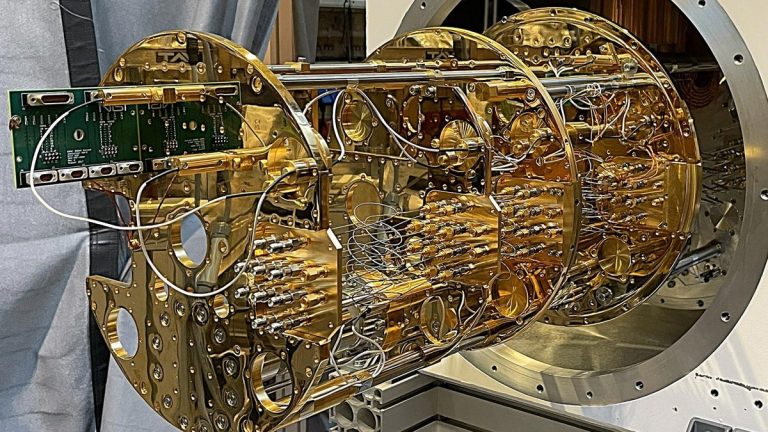
New superconducting magnets will help squeeze the particle beams more tightly before they enter the experiments. When beams are more concentrated, more protons meet head-on. That raises the number of collisions and boosts the chance of seeing rare interactions.
Superconducting technology is essential because the LHC operates at extreme conditions. Its magnets guide and focus particles moving close to the speed of light. To do that, the magnets must carry huge electrical currents with exceptional stability.
The upgrade also demands careful integration with the existing accelerator. The LHC is a massive scientific instrument built from thousands of interconnected systems. Any new component has to work with cryogenics, electrical power, beam controls, safety systems and the experiments themselves.
The cost of the renovation has been reported at about 1.2 billion Swiss francs, or roughly $1.5 billion. CERN member contributions will cover the main cost, with additional in-kind contributions from international partners including the United States, Japan, Canada and China.
AI will help sort the flood of data
The upgraded collider will produce a staggering number of collisions. Several billion events per second can occur inside the detectors and only a fraction can be stored for later analysis. That creates one of the central challenges of the HL-LHC era.
Experiments such as ATLAS and CMS rely on trigger systems that decide which events to keep. These systems must act almost instantly. They search for signs of interesting physics while most collisions are still being discarded.
Artificial intelligence will play a growing role in that selection process. AI tools can help identify promising events in real time, especially when the detector environment becomes more crowded. The goal is to preserve the most scientifically valuable data before it disappears from the live stream.
This approach is especially important because rare physics can resemble ordinary background activity. A useful algorithm has to spot subtle patterns while keeping errors under control. Physicists will still design, test and validate those systems.
The challenge is part engineering and part scientific judgment. If the detectors record too much, storage and analysis become unmanageable. If they record too little, rare discoveries could be missed. The HL-LHC will force experiments to make those choices faster than ever.
The Higgs boson gets a deeper test
The LHC is best known for the 2012 discovery of the Higgs boson, a particle linked to the mechanism that gives other particles mass. That discovery confirmed a long-standing prediction and helped earn Peter Higgs and François Englert the 2013 Nobel Prize in Physics.
The next phase will turn the Higgs from a discovery into a precision tool. CERN expects the HL-LHC to produce around 380 million Higgs bosons over its operating lifetime. Since LHC operations began in 2008, the machine has produced about 55 million.
With many more Higgs bosons, physicists can measure the particle’s behavior in greater detail. They can test how often it forms, how it decays and whether those numbers match the Standard Model. Small deviations could point toward unknown particles or forces.
One of the most prized goals is to produce two Higgs bosons at once and study how they interact. This process is extremely rare. Observing it would give scientists a direct window into the Higgs field’s self-interaction, a feature tied to how the universe settled into its present state after the Big Bang.
The HL-LHC’s value comes from statistical power. A larger sample lets researchers shrink uncertainties and separate faint signals from noise. In a field where tiny differences matter, more cleanly measured events can change the picture.
What scientists hope to find in 2030
By June 2030, CERN plans to bring the upgraded collider online for a new decade of exploration. The experiments will return to familiar questions with far stronger tools. They will also pursue discoveries that cannot be predicted in detail today.
Dark matter remains one of the biggest targets. Astronomers see its gravitational effects in galaxies and large-scale cosmic structure. Particle physicists want to know whether it is made of one or more unknown particles that can be produced in high-energy collisions.
The HL-LHC will also search for other forms of new physics. These may include heavy particles, rare decays, unusual Higgs behavior, or signs connected to extra dimensions. Each possibility requires careful comparison with known physics and large amounts of data.
Even if the upgraded collider finds no new particle, its measurements will still tighten the boundaries of what nature allows. Stronger limits can rule out theories and guide future machines. In modern physics, a more precise answer can be as useful as a dramatic signal.
The four-year pause is therefore an investment in discovery. When the beams return, the LHC will become a more powerful microscope for the smallest known scales of matter. Its next run could clarify the Higgs boson, sharpen the search for dark matter and reveal whether the universe is hiding new particles in plain sight.