News

RSS Feed
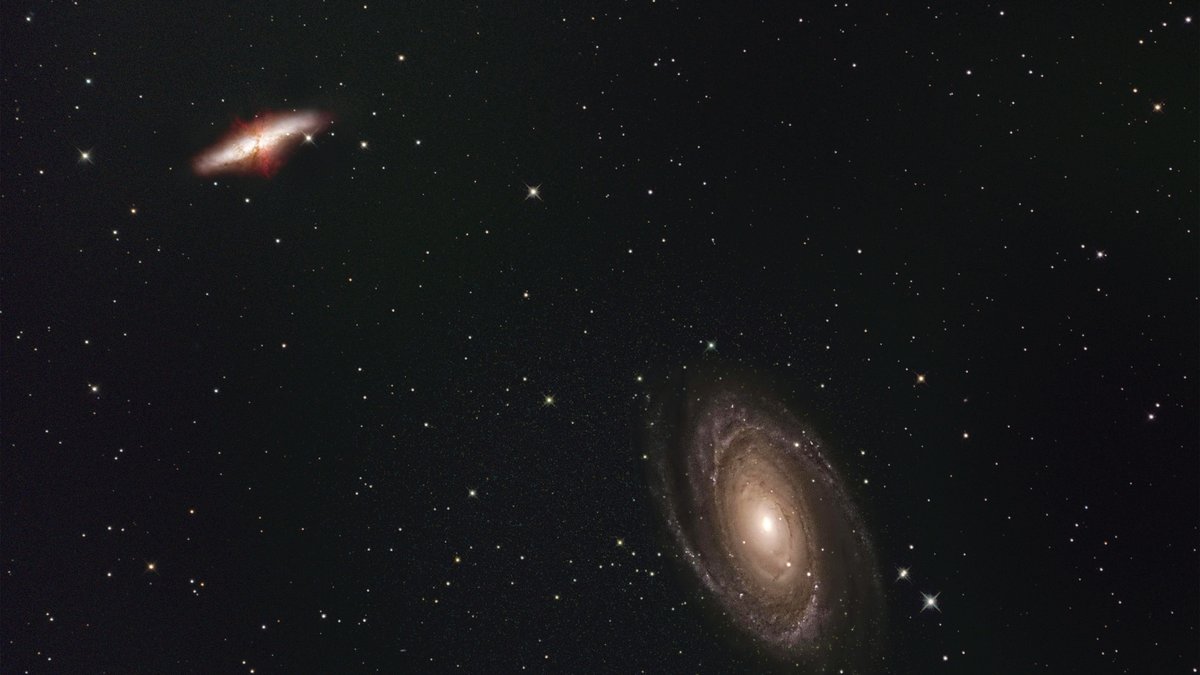
Captivating image of a spiral galaxy and surrounding star field, highlighting deep space beauty

Webb reveals a collision-scarred galaxy with a hidden, restless heart

NASA’s official Webb announcement shows how near- and mid-infrared vision can peel back the dusty center of Centaurus A, a nearby galaxy reshaped by a major cosmic collision. Released for the James Webb Space Telescope’s fourth science anniversary, the new images reveal millions of stars, intricate dust structures and activity around a feeding supermassive black…

More

More in News

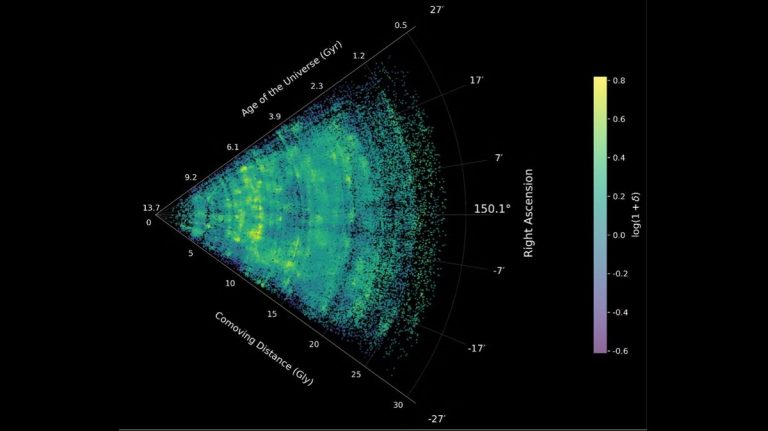
A "slice" of the cosmic web, as reconstructed through COSMOS-Web data. The vertex at left represents the present day, while the opposite edge reaches back to when the universe was less than 1 billion years old. Brighter, yellower regions represent dense areas containing galaxies, while dark regions show empty regions of space called voids. (Image

James Webb’s largest survey reveals the universe’s hidden cosmic web

Researchers at the University of California, Riverside have used NASA’s James Webb Space Telescope to produce the most detailed map yet of the cosmic web, the vast structure that organizes galaxies across the universe. The work uses data from COSMOS-Web, the largest JWST survey conducted so far, to trace galaxy environments back toward the universe’s…

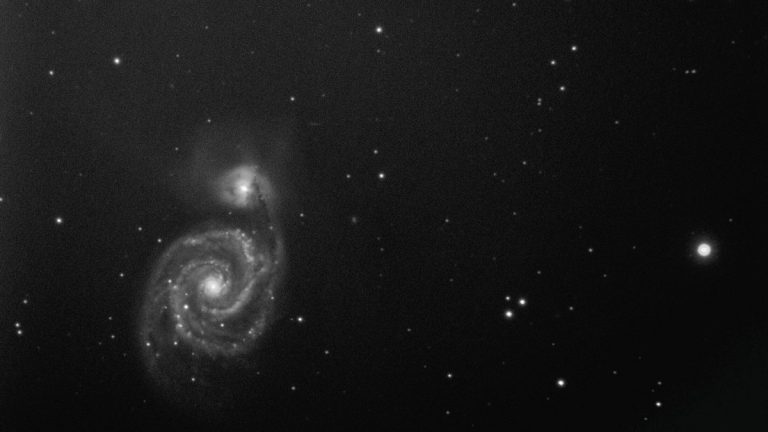
A captivating black and white image of a spiral galaxy in the expansive cosmos

JWST finds a mature barred spiral galaxy in the infant universe

A study posted to arXiv pushes one of galaxy evolution’s most important milestones deep into cosmic history. Researchers led by Xiaohan Wang of Tsinghua University report that JWST, with support from the Hubble Space Telescope, has identified M1149-BSG-z5, a massive barred spiral galaxy candidate seen when the universe was less than 1.2 billion years old.…

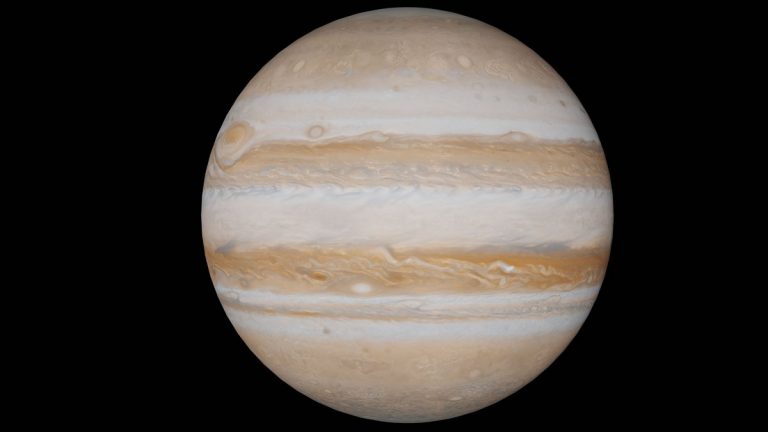
Detailed view of Jupiter showing its banded cloud layers in space

Jupiter’s clouds may hide far more oxygen than the Sun

Researchers at the University of Chicago and NASA’s Jet Propulsion Laboratory have sharpened one of planetary science’s biggest origin clues with a Jupiter study in The Planetary Science Journal. Their simulations suggest that Jupiter’s deep atmosphere may contain about 1 to 1.5 times the Sun’s oxygen abundance, a result that points to a planet built…