Researchers at the University of California, Riverside have used NASA’s James Webb Space Telescope to produce the most detailed map yet of the cosmic web, the vast structure that organizes galaxies across the universe. The work uses data from COSMOS-Web, the largest JWST survey conducted so far, to trace galaxy environments back toward the universe’s first billion years.
The stakes are enormous because the cosmic web is the universe’s largest known architecture. Galaxies gather along its filaments, sheets, clusters and knots. Between them stretch immense voids. By mapping that structure with Webb’s infrared vision, astronomers can watch how galaxies grew, aged and sometimes stopped making stars across most of cosmic history.
Published in The Astrophysical Journal, the study was led by an international team that includes researchers at University of California, Riverside. Lead author Hossein Hatamnia, a graduate student at UCR and Carnegie Observatories, described why the survey matters: “JWST has completely changed our view of the universe and COSMOS-Web was designed from the start to give us the wide, deep view we need to see the cosmic web.”
JWST maps the cosmic web in record detail
JWST gave astronomers a sharper way to place galaxies within the universe’s immense scaffolding. COSMOS-Web collected observations across a wide patch of sky, using Webb’s ability to detect faint infrared light from galaxies that are extremely distant. That light has traveled for billions of years before reaching the telescope.
The survey covered a contiguous area of sky roughly the size of three full moons. For deep-universe work, that is a broad view. Many Webb studies stare deeply at narrow regions. COSMOS-Web combines depth with area, which lets researchers compare galaxies in crowded regions with galaxies in emptier ones.
Those comparisons are crucial. A single galaxy can look like an isolated island in a telescope image. In reality, its history is tied to its surroundings. A galaxy inside a dense cosmic knot may grow under different conditions than one drifting through a quieter region.
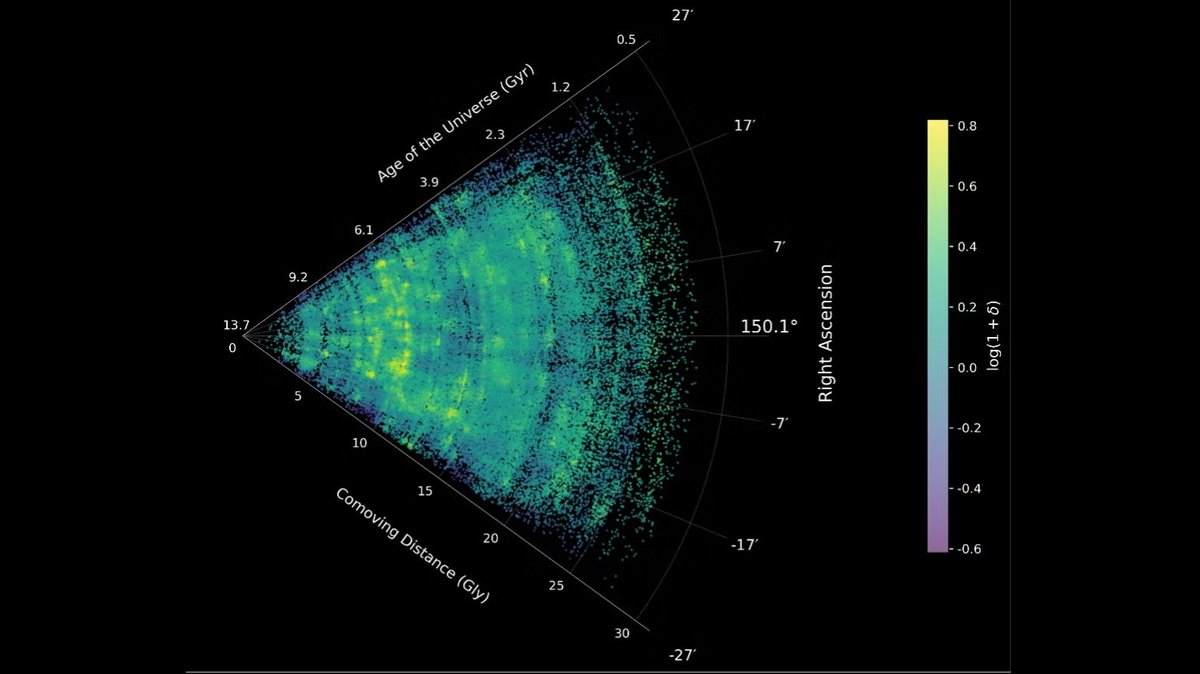
Using this survey, the team identified large-scale structures traced by galaxies. The resulting map shows clusters, filaments, groups and lower-density regions across deep time. It also improves on earlier maps of the same part of the sky by adding fainter, lower-mass and more distant galaxies.
Bahram Mobasher, a distinguished professor of physics and astronomy at UCR and Hatamnia’s advisor, emphasized the scale of the improvement. “The jump in depth and resolution is truly significant,” he said.
A 13-billion-year view of galaxy growth
COSMOS-Web gives researchers a time machine built from light. The farther away a galaxy is, the longer its light has traveled. That means astronomers see distant galaxies as they were in the past. With enough galaxies and enough distance estimates, they can build slices of cosmic history.
The study traces galaxy evolution across more than 13 billion years. It reaches to redshift values around 7, which corresponds to a very early era in the universe. Redshift measures how much the expansion of space has stretched a galaxy’s light toward longer wavelengths.
Webb is especially powerful for this task because ancient galaxies glow strongly in infrared wavelengths by the time their light reaches us. Earlier telescopes gave astronomers major pieces of the story. Webb adds far more detail in the distant universe, where many galaxies were too faint for previous surveys to map well.
Mobasher captured that change in a second quote from the UCR announcement: “We can now see the cosmic web at a time when the universe was only a few hundred million years old.” That early reach matters because the first generations of galaxies helped seed the structure that later became today’s clusters and filaments.
The researchers also compared their Webb-based reconstruction with COSMOS2020, a previous survey built from Hubble Space Telescope data and observations from other facilities. Webb’s sharper view improves redshift precision and gives a clearer sense of how galaxies are arranged in three dimensions.
How dense regions shaped early galaxies
The new map lets astronomers ask a deceptively simple question. Does a galaxy’s neighborhood change its life? The study suggests that it does and that the answer has changed over cosmic time.
In the early universe, dense regions appear to have been powerful sites of growth. Gas, dark matter and young galaxies gathered along the web’s thickest strands. These areas supplied the raw material for rapid star formation and galaxy buildup.
That pattern fits the broad picture of galaxy evolution. Gravity pulls matter into clumps. The clumps grow into halos. Gas falls in, cools and forms stars. Over time, galaxies merge and build larger systems. The cosmic web provides the landscape where those events unfold.
The Webb map helps reveal that landscape with better contrast. In earlier maps, dense regions could appear blurred or misplaced along the line of sight. The UCR-led team reported that the new reconstruction preserves more of the contrast between crowded and sparse cosmic environments.
This matters because environment can influence a galaxy’s future. A galaxy in a dense region may encounter other galaxies more often. It may also sit inside hotter gas or deeper gravitational wells. Those conditions can accelerate growth at one stage and limit star formation at another.
Why star formation slowed across cosmic time
Star formation across the universe reached its peak billions of years ago. Astronomers often call that peak “cosmic noon,” when galaxies were forming stars at a much higher rate than they do today. The new study adds a detailed environmental map to that story.
In the earlier universe, the densest parts of the web were associated with rapid galaxy growth. Later on, dense environments became more closely linked with galaxies that had slowed or stopped forming stars. These galaxies are often called quiescent galaxies.
Several processes can shut down star formation. One involves mass. When a galaxy’s surrounding halo grows extremely large, gas can become heated and remain too energetic to collapse easily into new stars. The research notes that halos around 1 trillion solar masses are an important scale for this kind of change.
Dark matter halos act as gravitational anchors for galaxies. They cannot be seen directly through ordinary light, yet their gravity shapes where gas and stars collect. When these halos become massive enough, they can change how gas behaves inside and around a galaxy.
Supermassive black holes may also play a role. When actively feeding, they can launch energetic jets and outflows that heat surrounding gas. In the more recent universe, galaxy environment becomes increasingly important as well. Crowded regions can strip galaxies of gas or keep fresh cold gas from settling in.
COSMOS-Web opens the map to astronomers
The COSMOS field has long served as a shared window on the distant universe. It has been observed by many telescopes across different wavelengths. That history gives astronomers a rich background for interpreting the new Webb data.
The UCR-led team is releasing the large-scale structure maps publicly, following the open-science tradition of the COSMOS project. The catalog used for the cosmic web reconstruction includes about 164,000 galaxies. That public release should help other scientists test galaxy formation models and compare theory with observation.
The map can also guide future research. Astronomers can use it to choose galaxies in specific environments, such as dense knots, filaments, or void-like regions. That makes it easier to study how location affects shape, mass, star formation and the growth of central black holes.
For general readers, the most striking result is visual and conceptual. Webb is showing that galaxies are part of a larger cosmic pattern, one that stretches across nearly the whole history of the universe. The map turns faint points of infrared light into a record of structure, growth and decline.
The next steps will come from combining COSMOS-Web with other surveys and deeper follow-up observations. Each new dataset can sharpen the timeline of how matter gathered into the web. With Webb, astronomers now have one of their clearest views yet of the universe’s giant frame.