Researchers at the University of Chicago and NASA’s Jet Propulsion Laboratory have sharpened one of planetary science’s biggest origin clues with a Jupiter study in The Planetary Science Journal. Their simulations suggest that Jupiter’s deep atmosphere may contain about 1 to 1.5 times the Sun’s oxygen abundance, a result that points to a planet built with help from ice-rich material in the early solar system.
The finding reaches beneath the familiar stripes and storms that make Jupiter so spectacular through a telescope. Oxygen on Jupiter is mostly tied up in water and much of that water is thought to lie far below the visible cloud tops. That makes the planet’s hidden chemistry difficult to measure directly, even for spacecraft designed to study the giant world at close range.
To get around that barrier, the research team combined chemistry and atmospheric motion in a detailed computer model. The result offers a new estimate for Jupiter’s deep oxygen, while also suggesting that material moves through the planet’s deep atmosphere much more slowly than many models have assumed.
Simulations probe beneath Jupiter’s storms
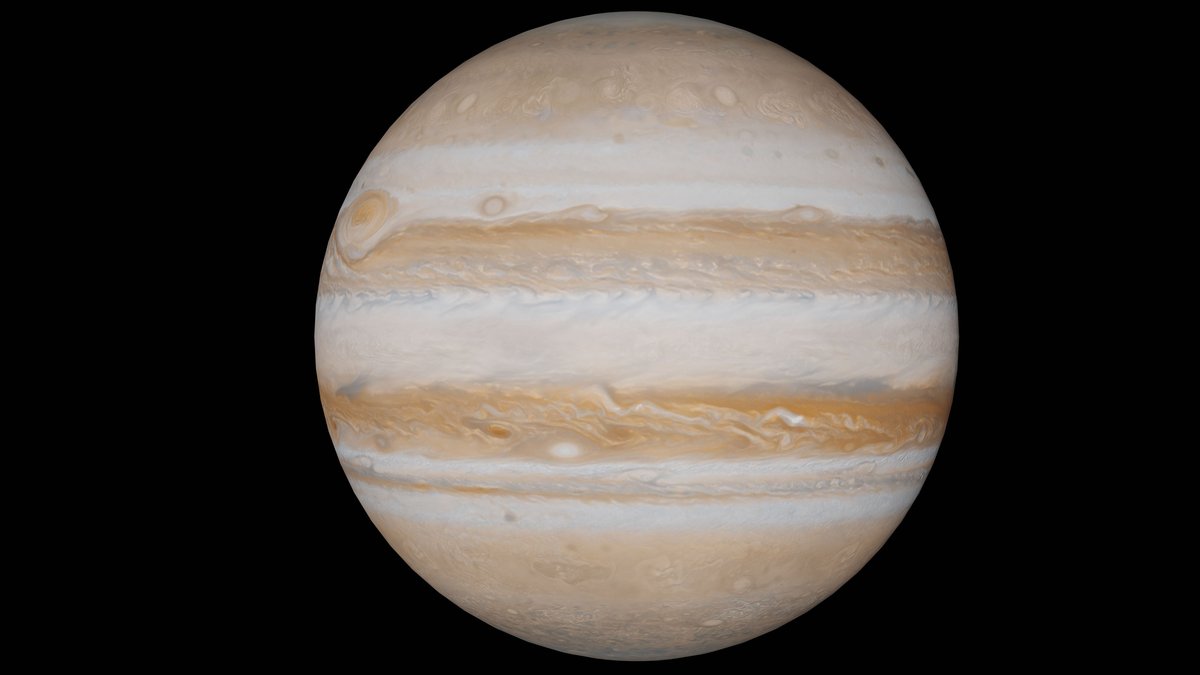
Jupiter’s upper atmosphere is a moving canvas of bright zones, darker belts and huge storm systems. The Great Red Spot alone has been watched for generations. Yet the most important chemical evidence for Jupiter’s formation sits far deeper, in regions that spacecraft and telescopes can only infer indirectly.
The new work focuses on computer simulations that connect two pieces of the puzzle. One part tracks chemical reactions in Jupiter’s atmosphere. The other follows how gases move vertically through the planet’s immense layers. By linking those processes, the team built a more realistic picture of how deep material can influence the gases seen higher up.
A key tracer in the model is carbon monoxide. On Jupiter, carbon monoxide can act as a messenger from hot depths, because its abundance depends on both chemistry and transport. If gases rise too quickly or too slowly, the amount that survives into observable layers changes. That makes carbon monoxide useful for estimating the oxygen locked away below.
The approach matters because Jupiter’s water is hard to pin down. Water carries much of the planet’s oxygen, but it condenses far below the cloud tops that dominate visible images. NASA’s Juno mission has provided important measurements of the planet’s deep atmosphere, gravity and magnetic field. Even so, the global oxygen picture remains a major challenge.
By coupling chemical kinetic transport with 2D hydrodynamic modeling, the study gives researchers a way to test how oxygen abundance, heat and circulation fit together. The result supports a modest supersolar oxygen abundance, rather than an extreme enrichment.
A chemical clue to Jupiter’s birth
The new estimate points toward a Jupiter that incorporated a meaningful amount of frozen material while it was forming. In planetary science, “supersolar” refers to an abundance higher than the Sun’s composition when measured in a standardized way. Here, the key comparison is oxygen abundance relative to hydrogen.
That detail matters because the Sun preserves the basic chemistry of the gas cloud that gave birth to the solar system. A planet with more oxygen than that baseline likely gained extra oxygen-bearing material. For Jupiter, that material would most naturally include water ice.
Early in the solar system’s history, temperatures varied sharply with distance from the young Sun. Far enough out, water could freeze into solid grains and icy bodies. This region is often called the snow line. Beyond it, growing planets could collect ice more easily than planets forming in warmer zones.
If Jupiter grew in or near such a region, icy solids could have become part of the planet as it accumulated gas. That process would enrich the planet in oxygen compared with the Sun’s original mixture. The study’s estimate fits that broad formation picture, while still leaving room for future refinement.
Jeehyun Yang, the study’s lead author and a postdoctoral researcher at UChicago, framed the work as part of a larger debate about giant planets. Jupiter’s chemistry can help reveal where it formed, how it migrated and what kinds of material it swallowed as it grew.
Slower mixing changes the model
The study also suggests that Jupiter’s atmosphere circulates vertically at a slower pace than standard assumptions have often allowed. That change affects the chemistry. It also affects how scientists interpret measurements from the upper atmosphere.
“Our model suggests the diffusion would have to be 35 to 40 times slower compared to what the standard assumption has been,” Yang said.
In practical terms, that means a molecule may take weeks to move through a layer of Jupiter’s atmosphere. Earlier assumptions could make that journey seem more like a matter of hours. The slower pace gives chemical reactions more time to reshape gases before they reach levels that can be observed.
This is where the model becomes especially useful. Atmospheric chemistry and vertical motion influence each other. A gas rising from hotter layers may begin with one chemical identity, then shift as pressure and temperature change. Faster mixing preserves one kind of chemical fingerprint. Slower mixing leaves another.
That slower circulation also changes how scientists think about Jupiter’s deep atmosphere. Heat, clouds and trace gases are all linked. A better estimate of mixing speed can improve models of how Jupiter transports energy from its interior to the upper atmosphere.
Why oxygen matters for planet formation
Oxygen is one of the most important elements for reconstructing Jupiter’s history because it is closely tied to water. Water ice was a major building block in the outer solar system. Its distribution helped shape the planets, moons and smaller bodies that formed beyond the inner rocky worlds.
For Jupiter, an oxygen estimate helps distinguish between different growth pathways. A planet built mostly from solar-composition gas would keep a chemistry closer to the Sun’s baseline. A planet that collected many icy solids would carry a stronger oxygen signature.
The new study supports the idea that icy material played an important role. That interpretation fits with a Jupiter that formed in a cold region where water ice was abundant. It also fits with the broader picture of giant planets as worlds shaped by both gas and solid material.
Still, the result is best understood as a model-based constraint. The study uses advanced simulations to explain observed chemical tracers. It does not represent a direct sample from Jupiter’s deep interior. That distinction is important because the planet’s depths remain physically unreachable by current spacecraft.
Even with that caution, the oxygen estimate is valuable. Jupiter is the largest planet in the solar system and its formation influenced the architecture around it. Its gravity shaped asteroid paths, affected the growth of other planets and helped set the early solar system’s dynamics.
What this means for distant worlds
Jupiter can serve as a local test case for understanding giant planets around other stars. Astronomers have found many gas giants beyond the solar system. Some orbit close to their stars, while others travel farther out. Their present locations can hide complicated formation histories.
Models like this one help researchers connect atmospheric chemistry to planetary origins. If scientists can infer oxygen, carbon and other elemental abundances in exoplanet atmospheres, they can begin to reconstruct where those worlds formed. They can also ask how much solid material those planets accumulated.
The same logic may help future studies of exoplanet atmospheres. Telescopes can detect certain gases in distant worlds by studying starlight that passes through or reflects from their atmospheres. Interpreting those signals requires models that account for heat, chemistry and circulation together.
Jupiter remains the nearest giant laboratory for that work. Its atmosphere is complex, but it can be studied with far more detail than any exoplanet. Each improvement in Jupiter modeling gives scientists a stronger foundation for interpreting worlds that appear only as faint signals around distant stars.
Yang emphasized that even the solar system’s best-known giant planet still holds surprises. “It really shows how much we still have to learn about planets, even in our own solar system,” Yang said.
The study’s broader message is that planet formation leaves chemical traces. On Jupiter, those traces are buried beneath clouds, storms and crushing pressure. With better models, scientists are beginning to read that record more clearly, one hidden molecule at a time.