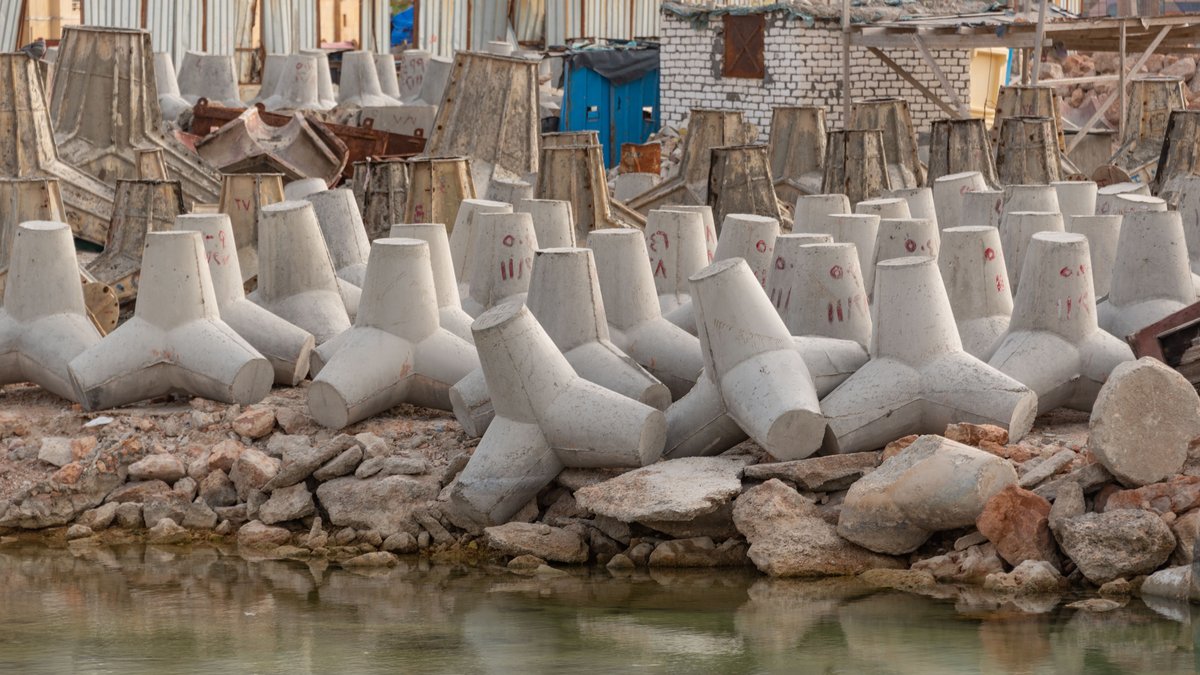
Researchers at Florida International University have installed a new set of 3D-printed seawall tiles at Morningside Park in Miami, launching a real-world test of coastal infrastructure that can protect shorelines while giving marine organisms more places to live.
The project, called BioCAP, places modular tiles onto an existing seawall along Biscayne Bay. Each tile has grooves, ridges, crevices and small pools designed to create habitat on a surface that would otherwise offer few sheltered spaces for marine life.
Led by Shahin Vassigh, principal investigator on the project, the installation brings together FIU’s Institute of Environment and its Robotics and Digital Fabrication Lab. The team is testing whether design and digital manufacturing can turn ordinary coastal defenses into more active parts of the shoreline ecosystem.
A living test on Biscayne Bay
Morningside Park now serves as an open-air laboratory for one of South Florida’s most urgent design problems. Miami depends on seawalls to help protect roads, homes, parks and public spaces from flooding, erosion, storm surge and everyday wave action.
Those seawalls have become a familiar part of the urban coastline. Their smooth concrete faces are built to hold back water, yet natural shorelines often contain cracks, ledges, tide pools, plants, rocks and other irregular features that shelter small organisms. BioCAP adds some of that missing complexity to built infrastructure.
Vassigh described the project as a chance to expand the role of shoreline protection. “Our goal is to rethink what shoreline protection can look like in urban coastal areas,” she said.
The installation is also a long-term field test. After the tiles were attached to the seawall, researchers began watching how organisms arrive, settle and grow across the surfaces. The team will also examine whether the habitat features can help improve water quality and shoreline performance over time.
How the BioCAP tiles work
The 3D-printed seawall tiles are modular and interlocking. That means they can be attached to existing walls rather than requiring a full replacement of coastal infrastructure. For cities with miles of seawalls already in place, that practical feature matters.
Each tile is made with robotic fabrication, which allows the design team to shape surfaces with repeating patterns and carefully placed features. The textures include ridges, grooves, crevices and small water-holding pockets. Together, those features create a much more varied surface than bare concrete.
BioCAP stands for Biodiversity Improvement by Optimizing Coastal Adaptation and Performance. The name reflects the project’s dual aim. The tiles are meant to support life along seawalls while helping coastal structures interact more effectively with wave energy.
According to FIU, the system was designed and developed at the university’s Robotics and Digital Fabrication Lab. The broader project includes FIU’s Institute of Environment, the College of Communication, Architecture + The Arts and an interdisciplinary group of faculty, field scientists and students.
Vassigh said the tiles can “support marine life, improve habitat complexity and enhance coastal resilience.” That short summary captures the project’s central idea: a seawall can be engineered to do more than create a hard edge between land and water.
Why texture matters underwater
Along a natural shoreline, texture is valuable real estate. Tiny depressions hold water during tidal changes. Crevices provide shelter from sun, waves and predators. Rough surfaces give young organisms better chances to attach and survive.
The BioCAP design responds to different vertical zones along a seawall. Near the upper tidal zone, the tiles can provide space for organisms such as crabs and limpets. In the middle zone, oysters and barnacles can attach to textured surfaces. Below the waterline, the tiles can offer habitat for sponges and other submerged organisms.
This zone-based design is important because conditions change sharply from the top of a seawall to the submerged base. The upper area may be exposed to air and heat. The lower area remains underwater for longer periods. The middle zone experiences repeated wetting and drying as tides move in and out.
Small design choices can matter in each of these zones. A shallow pocket can trap water long enough to buffer heat stress. A shaded groove can protect a young organism during a low tide. A rough patch can help larvae attach after drifting through the water.
For marine life in an urban bay, these details can add up. More habitat complexity can create more opportunities for organisms to colonize a wall, which may help restore some ecological function along hardened shorelines.
Testing waves before the bay
Before the tiles entered the bay, FIU researchers tested them in a laboratory to study how they interact with waves. Those tests focused on wave energy and how the textured surfaces behave compared with plain concrete.
The project team reported that the textured tile surfaces reduced wave energy reflection compared with bare concrete. That result matters because vertical seawalls can send wave energy back into the water, which may contribute to turbulence and stress along the shoreline.
A more irregular surface can change that interaction. Grooves and pockets interrupt a smooth wave strike. Ridges create many small contact points instead of one flat plane. The effect can be similar in principle to the way a rocky shoreline breaks up moving water.
The field installation will give researchers a harder test. Biscayne Bay brings changing tides, weather, salinity, heat, organisms, sediments and everyday urban conditions. Lab tests can reveal basic performance, while the bay will show how the tiles behave under real coastal pressure.
That next step is crucial for a design meant for cities. A tile that works in controlled conditions must also hold up through biological growth, stormy days, seasonal shifts and the constant chemical and physical stress of seawater.
Sensors will watch the seawall change
Two of the installed tiles include sensors that will track conditions at the site. FIU reported that the sensors will monitor factors such as temperature, salinity and water quality.
Those water quality sensors will help researchers connect biological changes on the tiles with the surrounding environment. If oysters, barnacles, sponges, or other organisms colonize the surfaces, the team can compare that activity with data from the water around them.
Monitoring also helps answer a larger question. The tiles are designed to create habitat and the team wants to learn whether added habitat can contribute to improved water quality and shoreline performance. That requires time, repeated measurements and close observation.
Colonization can happen in stages. Early organisms may attach first and alter the surface. Later arrivals may settle into the new microhabitats. Over time, the wall could become a more biologically active structure, with different organisms occupying different levels of the tidal zone.
The sensors add a technical layer to what might otherwise look like a simple installation. Beneath the visible patterns on the concrete, the project is collecting environmental data that can help reveal how the tiles perform as a living shoreline tool.
What Miami could teach other coastal cities
Miami is a fitting place for this experiment because seawalls are already woven into the city’s waterfront. As sea-level rise, flooding, erosion and storm surge shape planning decisions, coastal cities need infrastructure that can serve multiple purposes at once.
BioCAP offers one practical route. The tiles are designed for existing walls, which makes them relevant for places where major reconstruction would be costly or disruptive. Retrofitting can let cities test ecological upgrades in targeted areas before larger deployments.
The project is also part of a broader shift toward coastal resilience that includes ecological performance. In that view, a shoreline defense can reduce risk while also restoring habitat features that were lost when natural edges were replaced by hard structures.
FIU identified BioCAP as an EPA-funded project led by Vassigh, Pezeshk, Bogosian and Ozer at the university’s Robotics and Digital Fabrication Lab, the College of Communication, Architecture + The Arts and the Institute of Environment. Additional NOAA funding is led by Todd Crowl, with support from faculty, field scientist Ben Binder and Nicholas Evans and students.
The results from Morningside Park could help guide future shoreline projects in South Florida and other coastal communities. If the tiles attract marine life, reduce reflected wave energy and provide useful environmental data, they may point toward a more adaptive future for urban seawalls.