An AUV is an autonomous underwater vehicle that carries out a programmed mission without a physical link to its operator. An ROV is a remotely operated vehicle connected to a surface vessel by a tether that carries commands, data and often power. Autonomy gives an AUV freedom to roam; the tether gives an ROV continuous human control and live communication.
NOAA’s AUV and ROV comparison centers on that connection. Both are unoccupied underwater robots and both can carry cameras, sonar, lights, or scientific sensors. Mission needs determine which architecture is more useful.
How an AUV operates
Before deployment, operators load waypoints, depths, speeds, sensor schedules and safety rules into the vehicle. Once launched, onboard computers control propulsion and steering. Navigation usually combines inertial sensors, depth readings, acoustic positioning and periodic surface GPS fixes because ordinary satellite navigation signals do not travel through seawater.
An AUV carries its energy onboard, commonly in batteries. It also stores most mission data until surfacing or recovery because underwater acoustic links have far less bandwidth than radio. Operators can sometimes send short acoustic commands, but they do not receive the continuous high-definition view typical of a tethered vehicle.
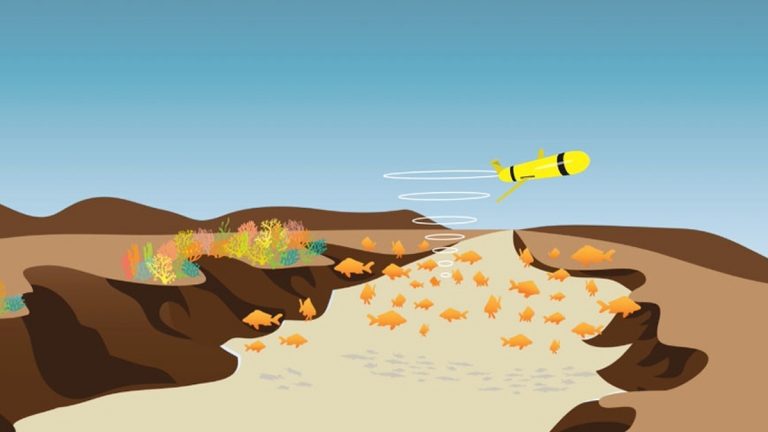
NOAA Ocean Exploration explains that an untethered AUV may carry cameras and sonar alongside depth sensors. Streamlined vehicles can survey long tracks efficiently, while hovering AUVs trade range for maneuverability. If a fault occurs, the software may abort, release ballast, surface, or wait for a recovery command.
Navigation error grows while the vehicle is submerged. A Doppler velocity log can estimate motion relative to the seafloor and acoustic beacons may provide position updates in a surveyed work area. Woods Hole Oceanographic Institution’s overview of AUV systems shows how designs are tailored to different depths and missions. Operators still compare the recovered track with GPS positions before trusting a map.
How an ROV operates
An ROV pilot controls the vehicle from a ship or shore station. Thrusters allow it to hover, move sideways and hold position near a target. Video and instrument readings travel up the tether in real time, so a science team can adjust the dive when an unexpected animal, vent, wreck feature, or hazard appears.
The cable bundle may carry electrical power and fiber-optic communications. Large work-class systems can therefore support bright lights, multiple cameras, sonar and strong manipulator arms without relying only on onboard batteries. A tether-management system or second vehicle can isolate the working ROV from ship motion and reduce cable drag.
The tether also creates constraints. It can snag on wreckage and scrape delicate habitat. Currents can transmit motion through it. The support ship must manage cable length and remain positioned over the dive. NOAA’s ROV description highlights the link that sends electrical signals between operator and vehicle.
ROV operations divide responsibility across a team. A pilot flies the vehicle, while a navigator tracks its position and a tether operator watches cable payout. Scientists can direct cameras or sampling from the control room without steering every thruster. Clear roles reduce the chance that a last-second science request puts the vehicle or cable in a dangerous position.
What each robot does best
AUVs excel at systematic surveys over broad areas. Side-scan sonar or multibeam mapping can reveal seafloor shape, submerged hazards, pipelines, mines and shipwrecks. A vehicle can follow closely spaced lines at steady altitude, producing consistent coverage without dragging a cable behind it.
ROVs excel at close inspection and intervention. Pilots can circle an object, aim a camera, collect a sample, turn a valve, cut a line, or attach a lifting hook. Live decisions are valuable when the target is complex and the next action depends on what the camera shows.
Search missions often use both. An AUV maps a wide field and identifies promising targets. An ROV then returns for detailed imaging or sampling. NOAA’s exploration technology shows how autonomous mapping supports high-resolution study of deep seafloor features.
Data quality can decide the platform before range does. A broad sonar survey benefits from steady altitude and repeatable lines, while a fragile sample may demand live judgment and a manipulator. Water clarity, bottom relief and the required resolution determine sensor spacing. A camera survey needs lighting and a stable viewing distance, while sonar coverage depends on range and overlap between adjacent passes. The time required to calibrate sensors and process the collected files belongs in the mission plan as well. Teams define the deliverable first, then match vehicle motion to the measurement.
Range, data and risk tradeoffs
An untethered vehicle can travel under ice, around obstacles, or far from a ship, limited by energy, navigation accuracy, communications and recovery plans. Losing contact is normal during much of an AUV dive. Mission designers must trust the software and build safe responses to leaks, low battery, navigation errors, or obstacles.
An ROV’s range is constrained by tether length and handling. In return, operators see problems immediately and can react. Surface power can support long dives, although ship time and a trained control team make operations expensive. Cable failure can remove power or communication at once.
Neither platform removes risk altogether. It transfers much of the danger away from divers, but launch and recovery involve heavy machinery, moving decks and high-tension lines. Deep water also imposes crushing pressure and makes recovery difficult. Careful mission planning remains essential for either system.
Both designs use layered safeguards. An AUV may monitor leaks, battery state, depth and mission time before choosing a programmed abort. An ROV crew watches insulation, cable tension and vehicle telemetry continuously. Emergency procedures are tested before launch so the team knows which fault calls for surfacing, holding position, or ending the dive. Recovery plans account for current and weather because a surfaced AUV can drift, while an unpowered ROV may hang far below the support ship.
How to choose between an AUV and ROV
Choose an AUV when the mission is predictable, spatial coverage is large and continuous operator input is unnecessary. Typical examples include bathymetric mapping, pipeline corridor surveys, environmental monitoring and searches across a defined grid. Battery endurance and the risk of losing a valuable vehicle must fit the task.
Choose an ROV when the team needs live video, precise hovering, physical manipulation, or immediate judgment. Hull inspections, equipment repair, biological sampling and investigation of a known wreck favor direct control. Turbid water may shift the sensor mix toward sonar, yet real-time piloting can still be useful.
Hybrid vehicles blur the boundary. Some systems can work untethered for autonomous mapping and later connect for remotely operated tasks. Increasing onboard intelligence also lets ROVs hold station automatically and helps AUVs recognize features, but the physical tether remains the clearest everyday test.
Payload limits deserve equal weight. Each sensor adds mass, drag, power demand and data storage. An AUV must carry those costs through the entire mission, while a large ROV may draw power from the surface and return samples through its launch system. The support vessel must also have suitable deck space and handling equipment, which can rule out an otherwise capable robot. Vehicle depth rating must exceed the planned working depth with an appropriate safety margin.
The practical choice follows the route taken by decisions and data during the dive, together with the energy supply. An AUV keeps those functions mainly onboard until recovery. An ROV maintains a live pathway to people and power at the surface. Mission requirements determine which arrangement fits each deployment safely.
Related reading: how bathymetry maps ocean depth and how scientists measure ocean currents.