A study in Earth’s Future found that pumping seawater onto Arctic sea ice during winter made test areas in Cambridge Bay, Nunavut, up to 32 centimeters thicker by mid-May. The flooded ice also stayed brighter during the melt season, a key sign that it reflected more sunlight while melting more slowly.
The work offers the first full-season field test of artificial sea ice thickening by winter flooding in the Canadian Arctic. Led by Edward Blanchard-Wrigglesworth of the University of Washington and Andrea Ceccolini of Real Ice and University College London, the team tested a simple idea with large climate stakes. They pumped seawater onto existing winter ice and let the Arctic cold do the rest.
The result is early and local, yet striking. Arctic sea ice is shrinking as the planet warms and brighter ice helps reflect sunlight back to space. The Cambridge Bay experiment suggests that targeted flooding can build thicker ice and increase surface brightness on small scales. The larger question is whether such a method can ever move beyond field plots and serve Arctic communities safely.
A first field test in Cambridge Bay
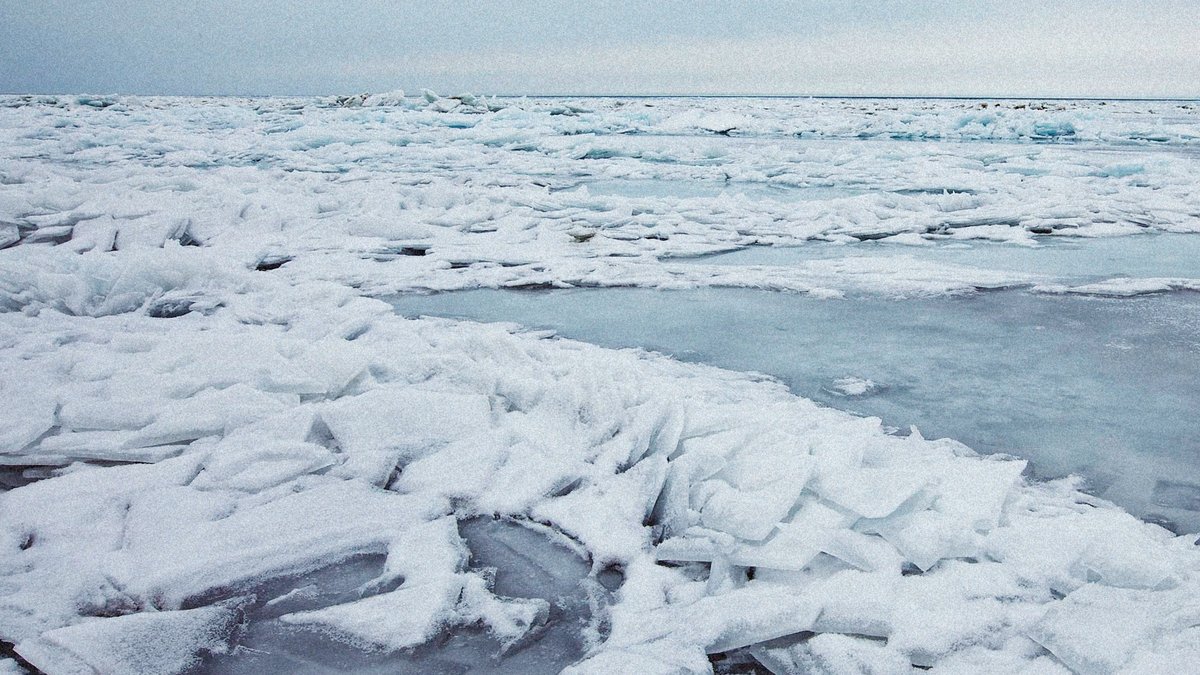
The campaign took place during the 2024/2025 winter and spring seasons at a 1 by 1 kilometer field site in Cambridge Bay, Nunavut. The researchers set up eight test areas and three control areas. The control sites were left alone, which gave the team a baseline for judging how the flooded ice changed.
In the test areas, the team used submersible pumps to bring seawater up onto the ice surface. Some areas were flooded once in December or January. Other areas were flooded twice, with a second treatment in February. Across the campaign, the total flooded area covered 0.25 square kilometers.
The study abstract describes the project as “the first to test and observe the impact of flooding and meltwater draining” on Arctic sea ice over both winter growth and spring melt. That matters because sea ice changes across seasons. A thicker patch in January means less if it vanishes quickly once spring sunlight returns.
By mid-May, before the main melt period, the flooded test areas showed the clearest signal. The paper reports that flooded test areas reached up to 32 centimeters more thickness than the control areas. Areas flooded twice gained more thickness than areas flooded once, which points to a dose effect in the field trial.
How seawater flooding builds new ice
Winter flooding works through a straightforward physical process. Sea ice often carries a snow layer on top. Snow is bright, but it also insulates the ice below. That insulation can reduce the flow of cold air into the sea ice during winter.
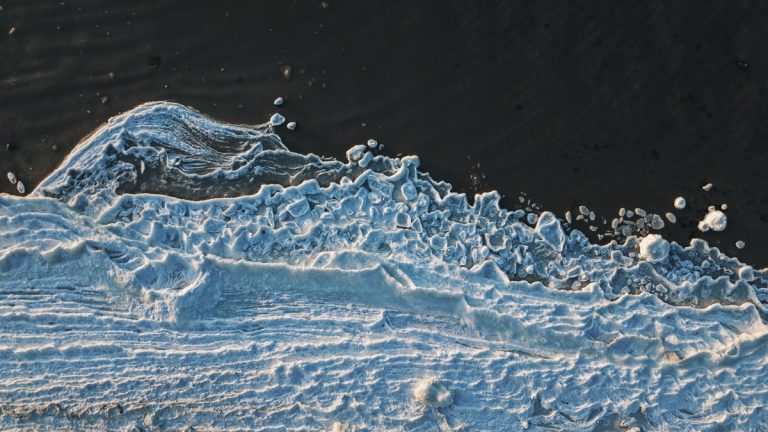
When seawater is pumped onto the surface, it spreads through the snow. The slushy mixture then freezes into a new layer. At the same time, thinning or soaking the snow changes the insulation above the original ice. Colder air can help drive additional growth from below.
The study’s method was simple in concept, although demanding in Arctic conditions. The paper states that “flooding treatments were carried out by pumping seawater onto the sea ice.” In practice, the work required careful timing, field logistics and repeated measurements across the winter.
The treated areas also had thinner snow cover by mid-May. According to the study, snow on flooded areas was 1 to 13 centimeters thinner than on control areas. That shift helps explain why the ice thickened through a mix of surface freezing and altered heat flow.
This kind of seawater flooding has familiar cousins. Arctic and Nordic communities have long used controlled flooding to strengthen ice roads or working platforms. The scientific question is how a known practical technique behaves when studied systematically across an Arctic growth and melt season.
Brighter ice could slow melting
Sea ice brightness is central to the Arctic climate system. Bright surfaces reflect more sunlight. Darker ocean water absorbs more energy, which can accelerate warming and further melting. Scientists call this reflectivity albedo.
The Cambridge Bay trial measured more than thickness. During the melt period, the flooded areas appeared brighter than the control ice. The study abstract reports that “sea ice in the flooded areas appeared brighter and showed slower melt rates.” That sentence captures the trial’s most climate-relevant result.
Thicker ice can persist longer into the melt season. Brighter ice can also reduce solar absorption at the surface. Together, those changes may help local ice resist spring and summer loss. The experiment showed that the flooded areas remained thicker than control areas during the melt period.
The team also tested melt pond drainage at one control site. Melt ponds are pools of water that form on sea ice in spring and summer. They darken the surface because water absorbs more sunlight than snow or pale ice. The researchers drilled small holes to drain one pond, exposing a brighter surface within days.
That drainage result matters because melt ponds can speed seasonal ice loss. A method that reduces dark surface water could help maintain local reflectivity. The Cambridge Bay study tested that idea alongside winter flooding, giving researchers two related ways to probe sea ice brightness.
The Arctic scale problem
The results are promising at field scale. The Arctic Ocean is vast, mobile, cold and politically complex. Any approach based on pumps, machines, power, maintenance and human operations faces a steep expansion problem.
The Cambridge Bay campaign covered a carefully managed site. It showed that controlled flooding can create thicker and brighter ice in a chosen area. Scaling that method across large Arctic regions would require far more equipment and coordination. It would also need a clear system for operating safely in remote sea ice conditions.
There are ecological questions as well. Sea ice is habitat for animals and a working landscape for Arctic communities. Adding seawater to the surface changes snow, salinity, ice structure and timing. Those changes need careful study before any broader deployment.
Governance is another challenge. The Arctic includes Indigenous homelands, national jurisdictions, fisheries, shipping routes and ecosystems under rapid stress. A technology that changes ice conditions would require local consent and transparent oversight. Scientific success in a test plot is only one part of that larger process.
The study therefore fits best as an early field experiment, rather than a ready climate intervention. It gives researchers measured evidence from a real Arctic site. It also sharpens the questions that must be answered before artificial thickening can be considered beyond local trials.
What the next trials need to prove
The next step is consistency. Researchers need to know whether winter flooding produces similar results in different weather, ice types, snow conditions and locations. One season in Cambridge Bay can reveal mechanism and feasibility. Many seasons can show reliability.
Future studies also need to track what happens inside the ice. Flooding can change salinity and create new ice layers. Those internal changes may influence strength, melt behavior and habitat conditions. More ice cores and sensor measurements could show how the treated ice evolves through winter and spring.
Local usefulness may prove as important as broad climate potential. Arctic communities face coastal erosion, changing travel conditions and shifting access to hunting areas. If thicker Arctic sea ice can be created in targeted places, it may offer practical adaptation value even at modest scale.
The strongest near-term case will come from careful trials with community involvement. Researchers will need to compare benefits against costs, environmental effects and operational risks. They’ll also need to measure whether brighter treated areas influence nearby melt patterns or remain confined to the flooded plots.
For now, the Cambridge Bay campaign shows that a simple physical idea can work in the field. Pumped seawater froze into added ice, the treated areas thickened and their surfaces stayed brighter into the melt season. In a warming Arctic, that’s a result worth testing with patience and caution.