Researchers at the University of Oxford have announced new discoveries from Oxfordshire’s Jurassic Highway, where a return excavation uncovered Europe’s longest known sauropod dinosaur trackway. The 220-meter sequence of footprints was made by a single long-necked dinosaur moving across a muddy lagoon edge around 166 million years ago.
The find adds hundreds of new footprints to a remarkable site at Dewars Farm Quarry near Bicester. Together, the tracks record the movements of giant herbivores and a large carnivorous dinosaur across a tropical Middle Jurassic landscape. For paleontologists, the quarry floor is a rare motion record from animals usually known from bones.
A Jurassic Highway Emerges in Oxfordshire
The Dewars Farm Quarry site first drew scientific attention after quarry worker Gary Johnson noticed regularly spaced bumps while stripping clay from the quarry floor. The pattern looked too orderly to be ordinary rock. That observation led quarry managers to contact specialists at the Oxford University Museum of Natural History and the University of Birmingham.
In June 2024, a team of more than 100 researchers, students and volunteers excavated the surface for a week. They exposed about 200 footprints across five extensive trackways. Four were attributed to sauropods, most likely animals similar to Cetiosaurus. The fifth trackway was attributed to Megalosaurus, a large meat-eating theropod with three-toed feet.
The site dates to the Middle Jurassic Period, around 166 million years ago. At that time, the area now known as central England sat in a warm setting of shallow seas, mudflats and lagoon margins. Dinosaurs crossed soft ground that was firm enough to hold their weight and delicate enough to capture the shape of their feet.
That combination gives the tracks unusual scientific value. A bone can reveal the size and anatomy of an animal. A trackway can preserve movement, pace, foot placement and the path an individual took through a vanished landscape.
Europe’s Longest Sauropod Trackway
The 2025 return expedition expanded the known track site and revealed four additional sauropod trackways. Among them was a continuous 220-meter line of footprints from one individual sauropod. Oxford described it as Europe’s longest sauropod dinosaur trackway.
That length matters because each step helps researchers measure variation in stride. A short patch of tracks may show foot shape. A long trackway can reveal rhythm. It can show how an animal’s gait changed across uneven mud and whether it moved steadily along a route used by others.
Dr Duncan Murdock, an Earth scientist at the Oxford University Museum of Natural History, emphasized the scale of the find. “What is most exciting about this site is the sheer size and number of footprints,” he said.
The 2025 dig was co-led by the Oxford University Museum of Natural History and the University of Birmingham. Researchers from Liverpool John Moores University also joined the work. The team identified and documented hundreds more individual prints during the week-long excavation.
Footprints From Giants and a Predator
The sauropod tracks are linked to large long-necked herbivores, likely similar to Cetiosaurus. These animals walked on four pillar-like legs and could reach roughly 18 meters in length. Their prints record the passage of enormous plant-eaters through a damp coastal setting.
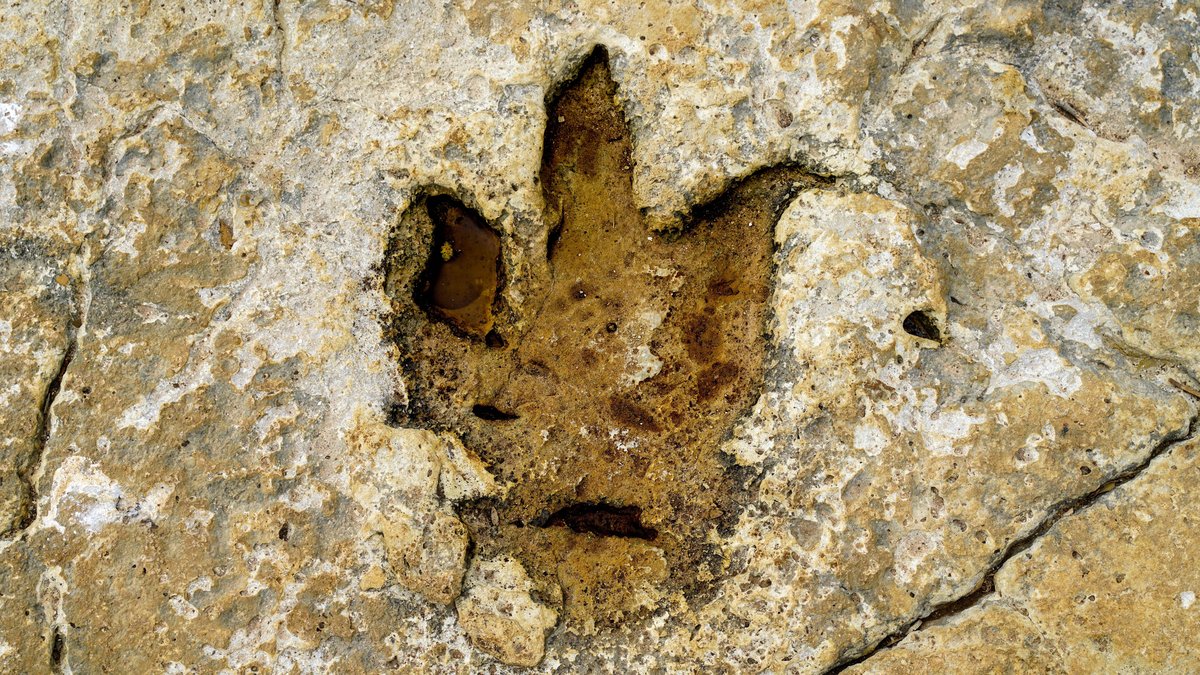
The carnivorous trackway belongs to Megalosaurus, a roughly 9-meter predator. Its footprints show three toes and claw marks. Each print is about 25 inches long, giving the trackway a very different appearance from the rounded sauropod impressions nearby.
The presence of both herbivore and carnivore tracks makes the site especially vivid. The animals used the same landscape and some trackways intersect. At one crossing, the Megalosaurus track appears to deform the mud around an earlier sauropod print. That detail suggests the predator passed after the sauropod.
Researchers treat that overlap carefully. The tracks show sequence and shared space. They leave the exact behavior open. The carnivore may have followed the same route soon after, or much later after the mud had partly settled. The rocks preserve footsteps with astonishing clarity, while the precise drama of the moment remains beyond reach.
How Mud Preserved a 166-Million-Year-Old Walk
The survival of the Dewars Farm footprints depended on a narrow set of conditions. The dinosaurs stepped onto mud that was soft enough to take impressions. The surface also needed enough strength to keep the prints from collapsing immediately.
After the animals passed, a layer of clay-rich sediment covered the tracks. That burial protected the impressions. Over millions of years, pressure turned the layered sediment into rock. The filled footprints remained sealed within the quarry floor until modern quarrying exposed them.
This process explains why the footprints appear as trackways rather than isolated marks. The ground recorded repeated steps along continuous paths. When the overlying clay was removed, the preserved surface revealed a fossilized record of movement across a lagoon edge.
The setting also helps explain the site’s richness. Mudflats near water can attract animals moving along shorelines. In the Middle Jurassic, this part of Oxfordshire offered a tropical environment with lagoons, mud, marine life and nearby vegetation. The tracks sit within that broader ecological picture.
What the Tracks Reveal About Dinosaur Movement
Trackways turn ancient animals into moving bodies. At Dewars Farm, researchers can measure stride length, foot size, track spacing and the direction of travel. Those measurements help estimate speed and posture.
The Megalosaurus trackway indicates a walking pace close to a brisk human walk, about 5 kilometers per hour. The sauropods appear to have moved at a similar pace despite their much larger bodies. That shared speed suggests steady travel across a soft surface.
Long trackways also help paleontologists see small changes from step to step. Footprints can deepen or widen depending on how the animal shifted its weight. A slight change in spacing may reflect uneven ground. A long sequence preserves those details across many strides.
The 2025 discoveries also point to repeated use of the area by sauropods. Dr Murdock said, “We now have evidence of tens of individuals moving through this area at around the same time, perhaps as a herd.” The wording is cautious and the idea fits the pattern of multiple large herbivores moving through the same landscape.
A Fossil Discovery With Deep Oxford Roots
The Oxfordshire find carries unusual historical weight because Megalosaurus has a central place in dinosaur science. In 1824, Oxford geologist William Buckland scientifically named Megalosaurus from fossils found in the region. That description came before the word dinosaur was coined.
The new trackway discoveries arrived almost two centuries after that early landmark in paleontology. They also come from the same county. In one region, scientists now have both the historical roots of dinosaur naming and fresh evidence of dinosaur behavior.
Body fossils and footprints answer different questions. Bones can show anatomy, size, growth and relationships between species. Dinosaur trackways show how living animals moved through a real environment. Dewars Farm brings those lines of evidence together in a landscape already famous for Jurassic fossils.
The site also adds detail to a period with a patchier dinosaur record than some later intervals. Middle Jurassic fossils are important because they capture dinosaurs during a key stage of their evolution and spread. A large tracksite from this time gives researchers a rare ground-level view of that world.
Why More Footprints May Still Be Hidden
The newly exposed trackways continue under quarry walls. That means the known paths may represent only part of the preserved surface. Future excavations could extend the documented trackways and reveal additional routes.
Researchers have already found more than footprints in the same sediment layers. The 2025 work also uncovered fossils including a crocodile jaw, marine invertebrates and plant material. These remains help reconstruct the ecosystem around the track makers.
The next steps will likely combine fieldwork with detailed documentation. Drone photography, mapping and 3D modeling can preserve the position and shape of tracks even as quarry conditions change. Those tools let scientists analyze stride patterns and surface details long after a dig ends.
The Dewars Farm discoveries show how a working quarry can become a window into deep time. A line of giant footprints, pressed into mud before flowering plants evolved, now offers a step-by-step record from a world 166 million years old.