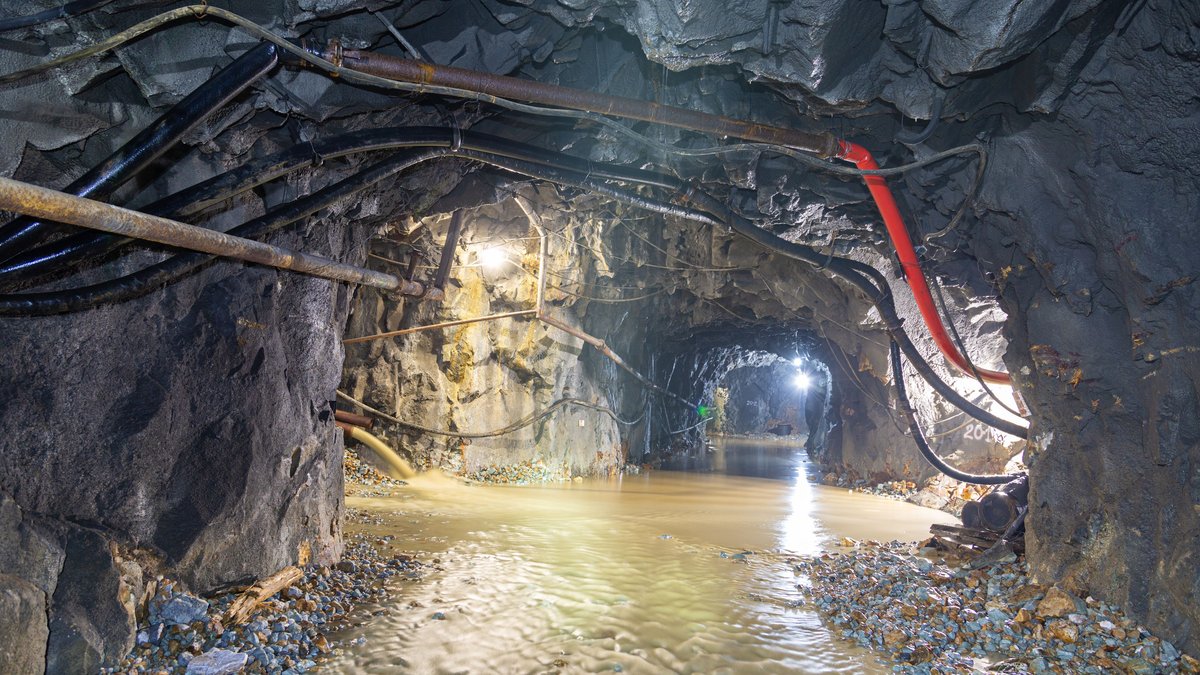
A study in Geochimica et Cosmochimica Acta traced ancient fracture water nearly 3 kilometers below Kidd Creek Mine in Ontario, where noble gases revealed a deep groundwater system isolated for roughly billion-year timescales. The work, led by researchers including Oliver Warr and Barbara Sherwood Lollar, pushes a familiar substance into an almost alien setting: liquid water still moving through rock that has held it away from the surface since deep in Earth’s past.
The discovery turns a working Canadian mine into a rare scientific time capsule. Far below the surface near Timmins, Ontario, briny water flows from cracks in ancient volcanic rock. Chemical clues suggest some of these fluids have residence times reaching about 2.2 billion years, a span that carries them back to the Precambrian world before animals, plants, forests and nearly everything humans recognize as complex life.
For geologists and astrobiologists, the finding matters because the water remains liquid and chemically active. It carries gases, salts and energy-rich compounds that were produced underground. That makes Kidd Creek more than a record holder. It offers a close look at how water, rock and microbes might interact in deep places cut off from sunlight.
A mine opened a window into the Precambrian
Kidd Creek Mine was built for metals, including copper, zinc and silver. Its scientific value comes from the rocks it exposes. The mine reaches into the Canadian Shield, a vast region of old continental crust that preserves some of Earth’s most ancient geological history.
At depths approaching 3 kilometers, the mine intersects fractures in Precambrian crystalline rock. These fractures can contain water that moved underground long ago and then remained separated from the surface. In that sealed setting, water becomes a chemical archive. It records interactions with rock and the slow buildup of gases over immense periods of time.
The deeper samples built on earlier work from Kidd Creek. In 2013, researchers reported ancient water from about 2.4 kilometers underground with residence times on the order of 1.1 to 1.7 billion years. Warr and colleagues later extended the investigation to fluids from around 2.9 kilometers deep. In the paper’s own words, “Here we extend the noble gas data from the Kidd Creek Mine in Timmins Ontario Canada.”
That move deeper into the mine sharpened the story. The samples suggested a fracture network with separate compartments, where water can remain isolated for different lengths of time. Some of the deep fluids were linked to residence times from roughly one billion years to about 2.2 billion years.
How noble gases revealed the water’s age
The age estimate comes from noble gas dating, a geochemical method suited to very old subsurface fluids. Noble gases include helium, neon, argon, krypton and xenon. They rarely react with other elements, so they can preserve signals that would be scrambled in more chemically active substances.
Inside ancient rock, radioactive decay and other long-running processes generate noble gases over time. When water sits in fractures, these gases can accumulate in the fluid. By measuring the mixture and abundance of those gases, researchers can estimate how long the water has been isolated from the surface environment.
The result is best understood as a residence time. It describes how long the water-bearing fracture system has been separated from modern circulation. Individual molecules can have complicated histories, yet the trapped fluid as a whole carries a signal of deep isolation.
This distinction matters because the numbers are enormous. A billion years is longer than the history of animals, longer than the rise of land plants and far longer than any human-scale geological change. The Precambrian groundwater at Kidd Creek gives scientists a direct sample from a deep Earth environment that has been sealed away across a large part of the planet’s history.
Why the brine tasted so strange
The Kidd Creek water gained public attention partly because Sherwood Lollar reportedly tasted it in the field. Field geologists sometimes use taste as a quick clue to salinity, followed by laboratory measurements that provide the actual science. In this case, the impression was memorable for a reason.
The fluid is a hypersaline brine, far saltier than ordinary seawater. It also carries a musty, sulfur-rich smell. Those sensory clues fit a deep underground environment where water has spent vast stretches of time reacting with minerals in the surrounding rock.
The taste and smell point to a more important chemical story. Salts become concentrated as water interacts with old crustal rocks. Dissolved gases and sulfur compounds build up. The water becomes dense, bitter and mineral-rich, shaped by conditions that have little in common with rivers, lakes, or rainfall at the surface.
That harsh character helps explain why the discovery feels so strange. The water is ancient and still flowing. It emerges from fractures in a modern mine, yet its chemistry comes from a hidden environment that has been evolving in darkness for geological ages.
Chemical fuel for life in the dark
The deepest question at Kidd Creek concerns life. Sunlight never reaches these fractures, so any microbial ecosystem must depend on chemistry from rock and water. The central ingredients are reactions that produce compounds such as hydrogen and sulfate.
Water-rock reactions can split molecules and generate chemical energy underground. Hydrogen can serve as fuel for some microbes. Sulfate and related compounds can support metabolisms that function in dark environments. Together, these reactions create a possible energy system beneath the crust.
That idea has changed how scientists think about the deep biosphere. Life at the surface usually depends, directly or indirectly, on sunlight. In deep fractured rock, microbes may persist using chemical energy produced in place. The environment is slow, salty and isolated, yet it can still offer resources that biology can use.
Studies at the Kidd Creek Observatory have reported native microbial communities in deep fracture waters. Those findings support the view that ancient subsurface fluids can host life. Scientists remain careful about the timeline. The water’s billion-year residence time does not mean the same microbes have been alive there for two billion years. It shows that the deep environment can preserve water and energy sources for extraordinary lengths of time.
That caution makes the discovery more useful. Kidd Creek gives researchers a real-world laboratory for asking how microbes survive with limited energy, how isolated water systems evolve and how long habitable conditions can last underground.
Why Mars scientists care about Kidd Creek
NASA astrobiology researchers care about places like Kidd Creek because deep Earth can resemble possible habitats on other worlds. Mars is the clearest comparison. Its surface is cold, dry and exposed to radiation, but the subsurface may preserve water or water-shaped minerals for long periods.
If chemistry can support microbes in Earth’s deep crust, then similar rock-water systems could matter on Mars. The key lesson is that sunlight is not the only path to habitability. Chemical reactions can create energy in buried environments where surface conditions are hostile.
Kidd Creek also helps scientists think about icy moons such as Europa and Enceladus. Those worlds may have oceans or water-rich layers below ice. Their potential habitats would depend on interactions between water, minerals and chemical energy, much like the processes studied in deep terrestrial rocks.
The Canadian mine is valuable because researchers can reach it, sample it and test instruments there. Future life-detection missions need ways to identify chemical traces, microbial signatures, or other signs of habitability in difficult environments. Deep mines provide a practical testing ground for those tools.
For astrobiology, the message is direct. Ancient brines on Earth show how water can persist underground and remain chemically active for immense spans of time. That expands the kinds of places scientists consider when they search for habitable environments beyond Earth.
The search for Earth’s oldest water continues
Kidd Creek remains one of the most striking examples of ancient deep groundwater ever sampled. It may also be a preview of a wider hidden reservoir. The Geochimica et Cosmochimica Acta study notes that large volumes of fluid reside in Precambrian crystalline basement rocks, making the deep crust an important part of Earth’s groundwater story.
Researchers have since reported billion-year-old groundwater from a South African mine, showing that Kidd Creek is part of a broader scientific pattern. Ancient fluids can survive in old continental crust when fracture networks remain isolated. Each new site helps reveal how common these systems may be.
The work also has practical implications. Deep groundwater systems matter for helium resources, subsurface energy, carbon storage and nuclear waste isolation. Understanding how fluids move, or stay trapped, over billion-year timescales can help scientists evaluate deep rock environments with greater confidence.
Still, the wonder of the discovery is hard to reduce to applications. Water from Kidd Creek links the present day to a planet before forests, flowers, insects and footsteps. It is a moving sample of Earth’s deep memory, carrying the chemistry of rock, time and darkness through fractures far below Ontario.
The search will continue because the oldest water found so far may simply be the oldest water humans have managed to reach. Deeper mines, new drilling projects and improved geochemical tools could uncover older or stranger fluids. For now, 2-billion-year-old water beneath a Canadian mine remains one of the clearest reminders that Earth’s hidden interior still holds stories from a world almost beyond imagination.