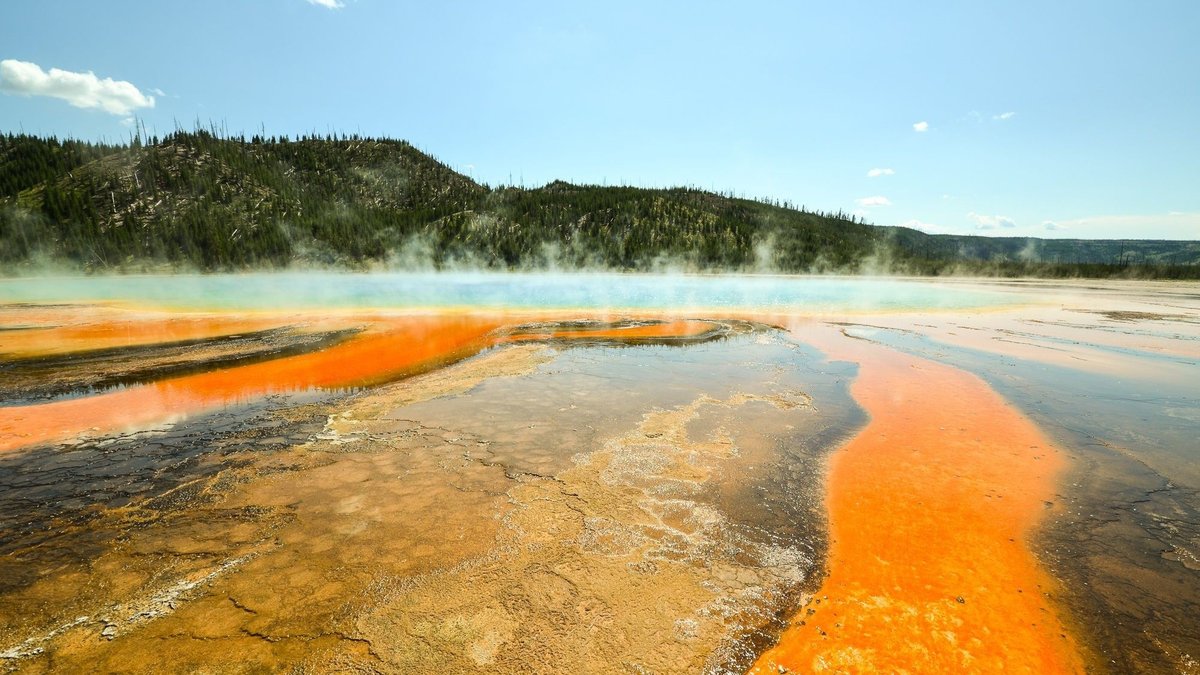
Researchers at the IGGCAS announcement have traced Yellowstone’s vast magma system to a surprising driver deep beneath western North America. Their three-dimensional geodynamic model points to an eastward flow of hot mantle material, described as a mantle wind, that helps generate magma beneath one of Earth’s most famous volcanic regions.
The work, published in Science in 2026, focuses on the hidden engine below the Yellowstone caldera. The model links motion in the mantle with magma formation in the shallow asthenosphere, then follows how that magma can move into the cold outer shell of the planet.
For volcano researchers, the finding is important because supervolcanoes require long-lived sources of heat and melt. Yellowstone has produced two supereruptions over the past 2.1 million years and its underground plumbing remains a natural laboratory for studying how extreme volcanic systems grow and persist.
A new source for Yellowstone’s magma
The Institute of Geology and Geophysics, Chinese Academy of Sciences team built a model that simulates the present-day behavior of western North America’s lithosphere and the flowing mantle below it. That pairing matters because Yellowstone’s magma system reaches across layers with very different physical properties.
The lithosphere is Earth’s rigid outer shell. It includes the crust and the uppermost mantle. Beneath it sits the asthenosphere, a hotter and weaker layer that flows slowly over geologic time.
According to the study, magma beneath Yellowstone is supplied by melting in the shallow asthenosphere. That places the source close enough to interact strongly with the base of the lithosphere. The model gives researchers a way to connect deep rock flow with the much shallower magmatic structures detected beneath Yellowstone.
This result offers a tectonic explanation for a volcanic system that has long been discussed through the lens of a deep mantle plume. In the new picture, broad mantle motion and the structure of the continent work together to create the conditions for melting.
The mantle wind beneath North America
A key feature of the model is an eastward-moving mantle wind. The phrase describes slow horizontal movement of hot rock within Earth’s mantle. It has nothing to do with air, weather, or rapid motion at the surface.
The study links this mantle wind to the long history of the Farallon Plate. That ancient oceanic plate subducted beneath North America and remnants of it remain deep under central and eastern parts of the continent. Its long-term sinking helped shape mantle flow across the region.
As the model describes it, the mantle wind transports hot asthenospheric material toward Yellowstone. When this buoyant material encounters the thick continental lithosphere, it is drawn downward and stretched. That stretching lowers pressure in a way that can promote melting.
Geologists call this process decompression melting. Hot mantle rock can begin to melt when pressure drops, even without a large increase in temperature. In Yellowstone’s case, the model suggests that this process helps feed the magmatic system from below.
How tectonic forces open a magma pathway
The new model also explains why Yellowstone’s magma system has its unusual shape. Previous geophysical studies have shown a large magmatic zone that extends through the lithosphere and dips toward the southwest. The IGGCAS model ties that geometry to forces acting on the continent from different directions.
To the east of Yellowstone, a thick lithospheric root resists mantle flow. The eastward mantle wind pushes against this strong block. To the west, buoyant lithosphere produces a force in the opposite direction.
Together, those forces stretch the lithosphere beneath the Yellowstone region. The study describes this as a tearing process that creates a southwest-dipping channel. That channel can guide magma upward and help it evolve as it moves through the outer layers of Earth.
This translithospheric magma plumbing system is central to the study’s interpretation. It connects magma generation in the asthenosphere with magma storage and movement across the lithosphere. That connection is difficult to capture if each layer is treated in isolation.
The model’s results also agree with independent geophysical and geochemical observations from the region, according to the IGGCAS announcement. That agreement gives the researchers confidence that the modeled forces reflect real features beneath western North America.
Why magma mush matters
Yellowstone’s hidden reservoir is best thought of as a broad magma mush system. In this kind of system, molten material is mixed through a much larger volume of hot, partly solid rock. The result is thick and sluggish compared with a pool of liquid magma.
This matters for how scientists think about supereruptions. A mush system can store heat and melt across a large region for long periods. It can also change gradually as new magma enters from below, cools, mixes and reacts with surrounding rock.
The IGGCAS study helps explain how such a system can be maintained. If shallow mantle melting continues to feed the lithosphere, the system can remain thermally and mechanically active over long spans of geologic time. The mantle wind supplies a steady tectonic driver in the model.
A brief, liquid-rich magma body may still form before an eruption. The broader mush zone provides the deeper framework in which that short-lived body could develop. For hazard science, that distinction is useful because it separates long-term volcanic architecture from the shorter processes that may precede eruptive activity.
What the model reveals about supervolcanoes
The study’s broader value comes from linking several pieces of the supervolcano puzzle. It connects mantle flow, lithospheric stretching, shallow melting and magma accumulation within one three-dimensional framework. That kind of combined view is essential for systems as large as Yellowstone.
Supereruptions release more than 1,000 cubic kilometers of magma, rock and ash. Events of that scale can affect climate, ecosystems and human societies. Understanding how the underlying magma systems form is one step toward improving long-term volcanic hazard assessment.
The work remains a model-based result. It uses physics and observations to test a mechanism for present-day Yellowstone and its conclusions depend on how well the model represents Earth’s interior. Future imaging, geochemical studies and simulations can further test the mantle wind idea.
Even with that caution, the research gives scientists a sharper way to think about Yellowstone’s supervolcano. The system may be shaped by a broad underground flow tied to plate tectonics, lithospheric strength and shallow mantle melting. That makes Yellowstone more than a famous caldera. It becomes a window into how continents can organize enormous volcanic systems from the mantle upward.
For other supervolcanoes, the same framework may prove useful. Large mush systems occur in volcanic regions around the world. If similar tectonic forces can sustain them, researchers may be able to compare Yellowstone with other giant volcanic provinces and look for shared signs of mantle-driven magma supply.