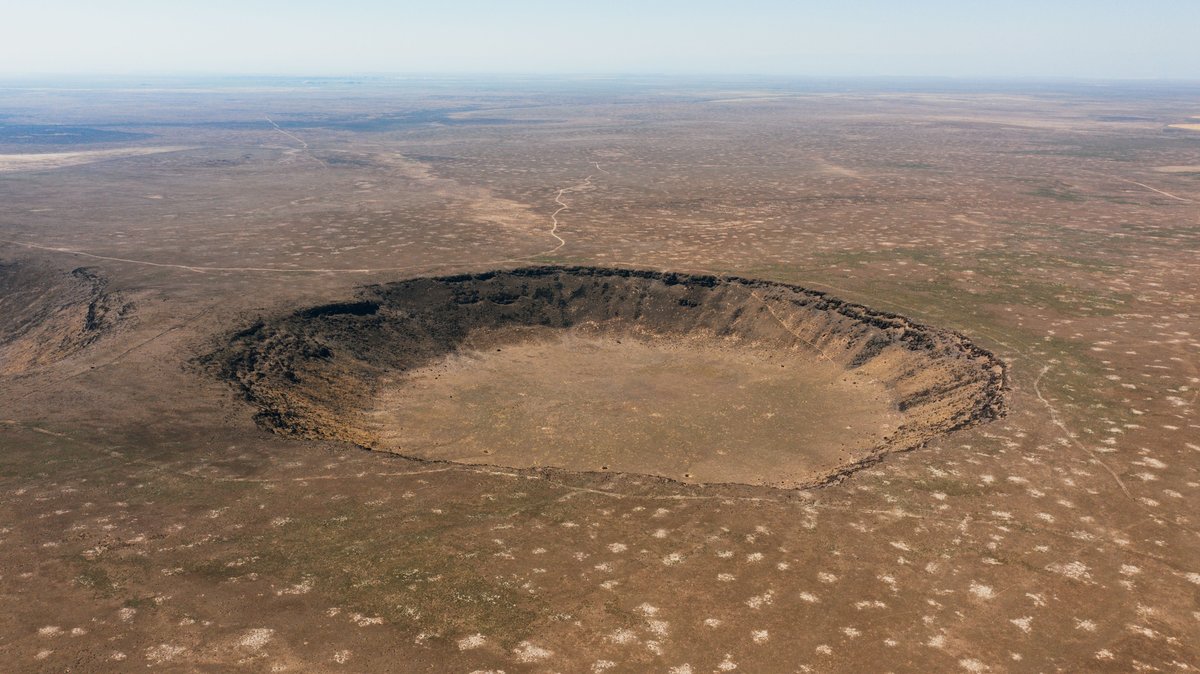
A study in Communications Earth & Environment found that the buried hot-water system beneath the dinosaur-killing Chicxulub crater lasted for at least 8 million years. The result pushes the crater’s hidden afterlife far beyond earlier estimates and gives scientists a rare, measurable window into how impact craters can remain warm, wet and potentially habitable long after the blast.
The research centers on the Chicxulub impact structure, the vast scar beneath Mexico’s Yucatán Peninsula left by the asteroid linked to the end-Cretaceous mass extinction 66 million years ago. The impact is famous for devastation at the surface. Beneath the crater floor, heat and water created a different kind of story.
Led by Annemarie E. Pickersgill, a research fellow associated in the the research report with the University of Glasgow, the team dated minerals from rock cores drilled deep into the crater’s peak ring. Those minerals formed as hot fluids moved through shattered rock. Their ages show that warm water kept circulating until about 58 million years ago.
The Crater Became a Deep Heat Engine
The Chicxulub asteroid struck with enough force to excavate a crater roughly 200 kilometers wide. Rock melted, fractured, collapsed and rebounded. That violence left a deep pile of broken material filled with heat.
Water then entered the system. Groundwater and seawater seeped into fractures and pore spaces, where they met hot rock. The result was a hydrothermal system, a network of circulating fluids that dissolved minerals in one place and deposited them in another.
Systems like this are familiar from volcanic regions and deep-sea vents. Hot water rises, cooler water sinks and chemistry changes along the way. Inside an impact crater, the same basic process can begin after a single catastrophic strike.
At Chicxulub, that process altered the crater’s rocks. Minerals such as clays, zeolites, calcite, chlorite, garnet and feldspar recorded the movement of fluids after the impact. The new study focused on minerals that could carry a clock.
Drilling Into Chicxulub’s Peak Ring
In 2016, an international drilling campaign reached into Chicxulub’s peak ring, a raised ring of rock formed during the collapse and rebound of a giant crater. The drilling took place at Site M0077, beneath the seafloor, during International Ocean Discovery Program and International Continental Scientific Drilling Program Expedition 364.
The core recovered from that site opened a direct view into rocks that had been unavailable to scientists. Some samples came from more than 700 meters below the seafloor. These rocks preserved a record of impact melting, cooling, fracturing and later chemical alteration.
The peak ring matters because it sits near the heart of the crater’s post-impact plumbing. There, shattered rock could hold heat and allow fluids to move. That made it an ideal place to test how long Chicxulub’s hydrothermal system survived.
The recovered Core M0077A showed strong evidence of post-impact alteration. The rocks had been chemically reworked by fluids, leaving minerals that cut across or overprinted earlier impact features. For geologists, that sequence matters because it shows the minerals formed after the asteroid strike.
A Mineral Clock in the Core
The key timekeeper in the study was K-rich feldspar. This potassium-bearing mineral formed as an overgrowth on earlier feldspar crystals inside impact melt rocks. Its texture showed that it crystallized after the original melt had cooled.
That made it valuable for argon-argon dating. In this method, radioactive potassium decays into argon. Because feldspar can trap that argon, scientists can measure how much has accumulated and calculate when the mineral formed.
The team analyzed tiny pieces of impact melt rock from several core depths. Some samples contained plagioclase crystals from rapidly cooled impact melt. Others contained K-rich feldspar overgrowths linked to later hydrothermal activity.
This distinction gave the researchers a way to separate the impact moment from the long aftermath. Plagioclase could record the original cooling of the melt. K-rich feldspar could record later episodes when hot fluid still moved through the crater.
The resulting dates stretched across a surprisingly long span. Plateau ages from key samples ranged from about 66 million years ago to about 58 million years ago. In practical terms, the mineral clock showed that the crater’s warm-water engine kept running for millions of years after the skies cleared.
Eight Million Years of Warm Water
The headline result is simple and striking. The study found that hydrothermal activity persisted for at least 8 million years after the Chicxulub impact. That makes it roughly four times longer than earlier estimates for the crater.
Previous work had suggested a much shorter lifetime. Some numerical simulations and geological interpretations pointed to about two million years of activity, with other constraints indicating shorter intervals at high temperature. Those earlier numbers gave scientists a first framework, but they relied heavily on indirect evidence and models.
The new study adds direct radioisotopic ages from minerals formed by the hydrothermal system itself. The authors also rebuilt numerical models using measurements from the recovered rock. The best-fitting simulations supported a similar lifetime, with fluid circulation fading near the eight-million-year mark.
The paper’s abstract describes Chicxulub as “the longest-lived impact generated hydrothermal system documented on Earth.” That claim rests on the mineral ages and the supporting simulations, rather than on the crater’s size alone.
This record length changes the scale of the story. Chicxulub’s surface aftermath unfolded over years, centuries and millennia. Deep below, the hot-water system endured across a span long enough for ecosystems to evolve elsewhere on the recovering planet.
Why the Finding Matters for Life
Long-lived heat and water are central to the astrobiology implications of the study. On Earth today, warm fluids moving through rock can support microbes that use chemical energy. Deep-sea vents and geothermal springs offer modern examples of life in dark, mineral-rich environments.
Pickersgill captured the point in plain language. “Wherever on Earth you find flowing warm water, you find life,” she said in the the research report.
The Chicxulub study examines habitability through time. A crater with water and heat for a few thousand years would offer one kind of opportunity. A crater with water and heat for millions of years offers a much larger window for chemistry and microbes.
The study abstract states that hydrothermal systems “likely played an essential role in the origin of life.” In the context of Chicxulub, that idea links a destructive impact to a sheltered subsurface environment where warmth, water and chemical gradients persisted.
The researchers remain cautious about what Chicxulub proves. The study measures the duration of hydrothermal activity. It does not demonstrate that microbes lived inside this particular crater during that interval. Even so, a long-lasting impact-generated hydrothermal system strengthens the case that large craters can create habitats with staying power.
What Chicxulub Reveals About Mars
Mars gives the Chicxulub finding a wider reach. The Red Planet preserves countless impact craters, including many that formed when water was more active at or near the surface. Some of those craters may once have hosted warm subsurface systems.
Earth has lost much of its oldest impact record through plate tectonics, erosion, burial and recycling of crust. Chicxulub is younger than the earliest chapter of Earth history, yet it remains one of the best preserved large peak-ring basins on the planet. That makes it a natural analogue for ancient impact environments elsewhere.
For Mars, the implications are practical. A crater that stayed warm and wet underground could preserve chemical traces, mineral deposits, or other signs relevant to past habitability. Surface conditions might have become harsh while protected subsurface zones stayed active for far longer.
The study also speaks to planets, moons and asteroids across the solar system. Large impacts were common early in planetary history. Where those impacts met water or ice, they may have produced temporary hydrothermal habitats inside fractured rock.
Chicxulub provides a measured example from Earth. Its mineral ages show that impact-generated warmth can last for millions of years under the right conditions. That gives mission planners and planetary scientists a stronger reason to examine crater minerals closely when searching for ancient habitable environments.
The Next Clues Beneath the Crater
The study leaves room for an even longer story. The main evidence from Expedition 364 points to at least eight million years of hydrothermal activity in and around the peak ring. Older samples from another borehole, located miles away, may hint at still younger mineral ages.
If those hints hold up, parts of the system could have remained active closer to 16 million years after impact. That possibility requires more work. The current study’s strongest claim is the directly supported minimum lifetime of about eight million years.
The next steps are likely to focus on additional samples, improved dating and better models of how fluids moved through the crater. Researchers can also compare Chicxulub with other impact structures, including Sudbury and Lappajärvi, where hydrothermal activity has been studied through mineral ages or simulations.
What has already changed is the timescale. Chicxulub is famous for ending the age of non-avian dinosaurs. Its rocks now show that the same impact also powered a buried warm-water world for a span longer than many geological systems get to last.
That hidden world gives scientists a sharper way to think about prebiotic chemistry, early microbial habitats and the search for life beyond Earth. In the fractured rock below an ancient crater, catastrophe and habitability can be part of the same planetary process.