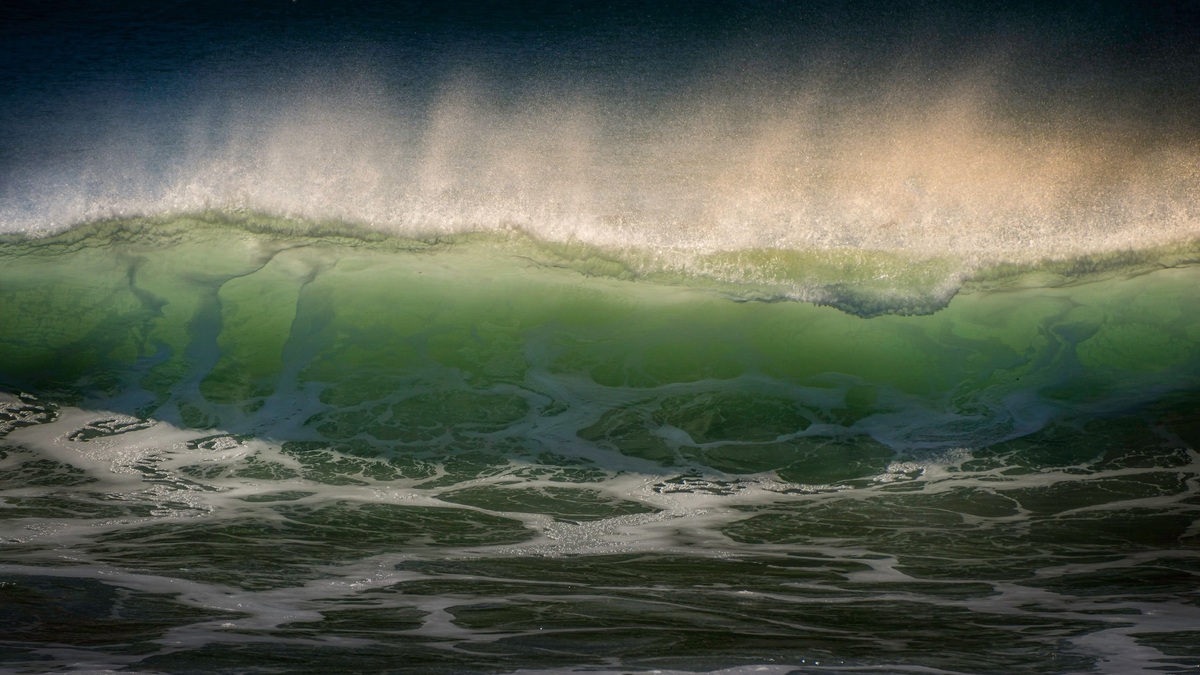
Ocean waves break when they enter water shallow enough for the seabed to interfere with their motion. The lower part of the wave slows first. Its wavelength then shortens as the crest grows steeper. Once the crest moves faster than the water beneath can support it, the top pitches forward and releases the wave’s energy as surf.
The process is easiest to see at a beach, yet it begins before white water appears. NOAA’s explanation of ocean wave motion describes energy moving through water while individual water particles trace nearly circular paths. As depth decreases, those paths become compressed against the bottom. The wave changes shape because its energy must continue through a smaller vertical space.
Breaking therefore depends on more than the height seen from shore. How quickly a wave becomes unstable depends on relative water depth together with the slope of the seabed. Wind conditions determine the incoming sea state, while reefs or sandbars can make one part of a crest break before another.
Waves carry energy toward shore
A surface wave usually begins when wind transfers energy to the sea. Friction and pressure differences roughen the surface, then continued wind builds larger motions. In deep water, a floating object generally rises, moves forward, sinks and returns toward its starting place as a crest passes. Most of the water does not travel across the ocean with the wave.
The diameter of that orbital motion decreases with depth. For ordinary deep-water waves, motion becomes weak below roughly half a wavelength. A wave with a wavelength of 100 meters can therefore interact with the bottom once the water becomes shallower than about 50 meters, even though the crest remains far offshore.
Wave energy continues advancing after the deepest particle motions begin to feel the seabed. The wave’s speed becomes tied to depth rather than only to its period and wavelength. This change is the start of shoaling, the broad transformation that prepares a wave to break.
Shallow water slows the wave
As a crest approaches the coast, the part of the wave nearest the bottom experiences resistance and loses speed. Crests behind it may still be moving faster in deeper water. They close the distance, which reduces the wavelength. The period usually stays almost constant because the source rhythm has not changed.
Energy becomes concentrated into the shorter horizontal distance. The crest rises while the trough becomes less distinct, producing a taller and more asymmetric profile. The National Weather Service describes this shallow-water transformation as a key part of surf formation. The growing height is called shoaling, although the full process also includes changes in speed and direction.
Steepness sets the breaking point
A wave cannot become indefinitely tall compared with its wavelength. Its steepness is the ratio of wave height to wavelength. In deep water, a sufficiently steep wave can break even without a seabed. Near shore, shortening wavelength and rising height push the ratio upward until the crest becomes unstable.
Coastal engineers often estimate depth-limited breaking with a wave height near four-fifths of the local water depth, though the exact ratio varies with beach slope and wave conditions. The rule means a one-meter-high wave commonly breaks in water only modestly deeper than one meter. It is a practical approximation rather than a universal boundary.
Water at the crest has forward momentum. When the crest outruns the supporting face, gravity pulls it down. Air becomes trapped and turbulence mixes through the upper water column. The organized motion of the incoming wave is converted into currents, heat and sound.
Breaking can also occur where opposing currents shorten waves. The same incoming period is squeezed into a smaller wavelength, increasing steepness. Bars and reefs create local shallow zones, so a breaker may appear well away from the visible shoreline.
Beach slope changes the breaker
A gently sloping beach tends to produce spilling breakers. White water forms near the crest and runs gradually down the wave face. Energy is released across a broad surf zone, which makes the collapse look less abrupt even when the surf remains powerful.
On a steeper bottom, the crest can curl over an open face before plunging into the trough. These plunging breakers create the familiar tube sought by surfers. Very steep shorelines may produce surging waves that climb the beach with little curling. The seabed profile helps determine which form appears.
Real beaches contain bars and channels that shift with storms. The same swell may spill over one sandbar, plunge across another section and remain unbroken in a nearby channel. Refraction adds another layer by turning crests as different portions enter shallow water at different times.
Breaking waves reshape the coast
Once a wave breaks, its momentum drives water toward land. Gravity then pulls water downslope as backwash, while alongshore differences in breaking angle create currents parallel to the beach. Concentrated return flow can form rip currents, narrow streams that carry water away from shore. NOAA’s coastal current guide explains how waves arriving at an angle help move sediment along the coast.
Turbulence lifts sand from the bottom and lets currents transport it. Small daily waves may rebuild a beach, whereas storm surf can move sand offshore and cut scarps into dunes. Reefs absorb part of the incoming energy before it reaches land, which can reduce erosion behind them.
The surf zone also mixes oxygen into water and exchanges material between the beach and nearshore sea. Its churning motion keeps sediment suspended while moving nutrients through habitat used by larvae. Breaking is therefore both a visible end to one wave and a driver of coastal change.
Why some waves never break at the beach
A small swell may lose energy through friction before it grows steep enough to collapse dramatically. A very deep shoreline can let waves reach a wall or cliff with limited shoaling. Local winds may also disrupt an orderly swell and replace it with irregular chop.
Tides move the effective breaking zone. At low tide, a sandbar may sit in shallow water and trigger breakers far offshore. Several hours later, higher water can allow the same swell to pass over the bar and break closer to land. NOAA tide observations help show the changing depth that surf forecasts must consider.
Wave forecasts combine coastal bathymetry with offshore measurements of height and period, plus the incoming direction. Longer-period swells feel the bottom in deeper water, so they can begin changing farther from shore. Watching a crest grow steeper until it curls and turns white reveals the final stage of an energy journey that may have started thousands of kilometers away.
How wave period changes the surf
Wave period is the time between successive crests. A long-period swell carries more energy for a given height than short local chop and begins interacting with the bottom in deeper water. It can produce powerful breakers even when the offshore height seems modest.
Short-period waves are closer together and often arrive with irregular local wind. They may break in a confused pattern across a broad area. Long-period crests are more orderly, which makes their refraction around headlands and concentration on particular beaches easier to recognize.
Surf reports pair height with period for this reason. Neither number alone describes the likely impact. Direction completes the picture by showing which coastal slopes and underwater features will receive the incoming swell energy.
What forecasters mean by wave height
Forecast significant wave height is an average of the highest third of waves, not the height of every crest. Individual breakers naturally vary and occasional waves rise well above the reported value. Beach observations also measure broken surf differently from offshore buoys.
Bathymetry transforms the offshore forecast before it reaches sand. A canyon may let energy approach with limited shoaling, while a shallow bank forces earlier breaking. Local surf models calculate this transformation with depth grids and recent water levels.
Wind at the beach can hold up a crest or flatten it. An offshore wind often makes the face cleaner, while strong onshore wind produces disorganized whitecaps. The underlying breaking mechanism remains the loss of stability as the wave becomes too steep for its depth.
Related reading: Ocean floor topography explained and abiotic factors in the ocean.