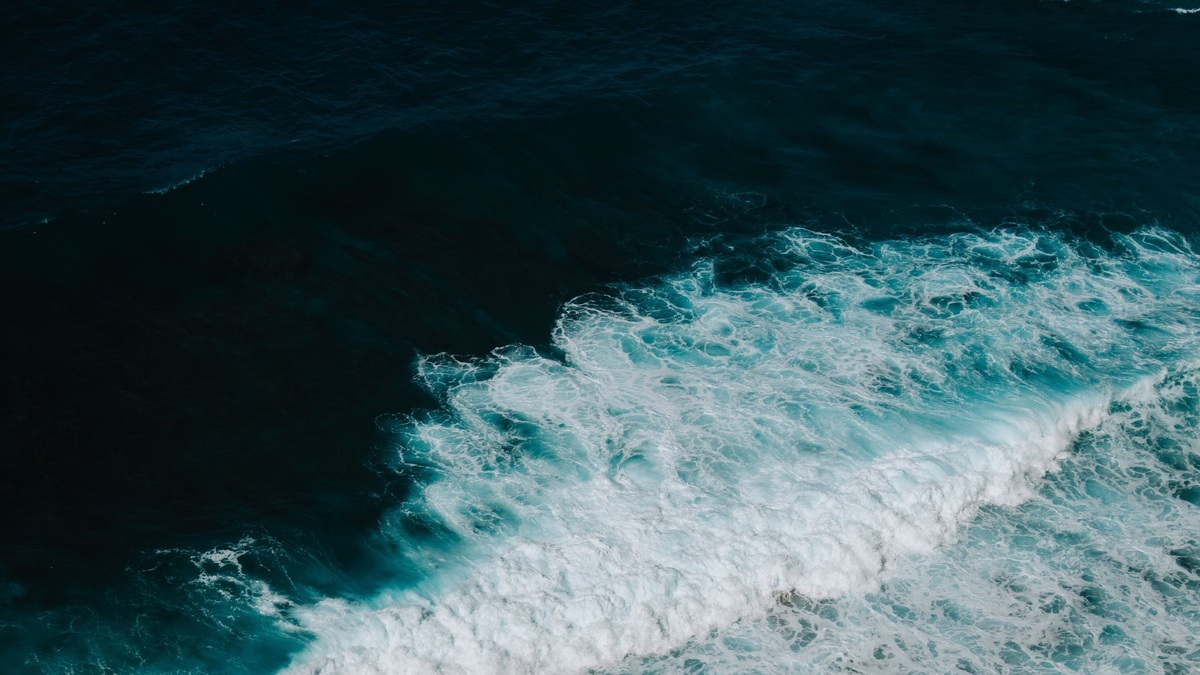
Most ocean waves begin when moving air transfers energy to the sea surface. A breeze first roughens otherwise smooth water, then continued wind pressure enlarges those ripples into recognizable crests and troughs. Stronger wind usually supplies energy faster, while a longer blow gives waves more time to grow. The distance over which the wind travels across open water also limits their eventual size.
The water itself does not cross an ocean with each crest. According to NOAA’s explanation, a wave mainly carries energy through water while individual particles trace small orbital paths. A floating object rises and shifts slightly forward. It then sinks and drifts back, ending near where it began.
Wind produces the familiar waves seen from beaches and ships, but it is only one possible source. Earthquakes can displace the water column and generate tsunamis. The gravitational pull of the Moon and Sun produces tides, which have far longer periods than ordinary surface waves. Understanding the source is essential because waves with similar heights can behave very differently.
Wind starts with tiny ripples
A perfectly smooth water surface gives the air little texture to push against. Small pressure variations and friction create capillary ripples, whose restoring force is mainly surface tension. Their raised faces present a larger target to the wind. Energy transfer becomes more effective as the roughness grows, so the first millimeter-scale disturbance can seed a developing field of wind waves.
Air flowing over a crest creates pressure differences across the wave. Turbulent gusts also apply irregular forces. Some disturbances gain energy while others fade, producing a mixed sea rather than an orderly procession of identical crests. The National Data Buoy Center describes this transfer as friction between wind and water, though the complete interaction also involves pressure acting on the sloped surface.
The growing waves begin to influence the air immediately above them. Their speed and direction affect how efficiently the wind can add more energy. Very young waves are short and steep because they have not had time to spread into longer periods. Whitecaps appear when some crests become unstable, dissipating part of the accumulated energy through turbulence and bubbles.
Speed, duration and fetch control growth
Wind speed sets the energy available for wave growth, but speed alone does not determine the sea state. A powerful gust lasting a few minutes may raise short, disorganized waves without building a large swell. Sustained wind keeps supplying energy and allows progressively longer waves to develop. Forecasters therefore consider how hard the wind blows and how long it maintains a useful direction.
Fetch is the uninterrupted distance over water along which the wind blows. NOAA’s coastal currents tutorial explains that large waves need strong, sustained wind acting across a long fetch. A narrow bay can limit wave growth even during strong weather, whereas a storm over a broad ocean has far more room to build a mature wave field.
Wave growth slows when one of those controls runs out. A wind shift can shorten the usable fetch, while a weakening storm reduces the energy supply. The existing waves continue onward and begin separating by period after they leave the generating wind.
Water particles move in orbital paths
The apparent forward rush of a crest can make a wave look like a moving wall of water. In deep water, however, particles near the surface follow nearly circular orbits. Their motion becomes weaker with depth. For a simple wave, a rough rule places the practical lower limit of noticeable orbital movement at about half the wavelength, which is the distance from one crest to the next.
The orbit is not perfectly closed in a real ocean. Waves can produce a small net transport called Stokes drift, while wind-driven currents move water independently. Even so, the distinction between energy propagation and bulk water transport remains useful. A wave group may travel hundreds of miles while the water supporting it stays within a much smaller region.
Wave period measures the time between successive crests passing a fixed point. Longer-period waves extend deeper and generally travel faster in deep water than short-period waves. Different components therefore separate as they leave a storm. The longest-period energy often outruns the rough local sea, reaching a distant coast as smooth swell before shorter waves arrive.
Wave height is measured vertically from trough to crest. Wavelength is horizontal and period is temporal. These quantities are related through wave physics, yet no single measurement describes the entire sea. Buoys record movement over time and convert it into a spectrum showing how energy is distributed among many periods.
Waves become swell away from the storm
Once waves move beyond the wind that generated them, they are called swell. Energy continues to spread across an expanding area, so swell height gradually declines. Dissipation also removes energy, but long-period waves can travel across an ocean basin. Their rounded crests and consistent direction often reveal a storm that is far beyond the local horizon.
Dispersion sorts the wave field because longer-period waves move faster in deep water. A distant observer may receive a sequence in which the period slowly shortens over time. Meteorologists can use that progression with direction measurements to infer where the storm-generated energy originated. Local winds may add a second, choppier wave system on top of the arriving swell.
Several systems can cross at the same place without permanently destroying one another. Their surface elevations temporarily add through superposition, producing larger or smaller individual waves. The pattern can look chaotic even though each component follows physical rules. Forecasts increasingly separate the systems by height, period and direction because each poses different conditions for vessels and coastlines.
Shallow water changes the wave
A wave begins to interact strongly with the seabed when the water becomes shallow compared with its wavelength. The lower part of the orbital motion is constrained and the wave slows. Its period remains nearly constant, so the wavelength shortens. Energy is compressed into less horizontal space, which often increases the height and makes the front face steeper.
Uneven depth can bend crests through refraction. The shallow portion slows first, rotating the wave toward a more shore-parallel alignment. Energy may concentrate on a headland while spreading inside a bay. Local bathymetry consequently helps determine where surf becomes powerful, even when offshore wave conditions appear uniform.
Breaking releases stored wave energy
Continued shoaling eventually makes many waves unstable. The crest moves faster than the supporting lower water and spills or plunges forward. NOAA Ocean Exploration’s wave overview links this coastal breaking to the disruption of orbital motion by the seafloor. Turbulence converts organized wave energy into heat and sound while mobilizing sediment.
Beach slope influences how the release looks. Gentle slopes tend to support spilling breakers with foamy water sliding down the face. Steeper seabeds can produce plunging crests and hollow curls. Very steep shores may favor surging waves that rush upward with little visible break. The incoming period and height also change the breaker type.
After breaking, water moving shoreward must return seaward. The resulting flow contributes to undertow and can feed concentrated rip currents through gaps in sandbars. Waves also drive longshore currents when they approach at an angle. These motions transport sediment and reshape beaches, connecting the energy of a distant wind field to visible changes along the coast.
Ocean waves therefore form through a chain of energy transfers. Wind supplies most everyday surface energy, the wave field organizes as it travels and the seabed transforms it near land. The crest seen from shore is one moment in that sequence, supported by water particles whose motion is much more local than the traveling pattern above them.
Related reading: Ocean floor topography explained and abiotic factors in the ocean.