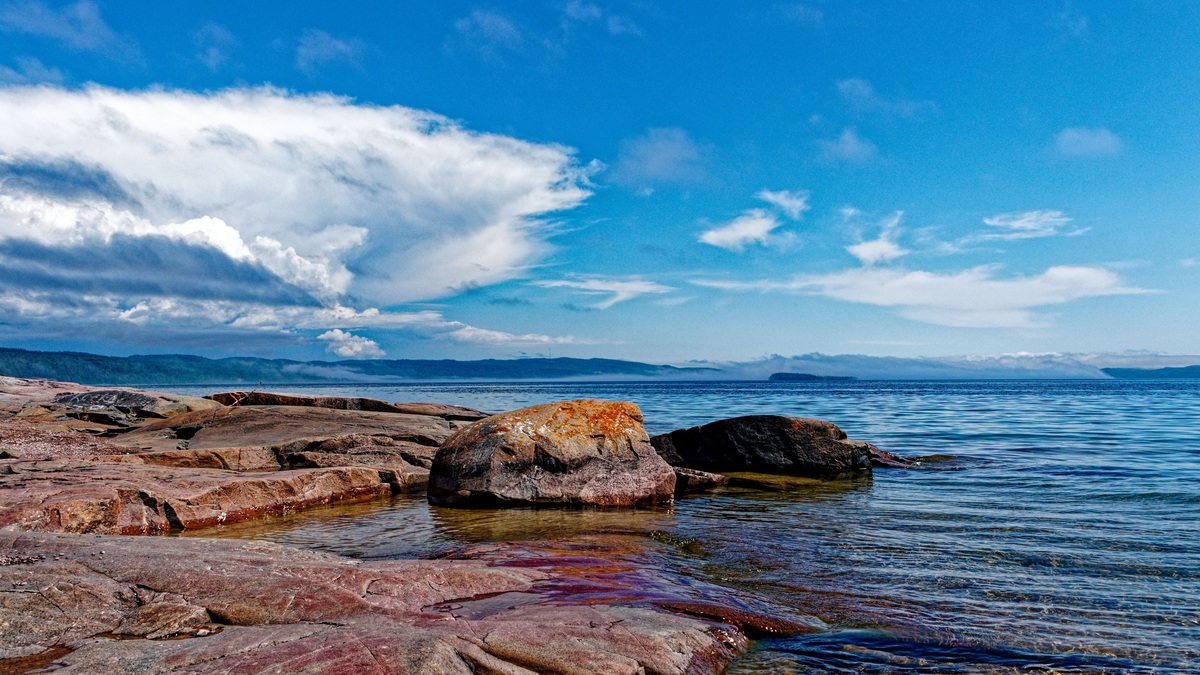
Lake Superior’s bottom is alive with a cold-water community of tiny animals, microbes and, in shallower places, larger fish and invertebrates. The characteristic deep-bottom residents include the amphipod Diporeia, aquatic worms, fingernail clams, midge larvae and flatworms. Bacteria and other microorganisms process organic matter within the sediment. Fish such as lake whitefish and slimy sculpin feed near the bottom, but they are mobile visitors rather than the organisms that define the benthic community.
The word benthic means living on, in or very close to the lakebed. It should not be confused with limnetic life in the open water above. NOAA’s Great Lakes Water Life Explorer makes the same habitat distinction when it records where Great Lakes species have been observed. Even Lake Superior’s deepest basin supports life because its cold water generally retains oxygen, while food arrives as particles sinking from the productive water above.
A lakebed with several habitats
There is no single type of Lake Superior bottom. Waves scour exposed nearshore rock, gravel and sand. Farther offshore, fine silt and clay settle in deeper, quieter water. Islands, reefs, shipwrecks and harbor structures add hard surfaces. Each substrate favors a different set of organisms, so a scoop of deep mud and a stone from a shallow reef can hold very different communities.
Depth changes the setting as well. Sunlight supports attached algae in clear, shallow areas, but useful light fades long before the lake reaches its maximum depth. Deep benthic animals therefore depend largely on organic particles produced higher in the water column or carried from land. The lakebed is linked to the rest of the aquatic food chain by this downward delivery of food and by fish that eat bottom animals.
Lake Superior is cold, clear and low in nutrients compared with the lower Great Lakes. Such an oligotrophic lake produces less food per unit area than a nutrient-rich lake, so deep-bottom animals are often small and scattered. Sparse does not mean empty. A federal Great Lakes biology monitoring report found a persistent dominant species complex in Lake Superior’s long-term benthic stations.
Diporeia, a key deep-water animal
Diporeia is a small, shrimp-like amphipod and one of the best-known animals in Lake Superior’s sediments. It spends much of the day close to or buried in the bottom, feeding on freshly settled algae and other organic material. The animal packages energy from tiny particles into prey that bottom-feeding fish can capture. An NOAA guide to benthic life describes amphipods, aquatic worms, midge larvae and other small animals that live on Great Lakes bottoms.
Research published in the Journal of Great Lakes Research reports that Diporeia remains Lake Superior’s dominant macroinvertebrate even after major declines elsewhere in the Great Lakes. It is especially abundant on the lake’s slopes at roughly 30 to 125 meters deep. Laboratory preference trials pointed toward sediment grain size as a stronger explanation for that distribution than the measured chemical characteristics of potential food.
The amphipod’s importance extends beyond abundance. Lake trout, lake whitefish, sculpins and other consumers can move energy from benthic prey into higher levels of the food web. EPA’s 2016 Lake Superior assessment calls Diporeia an important prey item for numerous fish species and notes its use as an indicator of ecological condition.
Worms, clams and insect larvae
Aquatic oligochaete worms live within soft sediment, where they consume detritus and microbes. Their burrowing mixes the upper layer of the lakebed and exposes buried material to oxygenated water. Small fingernail clams in the family Sphaeriidae filter particles or gather food at the sediment surface. Flatworms and enchytraeid worms also occur in deep samples, although a casual observer would need magnification to appreciate most of them.
Midge larvae, called chironomids, occupy tubes or burrows before emerging as winged adults. Nearshore stones may support insect larvae, snails and attached algae that are uncommon in deep mud. Crayfish occur in protected, rocky shallows, where crevices offer cover. Species composition changes across depth and substrate, which is why “the bottom” includes several ecological zones rather than one uniform floor.
Older surveys described four major deep-bottom groups: oligochaetes, chironomids, sphaeriid clams and Diporeia, formerly called Pontoporeia affinis. The taxonomy has been revised, but the broad ecological picture remains useful. Deep sediments host a community dominated by small deposit feeders and burrowers, while shallow hard bottoms add attached organisms and larger mobile animals.
Microbes do much of the recycling
Bacteria and other microorganisms live between sediment grains and on particles that settle to the bottom. They break down dead algae, animal waste and other organic matter. Benthic animals graze on this microbial coating or consume particles enriched by it. Their feeding and burrowing return nutrients to the thin layer of water above the sediment.
Photosynthesis cannot sustain the deep lakebed because sunlight does not reach it. The energy begins mainly with phytoplankton in the illuminated water and algae in the nearshore zone. Some of that production is eaten while suspended; some sinks as cells, fragments and fecal pellets. Bottom microbes and animals use the fraction that reaches them, creating a physical and biological connection between open water and sediment.
The connection also explains why conditions far above the bottom can alter benthic life. Changes in plankton production, water clarity or filter-feeding mussels can change how much edible material settles. Runoff can add fine sediment and contaminants near tributary mouths. Readers interested in the basin’s physical origin can trace the foundation of these habitats in how the Great Lakes formed.
Cold, darkness and oxygen
Lake Superior’s great depth creates darkness and near-freezing conditions over much of its floor. Cold slows growth and decomposition, yet it also helps water hold dissolved oxygen. Seasonal mixing carries oxygen downward and the lake’s relatively low biological productivity limits the amount consumed by decay. The binational Lake Superior management plan identifies warming and longer summer stratification as future risks to deep-water oxygen, but present deep water remains suitable for oxygen-dependent animals.
Substrate supplies another filter. Coarse rock offers attachment points and crevices but little material for a burrower to ingest. Soft silt holds organic particles and allows worms, clams and amphipods to dig. On the slopes where Diporeia is most abundant, physical sediment characteristics appear to help define favorable habitat.
Pressure rises with depth, although the temperature, oxygen supply, food delivery and substrate usually provide more useful explanations for where bottom organisms occur. The deepest point should not be pictured as a crowded aquarium. It is a dark, food-limited environment whose residents are mostly small and adapted to a slow energy supply.
Invasive species have changed some areas
Zebra and quagga mussels transformed benthic food webs in several lower Great Lakes by filtering suspended food and concentrating material at the bottom. Lake Superior’s cold, nutrient-poor open waters have limited their spread. The 2019 federal monitoring report found dreissenid mussels around Duluth-Superior Harbor and on hard substrates near the Apostle Islands, but none at the program’s long-term Lake Superior stations.
Localized establishment still deserves attention. Mussel beds alter hard surfaces, filter plankton and produce waste that changes nearby sediment. Other invaders affect shore and wetland habitats connected to the lake. Broader changes in wetlands, reefs and tributary mouths are covered in habitat loss in the Great Lakes.
Monitoring is essential because benthic change is easy to miss from shore. Scientists lower grabs that remove a measured patch of sediment, sieve the sample and identify the animals. Repeated stations reveal changes in density and community composition. Video, remotely operated vehicles and acoustic maps add information about reefs and other hard bottoms that a sediment grab cannot sample well.
What the bottom community reveals
Bottom organisms integrate conditions over months or years. A plankton sample captures a moving community at one moment, while a long-lived clam or a group of burrowing worms reflects the sediment and water quality where it has remained. Researchers use changes in abundance, diversity and pollution tolerance as evidence about habitat condition, while recognizing that depth and substrate naturally influence every sample.
The clearest answer to what lives at the bottom of Lake Superior is therefore a community, not a mysterious giant or a lifeless plain. Diporeia, worms, tiny clams, insect larvae, flatworms and microbes dominate much of the soft lakebed. Shallow rocks support additional attached and mobile life and bottom-feeding fish connect those organisms to the wider lake. Cold, oxygenated water keeps the deep floor habitable, while limited food sets the pace of life.
Explore the Lake Superior shoreline
Continue with the 1,300-mile Lake Superior Circle Tour, 15 attractions across the Great Lakes.