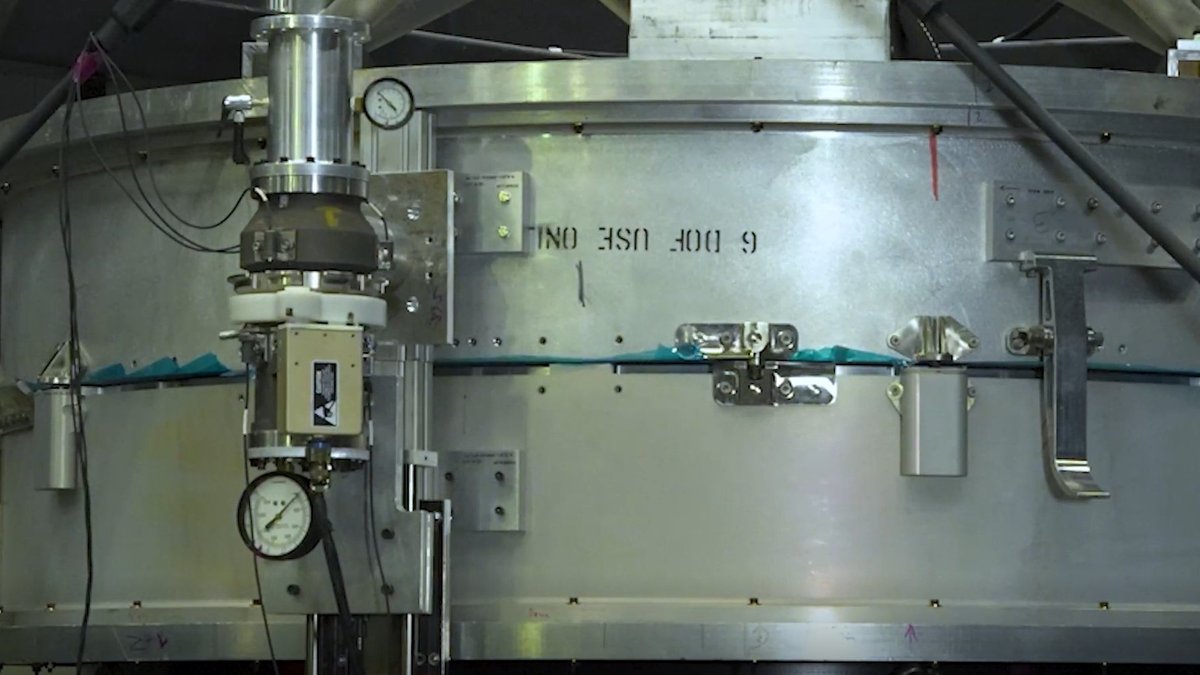
NASA has tested a developmental cryocoupler that could help future spacecraft refuel in Earth orbit before setting out for deeper destinations. The work, conducted by engineers at NASA’s Marshall Space Flight Center with L3Harris, targets one of the hardest practical problems in future exploration: moving extremely cold rocket propellant between spacecraft without wasting it.
The device acts like a specialized fuel nozzle for space. Future vehicles may dock with orbital propellant depots before leaving Earth orbit, much as aircraft or cars rely on refueling infrastructure. For missions to the Moon, Mars and beyond, that shift could change how spacecraft are designed. A vehicle could launch with less propellant, refill in orbit and reserve more mass for science instruments, cargo, or crew systems.
At the center of the test is cryogenic propellant transfer. Liquid hydrogen and liquid oxygen must be kept hundreds of degrees below zero Fahrenheit. At those temperatures, metals shrink, seals stiffen and small mechanical errors can become mission problems. NASA’s recent tests examined how a cryocoupler behaves when exposed to those extreme conditions and when its two halves approach each other at imperfect angles.
Why spacecraft may need orbital gas stations
Deep-space missions have always been shaped by a brutal accounting problem. Every pound of propellant launched from Earth demands more rocket power, which demands more hardware, which adds still more mass. In-space refueling offers a way to loosen that constraint for future exploration architectures.
An orbital propellant depot would serve as a fuel stop in space. A spacecraft could launch into Earth orbit, dock with the depot, load propellant and then depart for a more distant target. That approach could support large science spacecraft, cargo vehicles, human exploration missions and long-range transfer stages.
NASA is studying this capability because cryogenic propellants are central to powerful space transportation. Liquid hydrogen and liquid oxygen are efficient fuels for high-energy missions, but they are difficult to store and transfer. They boil easily if heat leaks into the system. Even a small loss can matter when mission planners are counting every kilogram.
Travis Belcher, cryocoupler project manager at NASA Marshall, described the scale of the challenge plainly. “In-orbit cryogenic refueling between two spacecraft has yet to be done,” he said. That sentence captures why a single connector can be important. Before orbit can become a practical staging ground, spacecraft need reliable ways to make and break fuel connections in space.
The idea also fits into a broader push toward more flexible space operations. Refueling could extend spacecraft lifetimes, reduce launch mass and support missions that would be hard to fly with a single tank filled on Earth. Belcher added, “These propellant transfers are essential for the kinds of missions NASA wants to fly in the future.”
The tiny connector behind deep-space refueling
A cryocoupler is the hardware that lets two propellant systems meet. One half could be on a depot. The other could be on a spacecraft tank line. When the two halves connect, they must form a sealed path for fluid that is far colder than any environment people experience on Earth.
The design NASA tested was developed by L3Harris. It is intended to connect and disconnect repeatedly, which matters for depots that may serve many vehicles. The device is also designed for automation. Astronauts should be able to avoid spacewalks for routine propellant transfers.
“The cryocouplers we’re working on can attach and detach multiple times and are fully automated,” Belcher said. That capability points to a future in which refueling operations are handled by spacecraft systems and robotic mechanisms. A crewed spacecraft could benefit from the same kind of automated docking precision that already supports many orbital operations.
The coupler also needs to tolerate imperfect alignment. In space, two vehicles may dock with tiny offsets in position or angle. The cryocoupler must accommodate some of that mismatch while still protecting the seal and the flow path. This is especially important when the system is handling liquid hydrogen or liquid oxygen, which demand careful thermal control.
Ground fueling systems for large rockets offer useful experience, but spacecraft refueling adds its own constraints. A launch-pad coupler can be massive, serviced by ground crews and reset between missions. A space-rated coupler must be compact, repeatable, remotely operated and able to survive the vacuum and temperature swings of orbit.
How NASA tested the cryocoupler
NASA and L3Harris ran two main types of tests at Marshall Space Flight Center. The first focused on cold-flow behavior. Engineers used liquid nitrogen at minus 321 degrees Fahrenheit to expose the cryocoupler to cryogenic temperatures. Liquid nitrogen is often used in testing because it is easier to handle than liquid hydrogen while still producing severe cold.
During those cold tests, the team moved liquid nitrogen through connected and disconnected configurations. The goal was to see how the device responds as materials contract, flow begins and temperature differences develop between the fluid and the surrounding hardware. In a cryogenic system, even familiar materials can behave in surprising ways.
The second test campaign explored how the cryocoupler performs during connection. One half of the coupler was mounted to a robotic table. That table could move and rotate in different directions, allowing engineers to simulate docking conditions where the two sides do not line up perfectly.
Above the table, the other half of the coupler remained stationary. By changing the table’s angle and position, engineers could probe the coupler’s operational limits. Those tests help determine how much misalignment the device can tolerate before a connection becomes unreliable.
This kind of testing is practical and incremental. NASA is learning how the hardware behaves before tying it to a specific mission design. The early work focuses on basic functionality, thermal response and mechanical performance. Later campaigns can push toward detailed requirements for real vehicles and depots.
Why ultra-cold fuel is so hard to move
Cryogenic propellants sit at temperatures where ordinary engineering instincts can break down. Liquid oxygen is cold enough to make many materials brittle. Liquid hydrogen is even colder and its tiny molecules can be difficult to contain. A connector must remain sealed while the parts around it shrink and shift.
The temperature gap is one of the central difficulties. When an ultra-cold fluid first enters warmer hardware, it rapidly pulls heat from the metal and seals. That thermal shock can produce contraction and stress. Engineers must anticipate how every part moves as it cools.
Flow behavior adds another complication. Fluids in microgravity do not settle the way they do on Earth. Bubbles, sloshing and vapor can affect transfer systems. While the recent cryocoupler work was ground testing, it supports a larger Cryogenic Fluid Management effort aimed at making storage and transfer more predictable for space missions.
Loss of propellant is also a serious concern. Cryogenic liquids can boil away if heat enters the tank or line. In a depot scenario, stored fuel may need to remain usable for long periods. Every valve, seal, line and connector becomes part of the thermal control challenge.
The cryocoupler sits at a particularly sensitive point in that chain. It must open a path for flow, close that path cleanly and remain dependable across multiple uses. A leaky or jammed connector could waste propellant, delay a mission, or threaten a spacecraft’s ability to depart on schedule.
What comes next for in-space refueling
NASA describes the current cryocoupler work as early-stage development. That framing matters. The tests show progress on core functions, while future campaigns will have to evaluate the hardware against the demands of particular missions. Different spacecraft may need different flow rates, connector sizes, docking tolerances and propellant combinations.
Belcher emphasized that path ahead. “Future test campaigns will design them for specific missions,” he said. Those future tests could assess durability, repeated cycles, tighter performance limits and behavior under conditions that more closely match operational systems.
The testing took place through a 2022 Announcement of Collaboration Opportunity. Under that arrangement, NASA centers provide selected companies with expertise, facilities, hardware and software at no cost. For this project, the collaboration brings together NASA’s cryogenic experience and L3Harris hardware development.
The work is overseen by NASA’s Cryogenic Fluid Management Portfolio, a cross-agency effort based at NASA Marshall and NASA’s Glenn Research Center in Cleveland. That portfolio includes technologies for storing, measuring, transferring and using cryogenic fluids during future missions. The cryocoupler is one piece of that larger system.
If the technology matures, orbital refueling could reshape mission planning. Spacecraft would still need launch vehicles, tanks, engines and careful thermal systems. They could also gain a new operational option: refuel after launch and then leave Earth orbit with a full tank. For deep-space exploration, that could make orbit feel less like a parking place and more like a launch pad.