NASA is preparing a rare orbital rescue through its Swift Boost mission, sending a robotic spacecraft to raise the altitude of the Neil Gehrels Swift Observatory before atmospheric drag pulls it too low. The plan centers on LINK, a servicing satellite built by Katalyst Space, which is scheduled to launch no earlier than Tuesday, June 30, 2026.
The observatory has spent more than 21 years watching the violent universe. It quickly turns toward gamma-ray bursts, stellar explosions, black hole activity and other short-lived events. Now the spacecraft has become the subject of an urgent engineering campaign, because its orbit has been shrinking faster during a period of increased solar activity.
The rescue attempt will send LINK into orbit on a Northrop Grumman Pegasus XL rocket. After launch, LINK will check its systems, approach Swift, survey the spacecraft, grapple it with robotic arms and slowly push it back toward a safer altitude. If the boost succeeds, Swift can return to its role as a rapid-response observatory for cosmic outbursts.
A fast rescue for Swift
NASA’s Neil Gehrels Swift Observatory launched in November 2004 to study gamma-ray bursts, which are among the most energetic explosions known. The spacecraft was built to react quickly. When it detects a burst, it can turn toward the event and alert telescopes on Earth and in space for follow-up observations.
That speed made Swift valuable across astronomy. Its instruments observe the sky in different kinds of light, allowing scientists to connect sudden flashes with their sources. S. Bradley Cenko, Swift’s principal investigator at NASA Goddard Space Flight Center, called the observatory “NASA’s multitool when it comes to studying the cosmos.”
Swift’s orbit has slowly declined for years. The recent problem is timing. NASA models showed the observatory could reach an altitude near 185 miles as early as July, which would give the rescue mission little room for delay. The operations team at Penn State’s Eberly College of Science adjusted the spacecraft’s pointing strategy to slow the descent.
Instead of aiming only at scientifically interesting targets, the team began choosing sky positions that help Swift fly through the upper atmosphere with a slimmer profile. They also reduced power use where possible, which let the spacecraft place its solar panels in a more aerodynamic orientation. NASA says recent predictions now keep Swift above the critical altitude until this fall.
Swift’s rapid response science is the reason NASA is trying such an ambitious intervention. Replacing the observatory’s capabilities would be difficult and costly. A successful boost would buy time for a spacecraft that still contributes to high-energy astrophysics.
Why the observatory is sinking
Every spacecraft in low Earth orbit moves through traces of atmosphere. The air is thin at those heights, yet it still pushes against spacecraft surfaces. Over time, that drag steals orbital energy and lowers altitude.
Solar activity can make the problem worse. When the Sun becomes more active, it heats and expands Earth’s upper atmosphere. That expansion increases drag at orbital heights, especially for spacecraft without propulsion systems that can regularly correct their altitude.
Swift has no onboard propulsion system for long-term orbit raising. Its mission design focused on fast pointing and space-based astronomy. After more than two decades in orbit, the changing space environment has placed the spacecraft on a steeper path downward.
The physics is simple in outline. A satellite stays in orbit because it moves sideways fast enough to keep falling around Earth. Drag slows that sideways motion. As the orbit drops lower, the spacecraft meets denser air, which can increase the rate of descent.
Atmospheric drag became the central mission threat. NASA could have allowed Swift to re-enter, as many spacecraft do at the end of operations. The agency instead turned the challenge into a test of commercial satellite servicing.
How LINK will grab and lift Swift
The servicing spacecraft, called LINK, was built by Katalyst Space for the boost attempt. It weighs about 880 pounds and stands about 5 feet tall. NASA describes it as roughly one-third of Swift’s overall size.
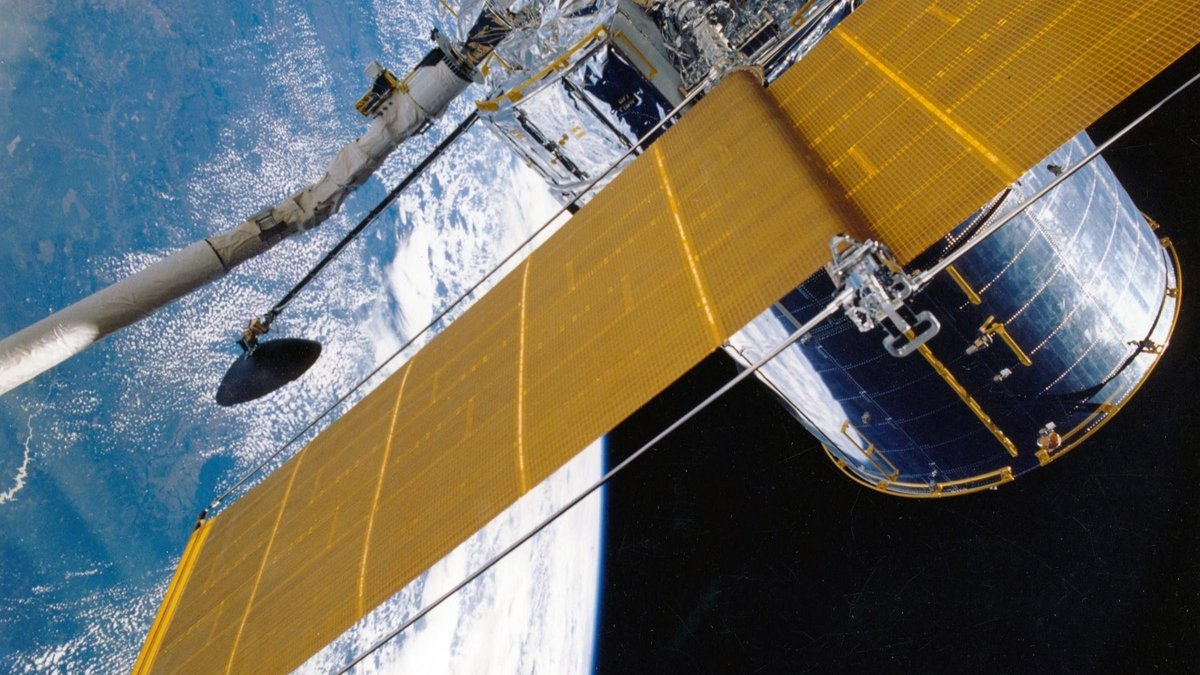
LINK carries nearly 20 feet of solar panels, three ion thrusters and three robotic arms. Those systems give it the power, maneuvering ability and physical reach needed for a slow rendezvous with an observatory that was built long before routine servicing became a goal.
Ghonhee Lee, CEO of Katalyst Space, described the difficulty plainly: “Swift wasn’t designed to be serviced.” That detail shapes the mission. LINK must approach an operating science satellite that lacks the special docking hardware used by spacecraft planned for maintenance.
After reaching orbit, LINK will spend several weeks in commissioning. Katalyst will evaluate propulsion, navigation, sensors and other spacecraft systems before attempting the approach. The spacecraft will then move closer to Swift, inspect it and prepare for a controlled grapple.
Once attached, LINK will raise Swift’s orbit gradually. NASA’s target is near 370 miles, close to the observatory’s original orbit. The operation is expected to unfold over months, because gentle changes reduce stress on both spacecraft and improve control during the boost.
A rocket launched from an aircraft
Pegasus XL gives this mission an unusual launch profile. The rocket will ride beneath Stargazer, Northrop Grumman’s modified L-1011 aircraft. The airplane carries the rocket to altitude, then releases it for powered flight to orbit.
The mission is poised for launch no earlier than Tuesday, June 30, at 6:23 a.m. EDT. The launch site is Kwajalein Atoll in the Republic of the Marshall Islands, in the South Pacific. That location helps place LINK into the orbital path needed to reach Swift.
Wes Collier, vice president of launch systems at Northrop Grumman, said, “We can deploy Pegasus from almost anywhere in the world using our Stargazer, a modified L-1011 aircraft.” For this mission, that flexibility matters because Swift’s orbit demands a specific launch geometry.
Earlier in June, engineers loaded LINK into the Pegasus XL rocket at NASA’s Wallops Flight Facility in Virginia. They then attached the rocket to Stargazer. The aircraft and payload departed for Kwajalein Atoll on Thursday, June 18.
The air-launch approach supports a tight schedule. NASA contracted Katalyst in September 2025 to attempt the boost. That gave the company less than a year to design, build, test and launch a spacecraft for one of the most delicate commercial servicing attempts yet tried.
What this could change for satellite servicing
Robotic satellite servicing has long been a major goal for space operations. Many satellites were launched with no plan for repair, refueling, or orbital repositioning. LINK is intended to show that a commercial spacecraft can interact with one of those older satellites in a useful way.
NASA officials are treating the mission with caution. Shawn Domagal-Goldman, division director for Astrophysics at NASA Headquarters, called it “a high-risk, high-reward mission.” The risk comes from the complex rendezvous and grapple. The reward could include more years of Swift science and a stronger U.S. servicing industry.
The broader idea reaches beyond one telescope. Space agencies and companies operate many valuable satellites in orbits where drag, fuel limits, or aging hardware can end missions. A spacecraft that can reposition, repair, refuel, or refit satellites after launch would change how operators think about spacecraft lifetimes.
Commercial space servicing could also reduce waste. Extending a working satellite can preserve expensive scientific capability without building a full replacement. It can also help move spacecraft away from unsafe orbits before they become hazards.
Swift gives the demonstration a real scientific stake. The observatory tracks some of the universe’s briefest and brightest events. If LINK lifts it successfully, NASA gains more time for astrophysics and a practical test of a technology that could reshape future orbital maintenance.