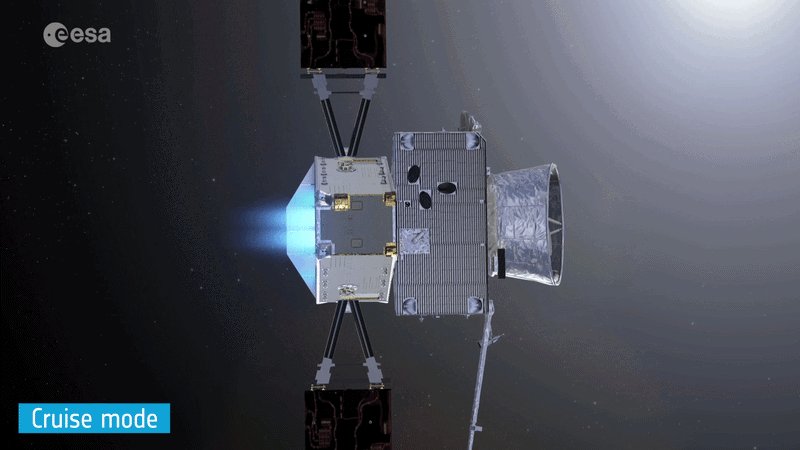
ESA’s official announcement marks a turning point for BepiColombo, the joint ESA/JAXA mission to Mercury. At 15:24 CEST on June 15, 2026, the spacecraft’s blue ion thrusters were switched off for the last time, ending the long solar electric propulsion phase that carried the mission across the inner Solar System.
The shutdown closes one of the most demanding cruise phases ever flown to another planet. Since launch in October 2018, BepiColombo has used low but steady thrust, gravity assists and careful navigation to move inward toward Mercury. The spacecraft is now beginning the arrival sequence that will lead to Mercury orbit insertion in November 2026.
That quiet blue glow came from the mission’s solar electric propulsion system. It used sunlight to power ion thrusters that fired charged xenon particles at very high speed. The method allowed the spacecraft to adjust its path for years while using far less propellant than a chemical system would need for the same long-duration cruise.
The final shutdown of solar electric propulsion
The final command ended an eight-year chapter in BepiColombo’s journey. The spacecraft’s solar electric propulsion system completed its last thrust arc on June 15, 2026, then shut down permanently as planned. The timing had to be exact, because the spacecraft was already following a carefully designed path toward Mercury.
Commands were sent from Earth ahead of time so the shutdown would happen at the right moment. From that point onward, the mission entered a new phase. BepiColombo will coast toward its next major event, the separation of the Mercury Transfer Module on September 3, 2026.
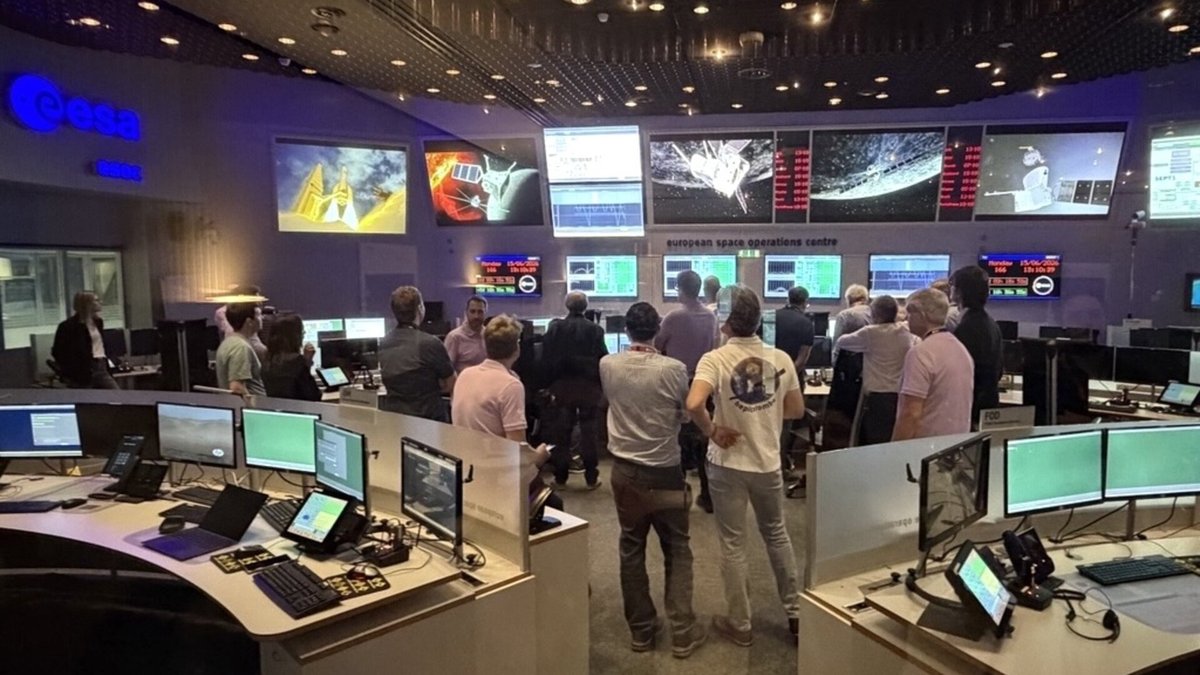
At ESA’s European Space Operations Centre in Darmstadt, Germany, mission teams and industry partners also reviewed what the propulsion system had taught them. Neil Wallace, the lead SEP thruster engineer, joined the review before the final shutdown. The lessons matter because electric propulsion is expected to play a growing role in future deep-space missions.
The shutdown also changes the character of the mission. For years, BepiColombo’s path depended on a slow and persistent push from ion engines. Now the spacecraft begins an arrival sequence shaped by gravity, chemical propulsion and a series of tightly timed operations near Mercury.
How ion thrusters carried BepiColombo inward
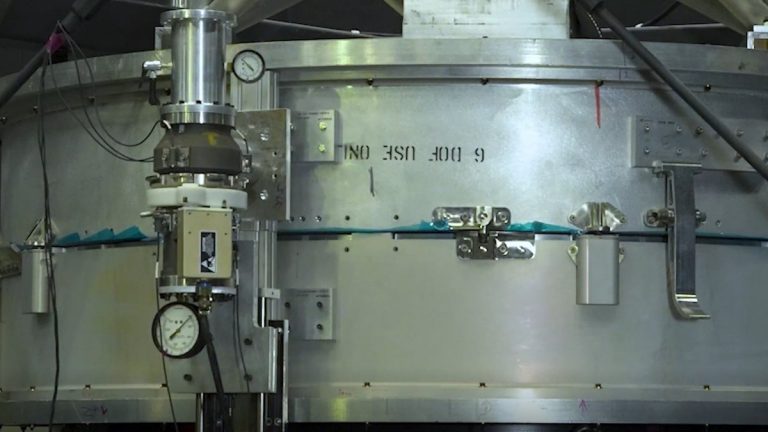
BepiColombo’s electric propulsion system sits in the Mercury Transfer Module, also called the MTM. This module carried four QinetiQ T6 thrusters that used electricity generated by the spacecraft’s solar arrays. Their job was to ionize xenon gas, creating a stream of charged particles that could be accelerated out of the engine.
The process is elegant in its simplicity. Solar energy becomes electricity. That electricity turns xenon into plasma. The thruster then pushes the charged particles outward at very high speed, producing a gentle force in the opposite direction.
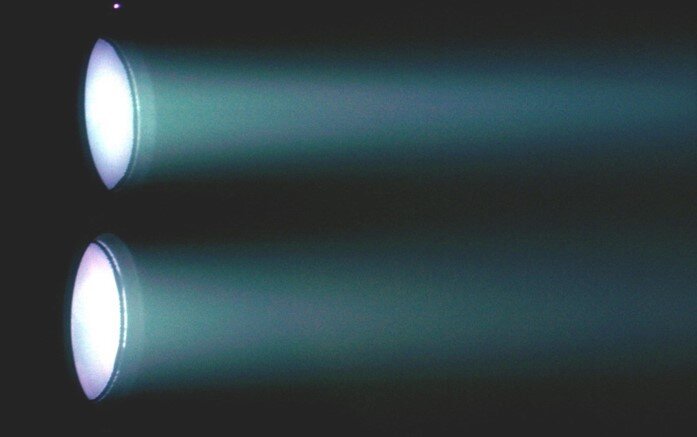
Each push is small, but space rewards patience. With no air resistance to fight, a low thrust applied for long periods can reshape a spacecraft’s orbit around the Sun. For BepiColombo, that steady thrust helped manage one of the strangest challenges in planetary travel, falling inward toward the Sun while preparing to be captured by Mercury.
The system also adjusted its thrust according to the power available from the solar arrays. That flexibility was important during a cruise through the inner Solar System, where lighting conditions and spacecraft geometry changed along the way. It allowed engineers to balance power, propulsion and thermal demands across many years of flight.
By the end of its work, the QinetiQ T6 thrusters had helped complete one of the most complex interplanetary transfers ever attempted. Their final shutdown was less like flipping off an ordinary engine and more like retiring a spacecraft tug after a long haul across deep space.
Why Mercury is so hard to reach
Mercury looks close to Earth compared with the outer planets, but reaching orbit there is a severe navigation challenge. A spacecraft heading inward gains speed as it falls toward the Sun. To enter orbit around Mercury, it has to arrive with the right path and the right energy.
The Sun dominates the trip. Its gravity pulls spacecraft into faster orbits as they move inward, which means mission planners must remove orbital energy over time. BepiColombo handled that task through a combination of electric thrust and planetary flybys.
Mercury adds another complication. It is small, so its gravity offers a narrower window for capture than a giant planet would. The mission cannot simply arrive fast and expect the planet to do the rest. Every flyby and thrust arc had to prepare the spacecraft for a controlled arrival.
That is why BepiColombo’s cruise lasted so long. The route was designed to gradually shape the spacecraft’s solar orbit until Mercury could finally receive it. The mission’s path reflects the physics of traveling inward, where the main task is losing speed in the right way.
Nine flybys and an eight-year cruise
BepiColombo’s cruise included nine planetary flybys. The mission passed Earth once, Venus twice and Mercury six times. Each encounter used a planet’s gravity to change the spacecraft’s direction and speed around the Sun.
Those flybys worked with the electric propulsion system. The thrusters provided long arcs of controlled thrust, while planetary encounters made larger changes to the trajectory. Together, they created a step-by-step route into the inner Solar System.
The mission launched in October 2018 and spent nearly eight years in cruise before the final electric thrust shutdown. During that time, BepiColombo had to operate close to the Sun, manage high temperatures and complete repeated navigation events. The spacecraft’s long journey was a campaign of steady adjustment rather than one dramatic burn.
Its Mercury flybys also gave mission teams early looks at the planet. Those passes were part of the transfer plan and they helped set up the final arrival geometry. The science orbit will come later, after the spacecraft stack completes the sequence of separation and capture maneuvers.
What happens after the transfer module separates
The next major event is MTM separation, scheduled for September 3, 2026. Once the Mercury Transfer Module is released, the part of the spacecraft that carried the ion thrusters will have completed its mission. The remaining spacecraft composite will continue toward Mercury.
That composite includes ESA’s Mercury Planetary Orbiter, JAXA’s Mio spacecraft and the protective structure used during cruise. The arrival sequence then depends on the Mercury Planetary Orbiter chemical propulsion system. Chemical propulsion can deliver the sharper maneuvers needed for the final approach and orbit insertion.
After MTM separation, BepiColombo will follow a ballistic path for part of its approach. In this context, ballistic means the spacecraft continues along a trajectory governed mainly by gravity until later maneuvers adjust it. The term describes a planned coast through space.
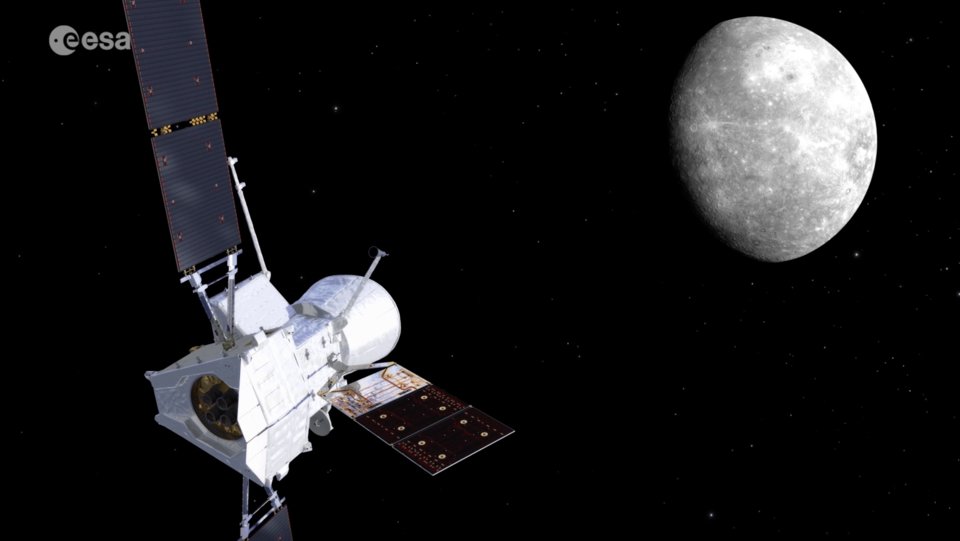
The handoff from electric propulsion to chemical propulsion is a major operational change. Electric thrusters shaped the long cruise. Chemical engines will handle the final steps that place the mission into the right orbit around Mercury.
The final path into Mercury orbit
The critical Mercury orbit insertion maneuver is scheduled for November 21, 2026. This burn will help BepiColombo become captured by Mercury’s gravity. It is one of the most important events of the mission, because it changes the spacecraft from a solar-orbiting traveler into a Mercury-orbiting observatory.
After insertion, the mission plan continues in stages. The spacecraft will guide Mio, JAXA’s Mercury Magnetospheric Orbiter, into its deployment orbit in early December 2026. Mio is designed to study Mercury’s magnetic environment and the charged particles around the planet.
ESA’s Mercury Planetary Orbiter will then be lowered toward its science orbit by March 2027. That gradual lowering is needed to place the orbiter where its instruments can study Mercury’s surface, interior, exosphere and surrounding space environment.
The arrival timeline shows why the final shutdown of the ion thrusters is such an important marker. The mission has moved from the cruise architecture into the Mercury operations architecture. Each step now brings the spacecraft closer to the configuration it needs for science.
What BepiColombo could reveal about the innermost planet
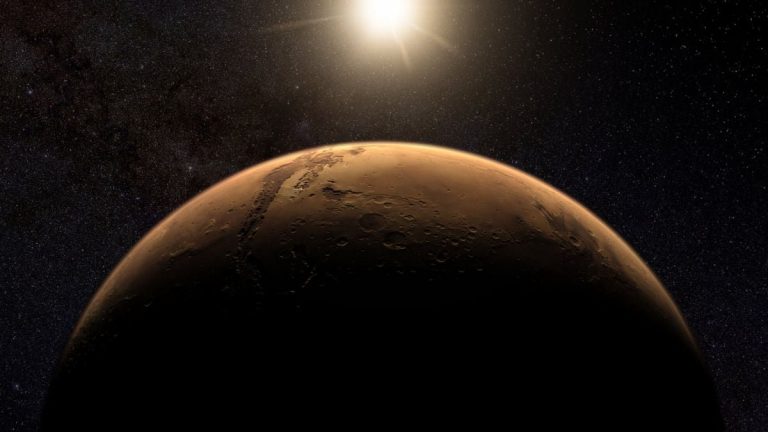
Mercury remains one of the least explored rocky planets. It sits deep in the Sun’s gravitational well, endures extreme heating and carries clues about how the inner Solar System formed. BepiColombo was built to investigate those clues from orbit.
The mission’s two orbiters bring complementary strengths. ESA’s Mercury Planetary Orbiter will focus on the planet itself, including its surface and internal structure. JAXA’s Mio spacecraft will examine the magnetic and plasma environment around Mercury.
Together, they could help scientists study why Mercury is so dense, how its magnetic field works and how the planet’s surface has been shaped over time. The data may also improve models of rocky planet formation near stars. Mercury is small, battered and close to the Sun, which makes it a natural laboratory for extreme planetary physics.
The end of the blue ion glow is therefore a beginning. BepiColombo has finished the propulsion phase that brought it to Mercury’s doorstep. The next months will decide how the mission unfolds around the Solar System’s innermost planet.