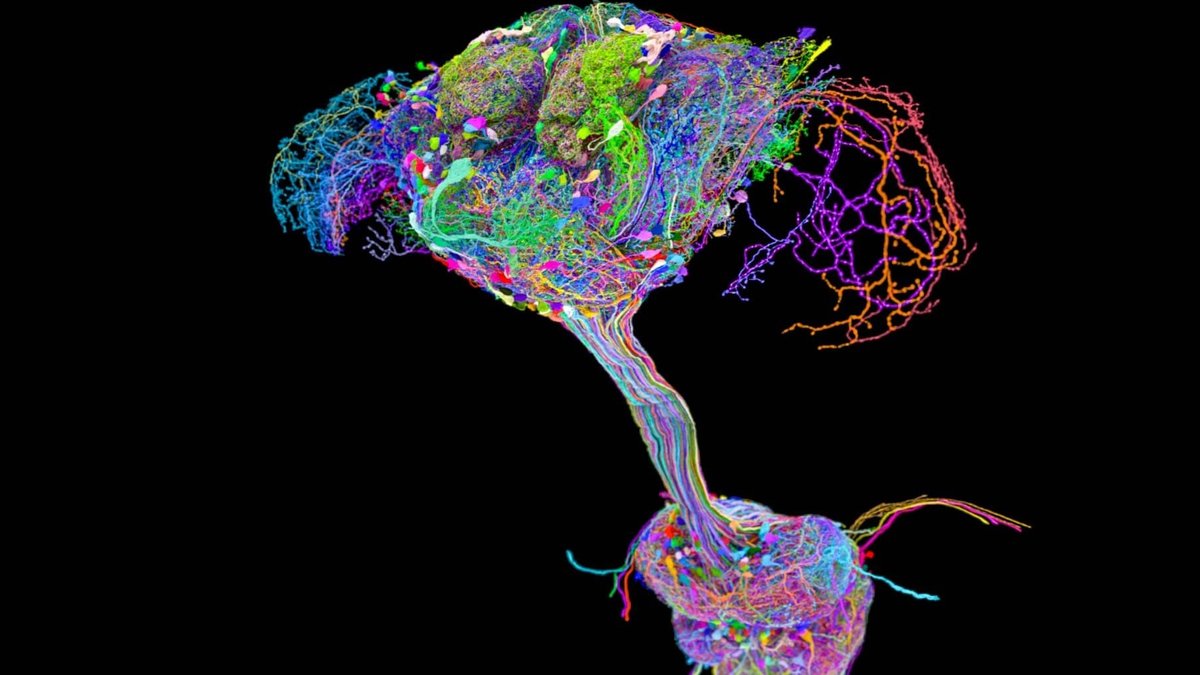
A study in Nature has brought neuroscience to a rare threshold, a synapse-level map that links the adult fruit fly’s brain with its nerve cord. The result gives researchers their most complete view yet of how a small animal’s nervous system connects sensation, movement and internal control.
The work was led by a large international team with major contributions from Harvard Medical School and Princeton University. By joining the fly brain to the insect’s version of a spinal cord, the researchers created a complete brain-to-body wiring map of the central nervous system. The map suggests that many actions are organized through local circuits that cooperate across the body.
That finding changes the way scientists can ask questions about behavior. A fruit fly can walk, fly, groom, taste, navigate, learn and respond to danger with a nervous system that is tiny compared with a human brain. Its compact size makes it possible to map its wiring in extraordinary detail, while its behavior remains rich enough to reveal general principles of neural control.
A First Full Brain-and-Cord Connectome
The new map is a connectome, a detailed wiring diagram showing how neurons connect at synapses. Earlier work had mapped the adult fruit fly brain. This study adds the ventral nerve cord, the structure that helps control the legs, wings and other body parts.
In the paper’s abstract, the authors describe the work as the “first densely-reconstructed adult fly connectome that unites the brain and ventral nerve cord.” That wording matters because the map brings two major control regions into one continuous dataset. Researchers can now follow signals across the central nervous system instead of studying brain and body-control circuits in separate pieces.
The organism at the center of the project is fruit fly Drosophila melanogaster, one of biology’s most powerful model animals. Its nervous system contains roughly 160,000 neurons, far fewer than a mammal’s brain. Even so, the fly performs behaviors that require sensory processing, timing, coordination and memory.
Rachel Wilson, a co-senior author and professor of neurobiology in the Blavatnik Institute at HMS, described the milestone in broad terms. “We can see all of the neurons and their connections as a complete unit for the first time and ask, ‘What do we learn from that?'” she said.
The study’s answer points toward a nervous system built from many cooperating parts. Brain regions still play key roles in learning, navigation and supervision of behavior. At the same time, circuits closer to the legs, wings, mouth and internal organs appear deeply involved in shaping action.
How the Team Built the 3D Wiring Map
Building the map required turning one adult fruit fly into an enormous imaging and reconstruction project. The researchers prepared thousands of ultrathin serial sections from the animal. Each slice preserved a tiny layer of neural tissue.
Those sections were then imaged with electron microscopy, a technique that can reveal structures far smaller than ordinary light microscopes can resolve. The resulting image collection captured neurons and synapses across the brain and nerve cord. Millions of images then had to be aligned and assembled into a single three-dimensional map.
Artificial intelligence helped stitch the images together and trace neural structures through the dataset. Human expertise remained essential because dense connectomes demand careful review. A small error in tracing can send a neuron down the wrong path, so proofreading is central to the work.
The finished reconstruction shows how neurons in the central nervous system connect with one another at synapse-level resolution. It also draws on identifiable neurons and previous literature to associate central nervous system circuits with sensory organs, appendages and effectors. That extra step helps give the wiring diagram a body-centered context.
Wei-Chung Allen Lee, a co-senior author at HMS and Boston Children’s Hospital, compared the value of the map to the detail in a digital navigation system. Once a wiring route is visible, researchers can ask more precise questions about where signals may flow and which neurons could shape specific behaviors.
Local Circuits That Control Movement
The most striking result concerns movement. The map shows that many motor functions are organized around local control circuits linked to specific body parts. A leg, for example, is strongly influenced by circuits associated with that leg.
The study describes these arrangements as “local feedback loops.” In plain terms, sensory information from a body part can feed into nearby circuits that help guide that same body part. The design gives the nervous system a direct way to adjust movement based on what the body is experiencing.
This local organization appeared in circuits tied to legs, wings, the mouth and other effectors. The map also revealed communication among local modules. Leg circuits can interact with other leg circuits, allowing the fly to coordinate walking across multiple limbs.
Alexander Bates, a co-first author and research fellow in the Wilson Lab, summarized the finding in the source material: “Our findings suggest that control for actions is highly distributed in local modules that link up and work together in different ways.”
That architecture helps explain how a tiny nervous system can produce flexible behavior. A fly walking across a surface needs fast feedback from its legs. A fly changing wing motion during flight needs rapid coordination. Local circuits can handle immediate demands while longer-range pathways connect those actions with broader goals.
What the Map Reveals About Behavior
Behavior emerges from a flow of information through the body. The connectome lets scientists trace that flow from sensation to action across the central nervous system. It also shows how movement circuits connect with systems that process vision, internal state and hormonal signals.
The authors found that effector neurons, including motor neurons and endocrine-related cells, are strongly influenced by sensory neurons from the same body region. That pattern places feedback close to the action. When a body part senses contact, position, or other cues, nearby circuits are positioned to help shape the response.
Long-range neurons still matter. Ascending neurons can carry information from the nerve cord toward the brain. Descending neurons can carry information from the brain toward body-control circuits. The map indicates that these long-range pathways connect local modules into larger behavior-centered networks.
Brain regions involved in learning and navigation appear to supervise parts of the system. That means memory, spatial information and decision-related signals can interact with body-level circuits. The result is a layered control system where local and central processes work together.
The paper’s abstract calls the architecture “distributed, parallelized and embodied.” That phrase captures the study’s main message. The fly’s nervous system appears to use many connected circuits that run in parallel and stay closely tied to the body parts they control.
Why Fruit Flies Matter for Brain Science
Fruit flies have shaped modern biology for more than a century. They are easy to breed, quick to study and supported by powerful genetic tools. Neuroscientists can control, record and label selected neurons with a precision that remains difficult in many other animals.
Those advantages make the fly a strong model for asking how neural circuits produce behavior. Its nervous system is small enough for dense mapping, while its actions are sophisticated enough to be scientifically useful. Fruit flies navigate, learn associations, court mates, avoid threats and respond to sensory cues.
Many discoveries from flies have carried into broader neuroscience. Work on smell, memory, navigation and neural development has often revealed principles that apply beyond insects. The new connectome gives scientists another platform for finding rules that may appear in larger nervous systems.
The team is careful about the scale of the comparison. The human nervous system is vastly larger and more complex. A fruit fly connectome cannot serve as a direct map of a mammal. Its value lies in making whole-system principles visible at a level of detail that larger animals currently resist.
Helen Yang, a co-first author and research fellow in the Wilson Lab, pointed to that broader possibility. “I would be shocked if this is unique to the fly,” she said. The next challenge is testing whether similar distributed arrangements appear in other species.
A New Resource for Neuroscience and AI
The complete connectome is freely available online, giving researchers around the world a shared dataset. Open resources of this scale can change a field because many labs can ask different questions from the same map. Yang has compared the connectome’s promise with the Human Genome Project, which enabled discoveries far beyond its original goals.
Near-term work will likely refine the map with additional biological information. One planned direction involves neuropeptides, small protein-like molecules that neurons use to communicate. Adding that layer could help researchers understand how chemical signaling shapes circuits that are already mapped by synaptic connections.
The study was supported in part by U.S. federal funding, including the BRAIN Initiative, the National Institutes of Health and the National Science Foundation. Support also came from a wide network of foundations, international agencies, universities and research organizations. That range reflects the scale of the project.
The map may also interest researchers in artificial intelligence. Artificial agents and robots still struggle to match the flexibility of small animals moving through real environments. A fly’s nervous system offers a compact example of how perception, action, feedback and internal state can be coordinated efficiently.
Future connectomes may extend this approach to more complex organisms. Advances in AI, computation, imaging and open scientific collaboration are making that goal more realistic. For now, the fruit fly offers a vivid whole-system map of neural teamwork, from sensory input to movement and internal control.