Wave diffraction is the sideways spreading of wave energy after a wave passes an obstacle or travels through an opening. It allows crests to curve into a sheltered region behind a breakwater, island or headland. The water there is calmer than the exposed side, yet it is rarely free of waves.
The process transfers energy along the crest from areas with larger waves toward areas with smaller waves. A U.S. Geological Survey analysis describes diffraction as energy movement along a crest behind features such as breakwaters or seabed depressions. The redistribution creates a gradual shadow rather than a perfectly sharp boundary.
Diffraction differs from refraction. Refraction bends propagation because speed varies with depth or current. Diffraction appears when the wave field has strong lateral differences, commonly at an obstacle edge or gap. Both can occur together along a real coast and numerical models often solve them within the same nearshore forecast.
Waves spread past an edge
Consider straight crests approaching a long breakwater. The protected water behind the wall does not receive the direct incoming system. At the tip, however, the crest ends abruptly next to calm water. The disturbance propagates sideways from that edge, producing curved crests that fan into the lee.
Diffraction is a general wave behavior rather than an ocean-only effect. Sound bends around a doorway and light spreads after passing through a small aperture. The amount depends on the relationship between wavelength and the size of the obstacle or opening. Ocean wavelengths can be large enough for harbor-scale features to produce obvious patterns.
The wave period remains the same as energy moves around the edge. Height declines inside the shadow because the available energy spreads across a widening arc. Close to the tip, conditions may remain energetic. Farther behind the structure, the crests become lower but can still influence moored vessels and sediment.
Phase determines the shape of each curved crest. Points on the new arc represent water oscillating at the same stage of the cycle. As successive arcs move outward, their spacing reflects the original wavelength. The pattern is easiest to see from above when long swell passes a compact island or the end of a jetty.
Gaps act as new wave sources
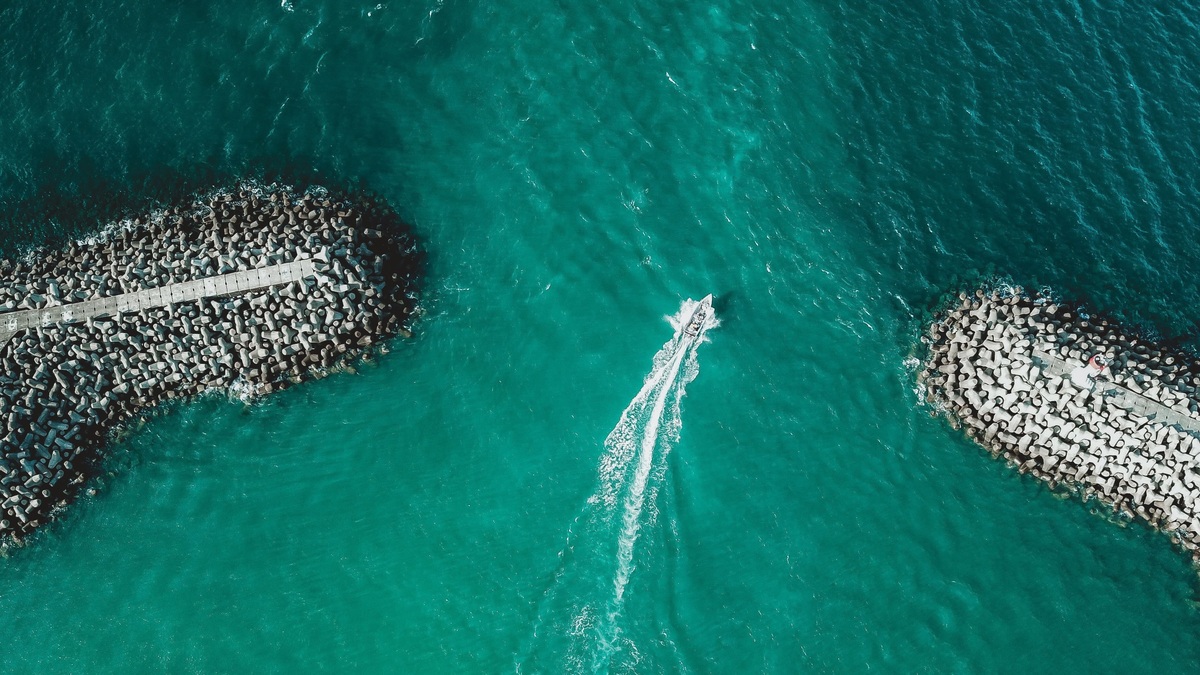
A narrow harbor entrance admits only part of an incoming crest. Once through, the wave expands across the basin as though the gap were a new source. If the opening is small compared with wavelength, spreading is strong. A very wide entrance preserves more of the original direction and straight crest shape.
Two entrances or two sides of an island can send diffracted waves into the same region. Their crests interfere, creating temporary zones of reinforcement and cancellation. Reflections from harbor walls add further complexity. Designers therefore analyze a range of periods and directions rather than one ideal wave.
A basin can amplify selected periods through harbor resonance. Diffracted energy entering at the right timing reflects repeatedly and supports a standing oscillation. The incoming height may be modest, yet persistent motion can strain mooring lines or interrupt cargo operations. Geometry and depth set the resonant periods.
Wavelength controls the pattern
Long-period swell has a long wavelength and can bend strongly around coastal structures of comparable scale. Short wind waves may cast a more defined shadow behind the same barrier because their wavelength is small relative to it. A harbor that is well protected from local chop can still experience long-period oscillation.
The ratio of opening width to wavelength helps determine the fan of energy. No single threshold separates diffracting from non-diffracting conditions because all waves spread to some degree. The visible effect becomes strongest when the geometry limits a wave front across a distance comparable with its wavelength.
Depth changes wavelength on the approach. Shoaling shortens crests as waves slow, modifying the diffraction pattern near an entrance. Tides alter water depth, so the same offshore period can enter a harbor differently over the tidal cycle.
Directional spreading in the incoming sea also matters. A real spectrum already contains energy arriving from neighboring angles. Some waves can enter behind a structure directly while others arrive through diffraction. Separating the contributions requires directional measurements or modeling.
Shorter waves are more sensitive to small surface disturbances and may dissipate faster, while long swell preserves a coherent phase over greater distances. The balance affects how cleanly a diffraction pattern appears. Random local wind waves can mask the curved swell crests without eliminating the underlying energy transfer.
Breakwaters create partial wave shadows
Breakwaters are built to reduce wave energy in harbors and along shorelines. Their length and orientation determine the exposed and sheltered zones. The arrangement of gaps changes that pattern. Extending a wall can improve protection for one direction while causing navigation or sediment problems elsewhere.
The NOAA coastal engineering reference describes stacks or jetties as features that produce diffraction. Small islands produce it as well. Curved crests appear behind them because waves travel around the obstruction and spread into the sheltered water.
A diffraction diagram uses lines of equal phase and contours of relative height to show the shadow. Height generally falls with angle and distance from the opening, but reflections or bottom features can create local peaks. Engineers validate models with field measurements when the consequences are important.
Diffraction coefficients express local height relative to the incident wave in idealized diagrams. A coefficient near one indicates little reduction, while lower values mark stronger shelter. The number depends on position and period. Structure geometry also changes it, so one value cannot be assigned permanently to an entire harbor.
Diffraction moves sediment
Reducing wave height changes the ability of water to mobilize sand. Curved diffracted crests also reach the shoreline at new angles, altering longshore transport. Sand can accumulate in the sheltered lee of a structure, sometimes forming a tombolo that eventually connects an island or breakwater to land.
The neighboring exposed coast may lose sediment because the structure interrupts the former transport pathway. A harbor entrance can begin to shoal as sand follows the changed currents. Maintenance dredging and beach nourishment often address consequences that extend beyond the original wave-protection goal.
Borrow pits in the seabed create a subtler perturbation. The USGS study of Breton Island notes that diffraction can transfer energy from higher-wave zones toward lower-wave zones around such features. If the altered pattern reaches the surf zone, it can change currents and shoreline response.
Models combine several transformations
Nearshore waves can receive local wind energy while undergoing shoaling. Refraction acts at the same time. Bottom friction dissipates energy and breaking imposes a depth limit. Diffraction adds lateral transfer, which simpler ray models cannot reproduce fully because independent rays do not exchange energy.
The National Weather Service’s Nearshore Wave Prediction System lists diffraction among the physics represented in operational guidance. Model resolution must be fine enough to describe harbor entrances or islands if their local shadow is the target. Broad regional grids may capture only larger features.
Forecast users should distinguish modeled offshore height from conditions inside a protected basin. Long swell can produce motion even when a breakwater blocks direct exposure. Entrance resonance and reflections add more motion. Local observations remain valuable for checking whether the modeled geometry matches the built shoreline.
Physical scale models remain useful for complicated projects. Engineers reproduce the harbor and generate representative waves in a basin, then measure the response at critical berths. Numerical and physical methods can cross-check one another, especially where nonlinear breaking or unusual structure shapes challenge simplified theory.
Wave diffraction fills in the apparent shadow behind an obstacle. The crest spreads sideways while its energy covers a wider area. New approach angles can then affect navigation or sediment. The curved crests around a breakwater tip are the clearest visible signature of the process.
Related reading: Ocean floor topography explained and abiotic factors in the ocean.