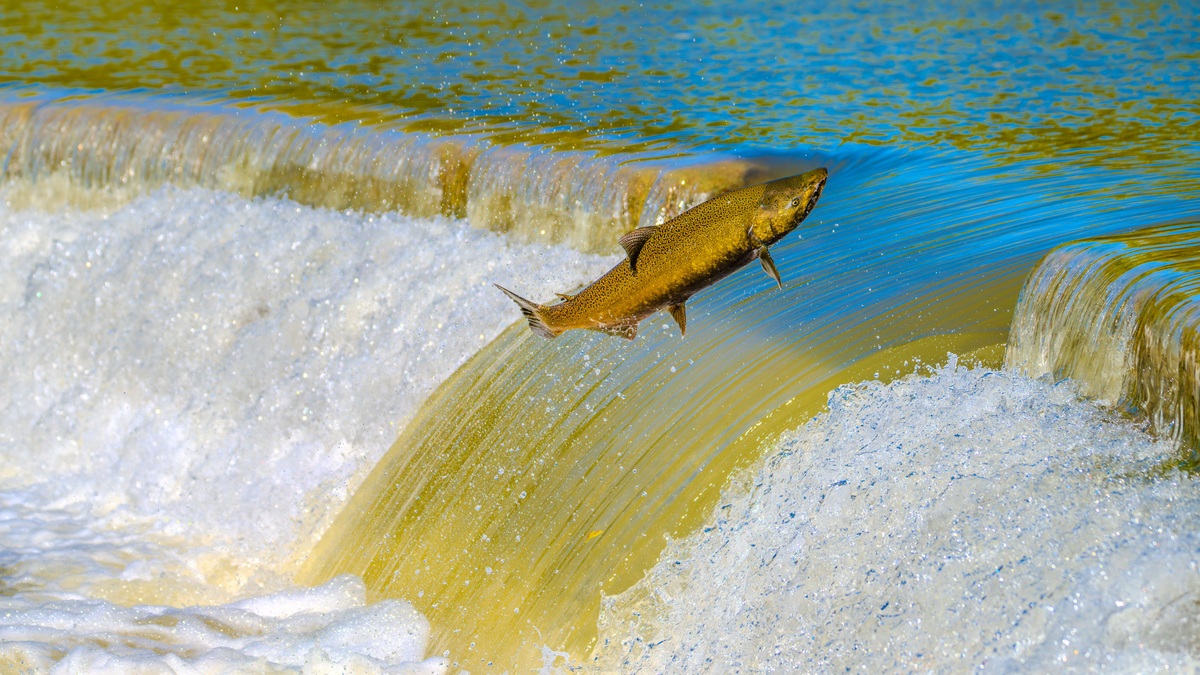
A fish ladder is a water-filled route that helps migrating fish move around a dam or another barrier. Instead of making one impossible leap, a fish enters flowing water at the base. It advances through smaller changes in elevation while resting in pools between them.
NOAA’s definition of a fish ladder, also called a fishway, emphasizes the detour. Designs reflect the river and its obstacle as well as the target species. Each must help fish locate the entrance and pass without exhaustion.
A successful ladder reconnects habitat only for animals able and willing to use it. Engineers therefore study swimming ability, seasonal flow, water temperature and migration timing. They also have to provide a safe route in the opposite direction for young fish or adults traveling downstream.
Dams interrupt fish life cycles
Many fish need different habitats at different stages of life. Anadromous species such as salmon and shad grow mainly at sea, then enter fresh water to reproduce. Catadromous American eels grow in rivers and estuaries before migrating to the ocean to spawn.
A dam can block adults from reaching upstream spawning grounds. It can also delay migration until fish consume energy reserves or encounter water that has become too warm. Populations may decline even when suitable habitat remains above the barrier.
Downstream migrants face a separate set of risks. Juvenile salmon may encounter turbines or spillways on their way to the ocean. Some dams provide bypass systems. Reservoirs slow river currents and extend travel time. The changed setting also alters encounters with predators.
NOAA Fisheries describes how West Coast dams affect salmon and steelhead through changes in passage, flow, temperature and habitat. A ladder addresses the barrier, but it cannot by itself restore every altered river process.
Flow leads fish to the entrance
The entrance is one of the most important parts of a fishway. Migrating fish follow currents, so the ladder must release an attraction flow they can detect without creating turbulence or velocity that excludes weaker swimmers.
Placement depends on how fish approach the dam. An entrance set far from the route fish naturally search may go unused even when the structure above it is passable. Changing river levels can make a good location ineffective at certain flows.
Once inside the ladder, fish pass through openings in the barriers between pools. Some designs instead send them over weirs. Each step dissipates part of the energy created by the difference in water level across the dam. Pools provide lower-velocity space where fish can recover.
Switchbacks allow a long ladder to climb beside a high obstruction without extending far downstream. Turning pools join the runs. The upper exit must place fish in water where they will not be swept back toward the dam.
The NOAA adult-passage overview shows this stepped arrangement and notes that tall dams may require many switchbacks. The visible staircase is only one part of a larger hydraulic system.
Fishways use several designs
Pool-and-weir ladders divide the climb into distinct basins separated by cross walls. Fish pass through submerged slots or over the crest. The arrangement suits some strong swimmers but requires careful control of the drop and turbulence between pools.
Vertical-slot fishways leave continuous openings in the cross walls. A usable passage can remain as water depth varies. The design therefore helps where both upstream and downstream levels fluctuate. Fish can often choose among velocities within each pool.
Denil fishways use closely spaced baffles in a sloping channel to break up the current. They can fit into a smaller footprint, though the resulting hydraulic conditions may favor particular species and sizes. Nature-like bypass channels take a longer route with rock ramps, riffles and pools that resemble a stream.
One design cannot serve every species
Salmon can swim rapidly and leap, but many resident fish cannot. Sturgeon have different body shapes and swimming behavior, while small-bodied species may tire in velocities that larger fish tolerate. A ladder designed around one target can selectively filter the community.
Temperature adds another constraint. Warm ladder water can deter cold-water fish or increase physiological stress. Operators may draw cooler water from depth or alter discharge. They can also manage passage timing during heat events.
Debris can block slots and screens. Sediment changes approach channels and high floods can damage structures. Effective passage therefore depends on regular inspection as well as sound operation throughout the migration season. Maintenance keeps those conditions intact.
Biologists monitor the results with counting windows, cameras, electronic tags and traps. Passage efficiency measures how many fish that approach a barrier enter and complete the route. Travel time and injury reveal problems that a simple count may miss.
NOAA’s salmonid passage guidelines define a fish ladder by how it dissipates the energy of the elevation difference. The engineering targets are tied to biological performance rather than appearance.
Downstream passage needs other tools
An upstream ladder may do little for juveniles moving toward the sea. Fish screens can keep them away from turbines and guide them toward a bypass. Surface collectors use the tendency of some young salmon to travel near the upper water column.
Spill can offer a route past a dam, although pressure changes, turbulence and predators still affect survival. Newer turbines may reduce injury. Managers compare the performance of routes under different operating conditions instead of assuming one method is always safest.
At the Clackamas River hydroelectric project, a collection system guides young fish into a pipeline around several dams. NOAA’s Clackamas fish-passage account describes how upstream ladders and a downstream route were designed as parts of one migration system.
Adult eels and juvenile eels may also need specialized ramps with rough or bristled surfaces. Their needs illustrate why “fish passage” covers more than the familiar concrete staircase built for salmon.
Alternatives include removal and transport
Some barriers are obsolete or unsafe. Others are too costly to modify. Removing them can restore a freer-flowing channel and reconnect habitat without requiring fish to find a constructed entrance. Removal planning must evaluate sediment alongside infrastructure constraints and the needs of the community.
Where a conventional ladder is impractical, trap-and-haul programs collect fish and move them around a dam by truck or barge. This method can reach habitat above very tall structures but requires continuing operation and careful handling.
Culverts under roads may create smaller barriers when they are perched, steep or too narrow. Replacing a culvert with a wider crossing can restore natural streambed conditions and serve more species than a narrow technical fishway.
The NOAA river-reopening program evaluates removal and bypass options according to each site. Culvert improvements form another part of its work. Hydropower, flood control, irrigation and public safety remain part of the decision.
A fish ladder is best understood as negotiated hydraulics. It converts one large barrier into a route whose currents and pauses match the animals expected to use it. Its value is measured by fish reaching habitat safely and on time, not merely by water flowing through concrete pools.
Counting fish tests the investment
Passage facilities can be expensive, so monitoring should begin with a clear biological objective. A project may aim to reconnect a specified length of spawning habitat, reduce delay below a dam or improve survival for a threatened population. Counts make more sense when interpreted against that objective and the number of fish arriving at the site.
Long records reveal changes hidden by a single strong migration year. Tag detections can show where fish hesitate, while temperature and flow data explain when performance declines. Managers can then adjust attraction water, operating schedules or physical features. If repeated improvements fail, a different passage method or removal of the barrier may provide greater ecological value.
Related reading: the biology of sea lampreys and fish found in Lake Michigan.