Seventy-one people tied to five Shuttle-Mir missions filled out weekly mood surveys over four and a half years and the strongest pattern in the data was not a dramatic collapse inside the station. The clearest shift ran outward through the mission hierarchy, with tension and dysphoric feelings moving from crew members toward mission control personnel, then from controllers toward managers on the ground.
In the Acta Astronautica study, psychiatrist Nick Kanas and colleagues examined reports from 5 American astronauts, 8 Russian cosmonauts and 58 American and Russian controllers who supported the missions. Their central question can be stated in plain language: when people live in a tiny, high-stakes workplace and cannot afford open conflict with the people beside them, where do the bad feelings go?
The answer still matters because long missions are built on layered authority. A commander leads the crew, specialists depend on one another in orbit, controllers carry the workload on the ground and management sets the larger rules. Shuttle-Mir showed that stress in one layer can spill into the next one down the chain even when the mission itself keeps working, which makes the program an early warning case for the International Space Station, lunar expeditions and later Mars planning.
How the Shuttle-Mir study watched both sides of the mission
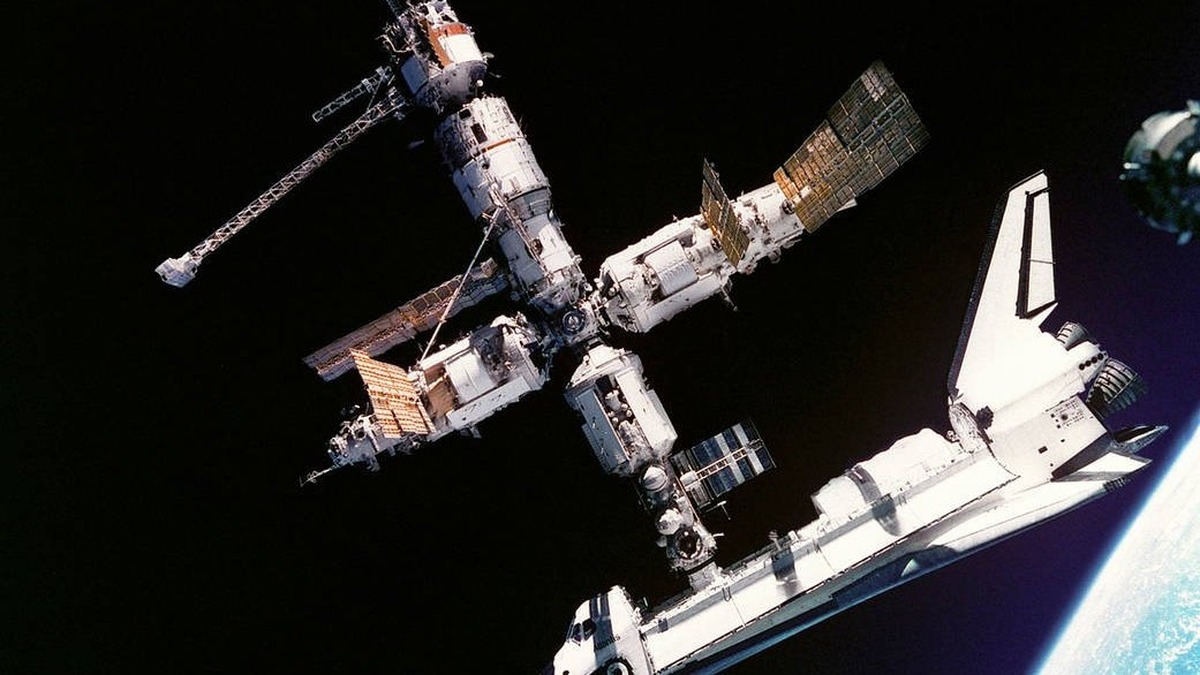
The researchers did something unusual for space psychology at the time: they studied the people in orbit and the people on the ground as parts of the same social system. According to NASA’s Shuttle-Mir overview, the program sent American astronauts to live with Russian cosmonauts on Mir from 1994 through 1998 as the United States and Russia prepared for the International Space Station. That made it a rare chance to examine a small multicultural crew, a distant control team and a demanding international command structure all at once.
Each week, participants answered standardized questions drawn from the Profile of Mood States, the Group Environment Scale and the Work Environment Scale. The team also used a critical incident log so subjects could note unusual events instead of forcing every experience into a number on a form. That mix gave the authors a way to track emotional tone, group cohesion, leader support and work pressure over time rather than relying on one dramatic anecdote after the mission ended.
Mission design helps explain why the hierarchy stood out so clearly. During the early docking phase described in NASA’s STS-71 mission history, Mir crews often centered on two Russians and one American, with the commander always Russian and Russian serving as the working language aboard the station. That arrangement kept operations moving, but it also created a visible majority and minority inside a three-person group where privacy was scarce and disagreement carried real operational cost.
The study also widened the frame beyond astronauts. Those 58 controllers were not background figures who occasionally answered a call from orbit. They were part of the same operational rhythm, handling schedules, technical problems and communication, often while working far from home in a multinational setting. By measuring both groups every week, the paper could compare how the same mission pressures landed differently in the cabin, in control rooms and higher up the supervisory chain.
Why the strongest emotional signal moved outward
The paper’s most striking finding was emotional displacement. Instead of showing the strongest hostility inside the crew’s tiny living space, the data pointed to tension being redirected toward outsiders who were close enough to absorb blame but far enough away that open conflict felt safer. In practical terms, if crewmates needed one another to keep the mission stable, frustration had an easier path toward voices on a headset than toward the person floating across the module.
NASA summarized the same result in a Shuttle-Mir psychology brief, where Kanas said, “We’re interested in group behavior, not in individual psychology.” In that NASA task book article, he also described the mechanism directly: “When people are not getting along very well, they displace their tension and unpleasant emotions to the outside.” The quote fits the statistics because the weekly questionnaires tracked a repeated social pattern, not one bad conversation.
A second analysis from the same Shuttle-Mir program sharpened the hierarchy even further. The follow-up PubMed paper reported strongly consistent confirmation on all six tested measures for displacement from crewmembers to mission control personnel and support on five of six measures for displacement from mission control personnel to management. In other words, the emotional spillover did not stop when it reached the first set of listeners on the ground.
That result matters for mission design because it treats a spaceflight team as a connected chain rather than a heroic crew plus an invisible support staff. Pressure does not vanish when it leaves the station. It can settle in planning meetings, voice loops and supervisory relationships, where it may alter judgment, patience and trust even when no one is openly breaking down. Shuttle-Mir showed that a functioning mission can still carry a hidden circulation of stress through the ranks.
Why Americans and controllers often felt the strain more strongly
The findings also pointed to unequal burden inside the same program. The NASA record for Human interactions during Shuttle/Mir space missions says American respondents were generally less happy with their interpersonal environment than Russian participants and mission control personnel reported more tension and dysphoria than crewmembers. That does not mean every American reacted the same way or every controller felt worse every week, but it does show that status inside the hierarchy shaped how the missions were experienced.
One reason was structural. The American in orbit was usually the lone minority member in a three-person crew, under a Russian commander and inside a Russian-language operational culture. A University of California, San Francisco release reproduced by ScienceDaily quoted Kanas this way: “A three-person crew is an unstable number psychosocially, especially when one is obviously in the minority.” The line is blunt, but it explains why nationality, language and chain of command could all land on the same person at once.
Ground personnel carried a different burden. They were responsible for technical success, but they did not receive the same reward structure as the people actually living in orbit. The NASA task book summary noted that American controllers had been sent to Russia and were away from their families, while Russian ground personnel were working through severe political and economic disruption that affected regular pay. Controllers therefore absorbed mission stress without the same sense of adventure, status or distance from routine demands that the flight crew often had.
Kanas also observed that both groups still scored better than many Earth work groups studied elsewhere, which keeps the paper from turning into a simple misery story. Space crews often described their work as deeply meaningful and controllers were part of a demanding elite operation. Even so, a meaningful mission does not erase hierarchy. Shuttle-Mir suggests that people can remain highly committed, perform well and still feel isolated, overloaded or poorly supported depending on where they sit in the team structure.
What Shuttle-Mir taught later missions about hierarchy
The lesson was not that long missions are doomed to spiral into conflict. A broader NASA summary, Psychosocial issues in space: results from Shuttle/Mir, emphasized that the missions succeeded while still revealing patterns that future planners needed to address. The value of the study lies in showing where to watch for strain before it damages cohesion, especially when a crew is small, culturally mixed and tightly dependent on a distant support structure.
Training was one obvious answer. In NASA’s lessons learned from Shuttle/Mir paper, the authors recommended pre-mission preparation for both crewmembers and ground personnel so they could recognize displacement, cultural tension and leadership gaps before those patterns hardened. They also argued for stronger support for minority crew members, more attention to the emotional climate of mission control and countermeasures that encouraged expressiveness, independence and self-discovery instead of treating every social problem as a private weakness.
The hierarchy itself also deserves design attention. A three-person crew can be efficient, but the Shuttle-Mir record suggests it becomes fragile when language, nationality and command all line up on one side of the same divide. Later programs could spread authority more carefully, rotate some leadership functions when possible, build more shared norms between orbit and the ground and make sure mission controllers are treated as a psychological frontline rather than a buffer that quietly absorbs whatever the crew cannot safely direct inward.
International Space Station operations, planned lunar bases and future Mars expeditions all depend on the same human fact that Shuttle-Mir exposed early: teams do not experience pressure as isolated individuals. They experience it through rank, distance, culture and dependence. Once a mission is understood that way, the study’s weekly questionnaires stop looking like a small historical footnote and start looking like a map of how stress can travel through a space program without ever leaving the chain of command.