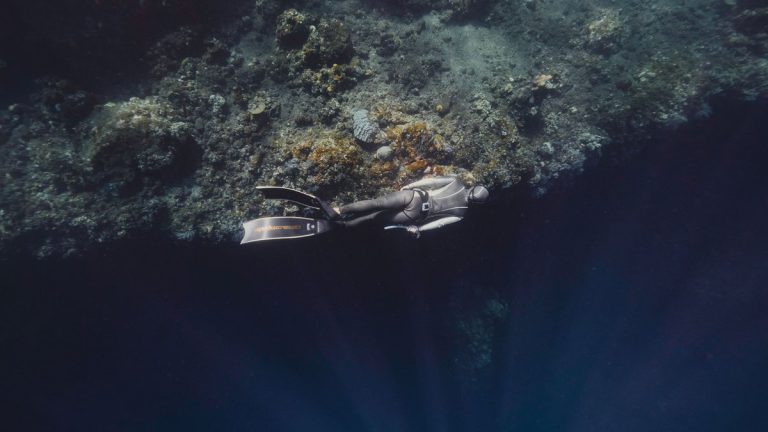
At a simulated depth of 480 meters, four professional divers took longer to solve visual problems, remembered fewer locations and threaded fewer buttons during a timed coordination test. Their grip strength changed far less, suggesting that extreme pressure can affect careful mental and motor work even when basic muscle force remains fairly steady.
The 2015 study, published in Frontiers in Psychology, followed the divers through compression, a stay at maximum pressure, decompression and recovery. Researchers from Zhejiang Sci-Tech University worked with the Institute of Naval Medicine in Shanghai and Nanjing Normal University. The team tested memory, visual thinking, grip strength and coordination at selected points throughout the experiment.
The results offer a rare view of human performance under pressure equal to a dive nearly half a kilometer deep. Such environments can influence the nervous system while confinement and psychological strain add further demands. Because only four men took part, the findings serve as detailed observations of an extreme experiment rather than a firm prediction for every professional diver.
Inside the 480-meter dive chamber
The simulated 480-meter saturation dive took place in a pressure chamber at the Institute of Naval Medicine in Shanghai. The living chamber measured 2.2 meters across and 5.5 meters long, giving the four men about 19.5 cubic meters of space. Temperature remained near 31 degrees Celsius, while humidity ranged from 50 to 70 percent.
Saturation diving allows the body’s tissues to absorb the breathing gases associated with a set pressure. Divers can then remain under pressure for an extended period and complete one long decompression at the end. In the Shanghai experiment, the chamber used a helium-oxygen atmosphere and pressure rose in carefully controlled stages. Compression became slower as the simulated depth increased, especially from 401 to 480 meters.
The divers paused for seven to nine hours at 300, 400 and 443 meters. Researchers collected mental test results at depths including 150, 350, 410 and 463 meters, then tested the men during their stay at 480 meters. Measurements continued during decompression, three days after the dive and one month later. Each diver had trained on the tasks before compression so that the team could establish a stable starting score.
Mental rotation slowed under pressure
Mental rotation is the ability to imagine an object turning in space. It helps people compare shapes viewed from different directions, a skill that can support equipment handling and navigation in difficult working conditions. The researchers used separate two-dimensional and three-dimensional tests to see how pressure affected this form of visual thought.
For the 2D task, the divers compared rotated versions of the letter R and decided whether the images matched or formed mirror images. Their accuracy changed only mildly across the experiment, ranging from 85 to about 111 percent of each person’s baseline. Reaction times varied much more. On average, the men became slower during compression, with the clearest increase recorded by 410 meters.
The 3D rotation test placed greater demands on the divers. They viewed pairs of complex objects and judged whether one could be rotated to match the other. Accuracy fell as compression continued, while some reaction times rose to more than twice the baseline level. Statistical analysis linked depth with changes in both speed and accuracy, although the size and timing of the effect differed greatly among the four men.
Slower responses may reflect a cautious work strategy under pressure. A diver who senses that a task has become harder may take additional time to avoid a dangerous mistake. The experiment could measure the delay and the answer, while the test design could not determine how much came from deliberate caution, nervous-system effects, fatigue, or stress.
Spatial memory declined near 410 meters
The researchers also examined spatial memory, which allows a person to remember where objects are located. Each diver studied five Chinese chess characters placed within a 6-by-6 grid. After 30 seconds, he had to recall the identity and position of the characters. Five different sheets were used during each test session.
Performance generally declined as chamber pressure increased. The clearest group-level impairment appeared between 410 and 480 meters, including the period when the divers remained at maximum pressure. One diver stayed close to his baseline through much of the experiment, while two others showed a steady decline during compression. Another recorded his lowest result at 410 meters.
Average spatial-memory scores fell from 4.85 correct responses before the dive to 4.42 during compression and 4.23 during the 480-meter stay. Scores rose to 4.73 during decompression and returned close to the starting level after the dive. The recovery suggests that the changes observed in the chamber were temporary within the limited follow-up period.
Hand-eye coordination weakened above 300 meters
A simple button-threading task measured hand-eye coordination. The divers received buttons with one open hole and an 80-centimeter cotton thread. Each man had one minute to connect as many buttons as possible. The test was repeated three times and researchers used the average result.
Coordination remained relatively steady at 150, 270 and 300 meters, then fell at the deeper measurement points. The lowest results occurred between 400 and 480 meters. Across individual tests, performance ranged from about 69 to 118 percent of baseline, yet all four divers followed a broadly similar downward path during compression.
The paper described the result directly: “The hand – eye coordination was clearly impaired by the high pressure environment, which declined continuously to 480 m.” During decompression, performance recovered by the time the chamber reached a simulated depth of 308 meters. Average scores later rose above the original baseline at the three-day follow-up.
Fine hand movements require the eyes, brain and muscles to exchange information quickly. A worker must see the target, judge distance, guide the fingers and correct small errors in real time. A delay anywhere along that chain can reduce the number of buttons threaded within one minute, even if the hands still produce almost the same gripping force.
Grip strength changed only slightly
Grip tests produced a different result. Each diver squeezed a hand dynamometer three times with each hand and the strongest reading was recorded. Individual measurements ranged from roughly 74 to 113 percent of baseline, but depth had no statistically significant effect on the group’s right-hand or left-hand strength.
Average right-hand strength declined from 55.5 kilograms before the experiment to 53.88 kilograms during the maximum-depth stay. It reached 51.9 kilograms during decompression, then rose again after the men returned to surface pressure. Left-hand strength followed a similar mild decline and recovery.
The gap between stable strength and weaker coordination provides an important clue. The divers could still generate force, while tasks requiring precise timing and visual control became less reliable. Deep-pressure work may therefore place greater strain on fine performance than on a short, simple burst of muscle power.
Four divers showed wide differences
Individual variability appeared in nearly every test. One diver sometimes performed above his baseline while another showed a large decline at the same pressure. Reaction times during the 3D task ranged from 58 to 226 percent of baseline and accuracy ranged from 37.5 to almost 119 percent.
Professional training may help some people adjust their speed or strategy, although the study did not test training as a separate factor. Personal responses could also reflect sleep, mood, physical condition, sensitivity to pressure, or ordinary differences in visual skills. With four participants living through the same chamber schedule, researchers could observe the variation but could not identify its cause.
The changing results also warn against treating one depth as a universal boundary. Group performance often worsened around 300 to 410 meters, depending on the task, yet each man followed his own path. Some results recovered during decompression, while a few reaction-time differences continued into the post-dive tests.
Limits of a four-diver study
The experiment involved four professional divers, all of whom were healthy, right-handed men between 27 and 32 years old. Such a small and uniform group limits how widely the findings can be applied. The results cannot establish how women, older divers, less experienced workers, or people with different health histories would respond.
The chamber also combined several possible influences. Rising pressure occurred alongside confinement, a long experimental schedule, changes in sleep and the psychological strain of an extreme simulated dive. The researchers measured performance during the combined experience, so the study could not assign a precise share of the effect to each condition.
Repeated testing creates another challenge because people may improve through practice. The researchers trained the divers before the experiment and compared later scores with a stable baseline, which helped reduce this problem. Fatigue, motivation and daily fluctuations could still influence some measurements, especially when one person’s score changed sharply.
The paper remains available through the PubMed Central archive, allowing its methods and complete results to be examined. Larger studies with more participants, closer monitoring of sleep and nervous-system activity and modern computerized tests could clarify which abilities are most vulnerable. The 2015 findings already point to a practical concern: physical strength alone may give an incomplete picture of a diver’s readiness for complex work at extreme pressure.