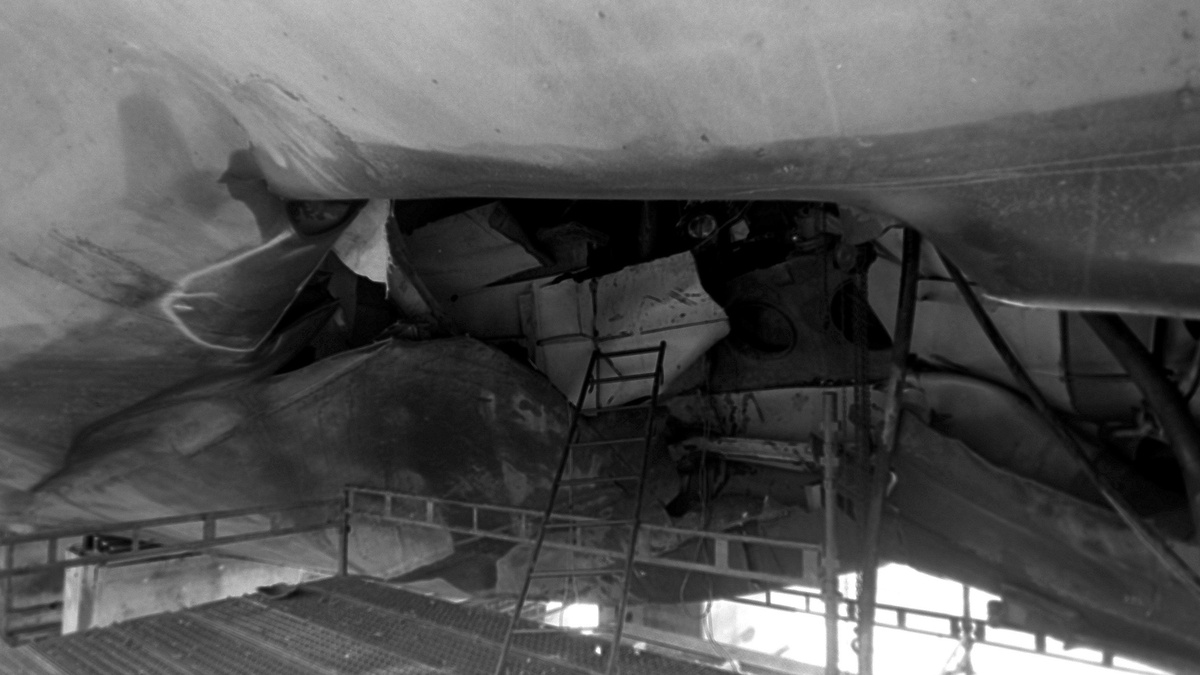
The explosion began beneath the hull of a U.S. frigate in the central Arabian Gulf on April 14, 1988. USS Samuel B. Roberts had entered a recently laid minefield while returning from an escort mission. A moored contact mine detonated, punching a vast hole into the ship and turning an ordinary patrol into a fight to keep the vessel afloat.
Four days later, the response became Operation Praying Mantis, a one-day attack on Iranian platforms and naval forces. The U.S. Navy’s official overview traces the story from the mine strike through the frigate’s survival. It also records the combat that followed. The operation remains an unusually concentrated episode of the Iran-Iraq War’s struggle over shipping in the Gulf. Merchant vessels carried oil through waters where a single mine could change a regional contest into a direct confrontation with a superpower.
The mine strike that nearly sank Samuel B. Roberts
Samuel B. Roberts was a guided-missile frigate, built to escort ships and work with a larger fleet. On the afternoon of April 14, lookouts spotted mines in the water, but the ship had already struck one. The blast ripped open the engine-room area and flooded compartments. Machinery failed, leaving the crew with a badly wounded ship far from a repair yard. The initial shock also damaged the ship’s gas turbines, making recovery depend on people working by hand inside dark, unstable spaces.
The mine wounded ten sailors, four of them seriously. Commander Paul X. Rinn, the ship’s commanding officer, was also injured. Damage-control teams fought flooding and fire while other sailors reinforced the weakened structure. Crews isolated damaged systems and recovered enough capability to keep the frigate afloat. The punishing work of naval damage control continued throughout the emergency. Sailors moved equipment by hand and relayed messages through the damaged ship. Temporary repairs kept water from spreading into more of the hull. Their work is central to the event’s history because the ship survived a hit that post-event computer simulations indicated should have sunk it.
Iran’s mining campaign had grown out of the Tanker War, the maritime front of the Iran-Iraq War. Kuwait had asked the United States to protect reflagged tankers, leading to Operation Earnest Will in 1987. A Navy historical account of the Tanker War identifies the Roberts strike as the trigger for the retaliation. The damaged frigate later traveled home on the Dutch heavy-lift ship Mighty Servant 2 before repairs returned her to service.
Why Iranian platforms became the first targets
American planners chose a limited response rather than a broad campaign against Iran. Their targets included the Sassan and Sirri oil platforms, installations the United States said were being used for military surveillance and to help direct Iranian naval activity. The selection connected the minefield to the infrastructure that supported operations at sea. It also gave U.S. forces fixed targets, rather than requiring them to search the Gulf for a minelayer that might already have disappeared.
At the start of the April 18 operation, U.S. forces approached the platforms in separate surface groups. Marines boarded Sassan and collected military material. They also found a ZU-23 antiaircraft gun. After the boarding teams withdrew, U.S. warships and aircraft attacked the installations. The action mixed an intelligence raid with a highly visible warning that further mining could bring a fast military response. Platform crews had time to evacuate after radio warnings, a detail consistent with the operation’s deliberately limited objectives.
The choice of offshore platforms also set a boundary for the opening moves. Washington sought to hit facilities at sea while avoiding a larger land war. Even so, the platforms sat within a much wider conflict. Commercial tankers moved through the same waters as naval escorts and the oil trade drew countries far beyond Iran and Iraq into the danger. Limits on the first targets could not guarantee that the operation would remain limited. Once Iranian vessels and aircraft moved to resist, the local decisions of crews at sea would determine how much fighting followed the planned attacks.
How the one-day battle spread across the Gulf
Iranian forces responded as the platform attacks unfolded. The missile boat Joshan approached a U.S. surface group and launched a Harpoon missile after receiving warnings to stop. U.S. ships replied with Standard missiles, then used gunfire against the badly damaged vessel. Navy historians identify the exchange as the U.S. Navy’s first and still only, surface-to-surface missile exchange with an enemy force. The moment showed how quickly a planned strike on fixed targets could become a contest between maneuvering warships.
Farther south, the Iranian frigate Sahand left Bandar Abbas and fired on U.S. aircraft. Aircraft from USS Enterprise, together with U.S. surface forces, struck the frigate with weapons that included Harpoon missiles. Sahand sank later that day. Her sister ship Sabalan was severely damaged by an air attack but managed to reach port, which kept the final outcome from becoming a complete destruction of Iran’s regular navy. The two engagements required U.S. commanders to coordinate ships and carrier aircraft across a broad stretch of water while holding the wider response within its assigned limits.
The battle was not a single ship duel. Surface groups attacked the platforms while other U.S. forces encountered Iranian vessels. Air operations continued over many hours in different parts of the Gulf. The 1988 history of USS Enterprise records the carrier’s role in the operation, including the combat against Sahand. A U.S. Marine AH-1T Cobra helicopter also went down during the operation, killing its two crewmen.
The outcome and the limits of the response
By the end of April 18, U.S. forces had destroyed two Iranian offshore platforms, sunk Joshan and Sahand and severely damaged Sabalan. The scale earned Operation Praying Mantis its place in Navy histories as the largest of five major U.S. naval surface actions since World War II. Official descriptions use the surface-action label because warships formed the core of the strike force, even though carrier aircraft and Marine helicopters also mattered. The result was a combined maritime operation rather than an isolated duel between two ships.
Its duration was measured in hours, which makes the fighting easy to compress into a few dramatic images while overlooking the political limits placed on it. U.S. leaders intended punishment and deterrence, rather than an open-ended war with Iran, so commanders had to apply overwhelming force to selected targets while avoiding an escalation that could widen the conflict.
Samuel B. Roberts remained the human center of the story. Her crew had survived a weapon far cheaper than the frigate it struck, then watched their loss of mobility produce a carefully planned counterattack. The ship’s own Navy history preserves the extent of the damage and the later journey home. Repairing the vessel was a separate, months-long part of the episode.
Operation Praying Mantis did not end the Iran-Iraq War or eliminate the danger to shipping. It showed how a minefield could force decisions far beyond the moment of an explosion. Navy historians report that Iran refrained from laying additional minefields in the Gulf after the operation, although tense encounters continued. The fighting ended on April 18. Samuel B. Roberts still faced a long recovery and the sailors who saved her carried the human consequences home. Four days had connected one hidden mine with a major clash between modern naval forces. The sequence remains a stark example of how quickly an attack on a single ship can widen at sea.