Microgravity did not make two human drone operators better at a hard judgment task, yet it did make them feel more sure of themselves. In a parabolic-flight study built around a virtual drone leaving a cave, confidence rose in weightlessness even though accuracy did not show a matching gain. For psychologists and spaceflight designers, that gap is the real story.
The result comes from a 2023 Scientific Reports study that treated confidence as a metacognitive signal, meaning a person’s judgment about whether a decision was correct. The researchers asked whether altered gravity changes the way people handle uncertainty while making a fast perceptual choice. Their answer was cautious but provocative: microgravity appeared to lift subjective confidence, especially when the visual evidence itself was uncertain.
Space operations create many moments where a person must decide before complete information arrives. A pilot, astronaut, or remote operator may need to judge a collision risk, a trajectory, or a system state while the body is also adapting to an unusual physical environment. The paper therefore sits at the overlap of metacognition, human factors and mission safety. It also carries a major warning label: the in-flight result came from only two participants, so every practical conclusion has to stay provisional.
How the experiment put confidence under pressure
The task was simple to describe and difficult to judge. Participants wore virtual reality goggles and watched a first-person view from a drone moving toward the exit of a cave. After 1.5 seconds of motion, they had to predict whether the drone would clear the opening or crash into the ceiling or floor. Then they rated how confident they were in that answer on a scale from 0 to 10.
The team built uncertainty directly into the scene by changing the drone’s pitch angle. Some trajectories were easy to read. Others sat near the boundary between a safe exit and a collision, which made the evidence ambiguous. The paper framed that ambiguity with ideas from predictive coding, a theory that treats the brain as a system that constantly makes predictions and updates them when incoming evidence is unclear or surprising.
Before anyone flew, the researchers ran a larger on-ground experiment with 22 volunteers at the University of Zurich. One person’s data had to be excluded because of a technical problem, leaving 21 participants for the main baseline analyses. Those ground trials helped establish the task, estimate how different visual angles mapped onto subjective crash probability and confirm a familiar pattern from psychology: when uncertainty rises, people usually become less accurate, slower and less confident.
What changed in microgravity and what did not
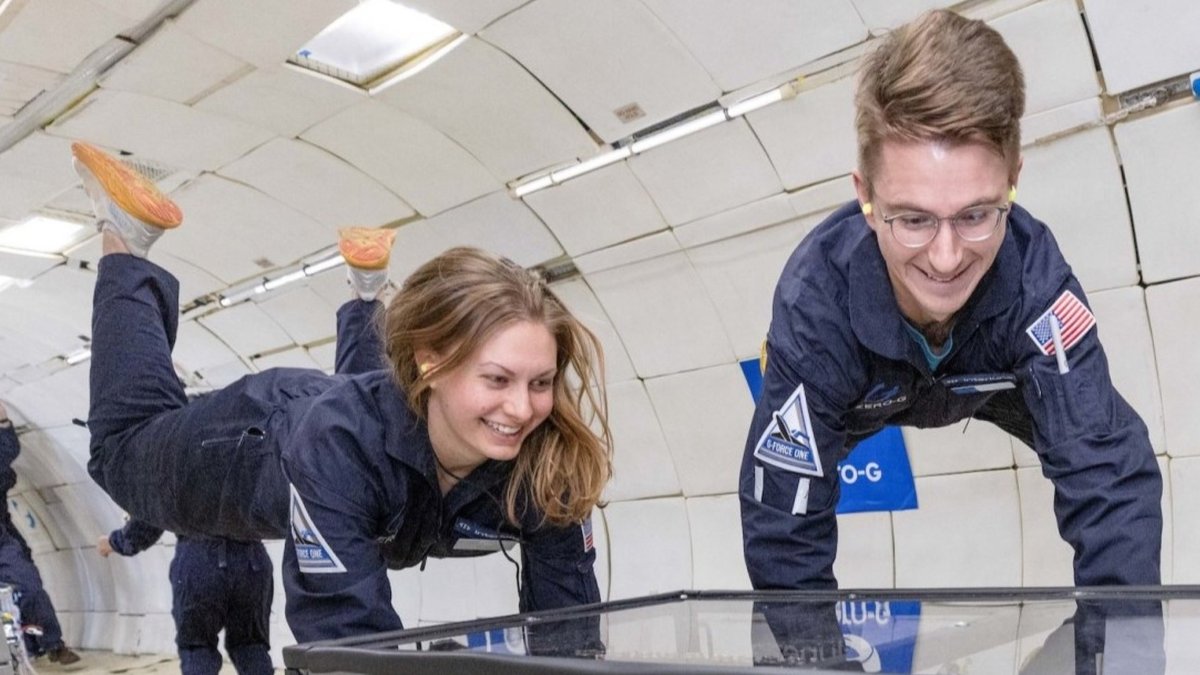
The flight phase was much smaller and much more unusual. One man and one woman from the ground cohort flew aboard a Cessna Citation II during a campaign of 20 parabolic maneuvers over two days. At the top of each parabola, the aircraft reached 0 G for about 30 seconds. On the climbs and descents, the same flight generated hypergravity near 2.5 G. The experiment therefore let the team compare normal gravity, hypergravity and microgravity inside the same demanding setting that future operators of aircraft such as NASA’s Ingenuity helicopter have helped make easier to imagine.
Average confidence ratings moved upward in weightlessness. The paper reports mean confidence scores of 7.3 in normal gravity, 7.7 in hypergravity and 8.1 in microgravity. Accuracy, however, did not follow the same direction. Reported in-flight accuracy was 63.6 percent in normal gravity, 75 percent in hypergravity and 68 percent in microgravity. Those numbers do not support a clean claim that microgravity improved performance itself.
The regression analysis sharpened the point. Confidence ratings were significantly higher under microgravity, while stimulus uncertainty still pushed confidence downward overall. The intriguing part was their interaction: when the stimulus was uncertain, microgravity nudged confidence upward instead of downward. In plain language, the environment seemed to weaken the normal internal brake that tells a person, I might be wrong here.
The researchers did not find a matching gravity effect on raw task performance relative to normal gravity. They explicitly write that altered gravity showed no effect on performance relative to normal gravity, even though absolute in-flight performance was worse than the stronger on-ground baseline. The psychological signal was therefore more about self-evaluation than about a simple gain or loss in ability.
Why uncertainty and confidence sit at the center of the finding
Confidence is more than a feeling of comfort. In cognitive science, it is a report about the perceived quality of one’s own decision. A healthy confidence signal helps people know when to act fast, when to check again and when to ask for help. When that signal drifts away from actual performance, the risk is not only error. The deeper risk is failing to notice the need for correction.
The study’s design matters here because the researchers separated several parts of a decision. They looked at the overt choice, whether the participant predicted a crash or no crash. They tracked response time. They also measured confidence after the choice, which is the metacognitive layer. That extra layer is why the result feels psychologically rich. A person can keep making roughly similar choices while the private sense of certainty starts moving on a different track.
On the ground, the expected relationship held together more neatly. Higher uncertainty predicted more mistakes and lower confidence. In flight, uncertainty still hurt performance in expected ways, but microgravity changed how that uncertainty was felt. The paper describes this as a possible alteration in uncertainty processing. That wording is careful and it should stay careful, because the dataset is thin. Even so, it points toward a real scientific question: does weightlessness change how the mind reads its own evidence?
The answer matters for remote piloting and future crewed missions because many critical actions are confidence-sensitive. An operator who knows a scene is ambiguous may slow down or hand the task to an automated aid. An operator who feels overly certain may press ahead. In that sense, the finding is about error monitoring as much as it is about perception.
What might cause overconfidence in weightlessness
The paper does not claim to have identified one mechanism. Instead, it sketches several plausible routes. Gravity acts as a strong sensory prior through the vestibular system, helping anchor the body to a reference frame. Remove that anchor and perception may rely on a different balance of cues. If the brain is computing uncertainty with altered bodily input, confidence may shift even when external task information has not changed.
The authors also discuss mood and body sensation. Participants reported euphoria in weightlessness and prior work has linked positive affect with higher confidence judgments. The paper further notes that a sense of body expansion may have contributed to altered judgment. Those ideas fit the broader psychology of metacognition, where self-assessment can be moved by bodily state and emotion, not only by evidence quality.
Another possibility is practical rather than emotional. Parabolic flight is noisy, physically unusual and brief. Seatbelts limited movement, the gravity window was short and the operators had to keep working through changing forces. Under those conditions, the brain may simplify the problem. A quicker internal commitment could feel efficient while still pulling confidence above what the evidence deserves. The study cannot separate those explanations, but it gives future experiments something concrete to test.
Why the two-person limitation changes everything
The paper is unusually direct about its limits and any honest summary needs to be just as direct. The in-flight phase involved only two fliers. The aircraft completed 20 parabolas across two days and the altered-gravity periods were short, which meant a limited number of trials in the states that matter most. A result from two people can be suggestive. It cannot settle a question about human cognition in space.
Other constraints pile on. The researchers did not plan from the start to measure mood or affect, even though those factors may be central to the confidence shift they observed. The task itself was also narrow: a simulated drone-navigation judgment in virtual reality, not a full mission scenario with social coordination, fatigue, or long-duration adaptation. For that reason, the paper supports a focused claim about perceptual decision-making and metacognitive confidence, not a broad claim about all space behavior.
Even the strength of the effect needs careful framing. The confidence-by-uncertainty interaction in microgravity reached only marginal significance in one reported test. The authors still treated it as important because it was theoretically coherent and fit the broader pattern in their data. Readers should therefore hold two ideas at once: the study found a real signal worth following and the evidence base is still too small for sweeping operational rules.
Within those limits, the study remains useful because it identifies a failure mode that mission planners can understand. A human operator may remain functional, may not look obviously impaired and may still become a little too sure while handling uncertain information in weightlessness. That is exactly the kind of subtle human-factor problem that can slip through if teams focus only on raw performance scores.
Future work can test whether the same pattern appears in larger parabolic-flight samples, longer analog missions, or tasks that demand navigation, diagnosis, or shared control with autonomous systems. Reviews of cognition in zero gravity suggest that altered gravity can influence several parts of human behavior, which makes this confidence result worth tracking beyond one task. If the effect holds up, the response may involve better training, interface cues that expose uncertainty, or automated backups that step in when human confidence climbs faster than human accuracy. For now, the main achievement is more modest and more interesting: a small experiment made visible a possible split between what a person does in microgravity and what that person believes about doing it well.