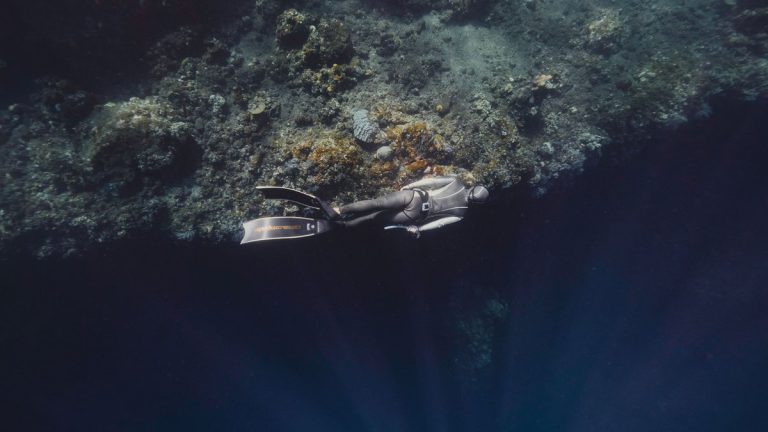
Twenty-seven scuba divers completed a simple but revealing comparison: they performed standard scuba skills in a pool and also worked through a color-number attention task on land and again underwater at 5 meters. The sharpest difference was linked to personal trait anxiety. Divers with higher trait anxiety took longer to clear their masks and they also answered more slowly on a test of cognitive control while submerged.
The findings came from an abstract in Diving and Hyperbaric Medicine, which split the divers into lower-anxiety and higher-anxiety groups using the State-Trait Anxiety Inventory. The gap was modest in absolute terms, yet it was large enough to stand out in a small study: mask clearing averaged 7.1 seconds in the lower-anxiety group and 10.8 seconds in the higher-anxiety group, while underwater Stroop response times averaged 64.4 seconds and 72.5 seconds.
Numbers like these do not mean anxiety alone decides whether a dive will go well. The same study found no significant effect on the other timed scuba skills and it did not show that slower Stroop performance directly caused slower skill work. Even so, the results fit a long-running safety concern in diving, where stress can narrow attention and make a familiar task feel less automatic when a diver is busy, cold, or unsettled.
How the study tested divers
The researchers used a straightforward design. Each diver completed the trait portion of the anxiety inventory before the in-water testing, then an instructor timed four standardized scuba skills in a pool. The paper summary does not suggest a chaotic or emergency setting. It points to a controlled training-style environment where differences in timing could be observed without the extra hazards of open water.
Mask clearing was the one skill that separated the groups. The same divers also completed a number-Stroop test, first on land and then underwater in fresh water at 5 meters. According to the American Psychological Association, Stroop tasks are commonly used to measure interference and cognitive control, because the test asks the brain to suppress an automatic response and choose a competing one.
Underwater performance slowed for both groups, which is a useful baseline point. The lower-anxiety group averaged 49.8 seconds on land and 64.4 seconds underwater. The higher-anxiety group averaged 53.3 seconds on land and 72.5 seconds underwater. That pattern suggests the underwater setting itself increased mental load, while higher trait anxiety added another measurable delay.
Where anxiety showed up and where it did not
The cleanest effect appeared in one practical skill and one mental test. Divers with higher trait anxiety were slower at clearing a flooded mask and they were slower on the Stroop task both on land and in the water. The underwater gap was larger than the dry-land gap, 8.1 seconds versus 3.5 seconds, which hints that the underwater setting may amplify a difference that already exists on the surface.
Trait anxiety describes a stable tendency to feel more anxious across situations. The study stayed cautious by measuring that tendency before the dive and comparing it with skill timing and response speed. It did not measure panic during a real emergency and it did not claim that a slower test score automatically predicts an accident.
Just as important, the study did not find a significant effect on the other scuba skills and the authors reported no meaningful correlation between the Stroop results and execution of those skills. A slower attention test therefore did not line up neatly with every part of scuba performance. The result is a focused signal about mask clearing under stress and about slower underwater processing in more anxious divers, rather than a sweeping statement about all diving ability.
Why mask clearing can feel harder underwater
Mask clearing is a routine drill, but it asks a diver to stay calm while water is in the mask, keep breathing through the regulator, manage body position and follow a practiced sequence. Each step is simple during training. Together they create a moment of task loading, especially for someone whose stress response rises quickly.
The Divers Alert Network describes a similar pattern in broader safety terms: as stress increases, a diver’s ability to recognize and respond properly can diminish. DAN describes rapid breathing and muscle tension as possible signs. Distractibility or an urge to escape to the surface can also appear as stress builds. The finding cannot reveal what each diver felt. A routine mask drill may nevertheless be a sensitive place to detect a timing difference.
A related clue comes from research summaries on cognitive functions in scuba diving, which have used Stroop-style tasks to track changes in processing speed after dives and under different breathing conditions. The present study stayed shallow and practical, yet it points in the same direction: underwater work can tax attention and people do not all carry that load in the same way.
What divers and instructors should take from it
The most useful lesson is modest. A diver who tends to feel more anxious may need more time with specific drills, especially drills that briefly remove comfort or visibility. Extra repetition, slower progression and calm practice conditions could be sensible responses because the study’s result centered on a learned skill rather than on raw physical strength.
Diving instructors already treat repetition and comfort as part of safe training and the paper gives that practice a small piece of measured support. A few extra seconds in a pool do not define real-world readiness on their own. They do suggest that underwater cognitive processing and basic skill execution can separate slightly when anxiety is higher, even at only 5 meters.
Several limits deserve equal weight. The sample included only 27 divers, the setting was fresh water in a pool, the paper summary reports grouped averages rather than a rich breakdown of experience or age and the researchers focused on trait anxiety rather than moment-to-moment fear. Readers should also remember that the result does not say higher-anxiety divers were unsafe or unable to complete the tasks. The study says they were slower on one skill and on a mental test, while other timed skills were not significantly affected.
For divers, the practical message is calm and specific: practice the uncomfortable skills until the sequence feels familiar, reduce unnecessary task loading and treat stress management as part of training rather than as an afterthought. For researchers, the next step is equally clear. Larger studies in open water, with more detail on experience level and real-time stress, could show when a few extra seconds remain a training issue and when they begin to affect underwater decision-making.